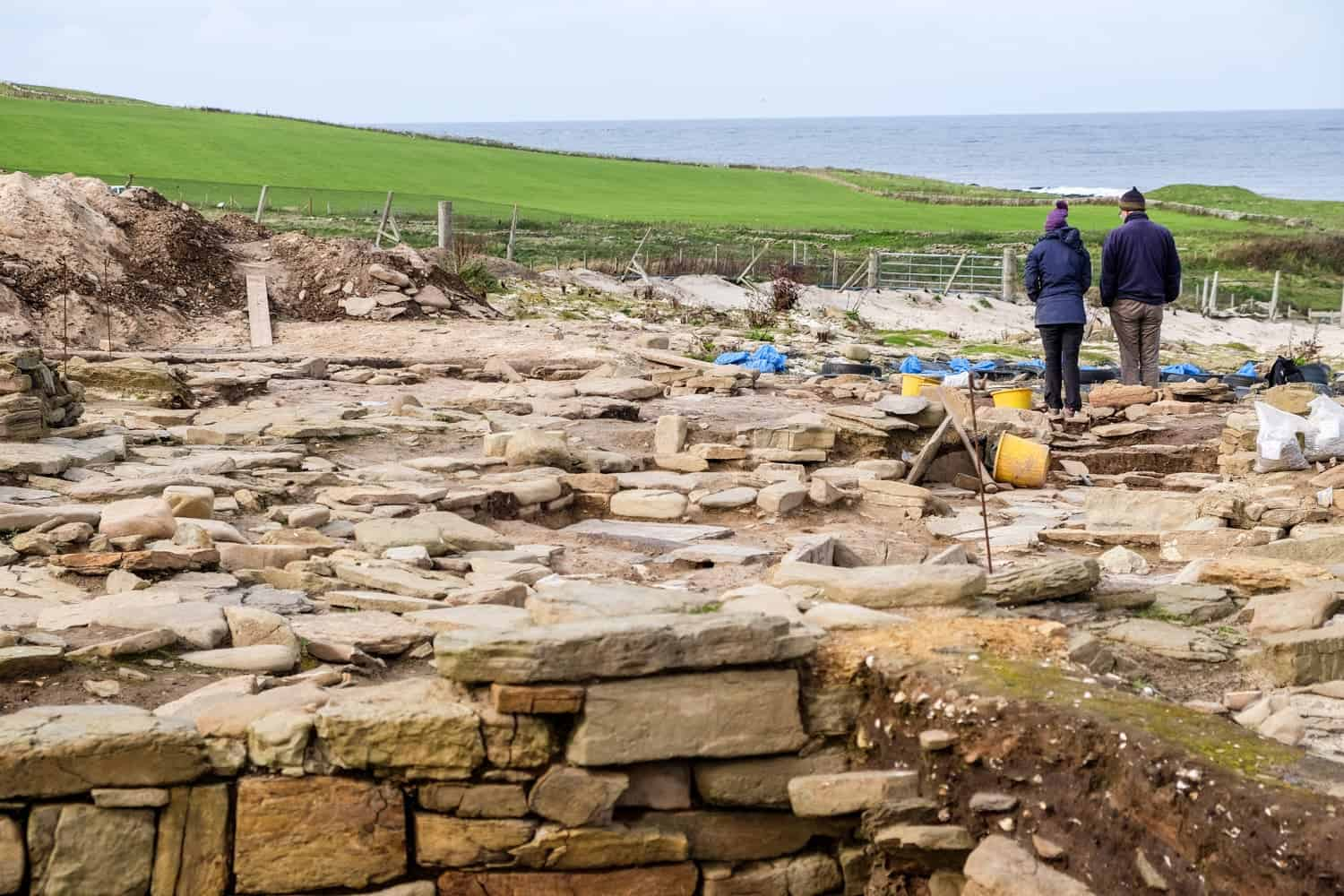
The Links of Noltland, on the island of Westray in Orkney, is one of Scotland's most important Neolithic archaeological sites.
The settlement contains substantial stone houses, agricultural evidence, pottery, tools, burials, and remarkable prehistoric figurines.
The site's long history demonstrates how communities in Orkney adapted to island environments over thousands of years.
A Coastal Neolithic Settlement
Westray provided access to:
fertile land;
marine resources;
freshwater;
and abundant stone.
The combination of farming and coastal resources made the island attractive to Neolithic communities.
Stone Houses
The houses at Links of Noltland were constructed from local stone.
Stone was particularly suitable for Orkney's treeless or sparsely wooded environment.
Unlike regions where timber was abundant, Orkney communities relied heavily on stone architecture.
House Design
Neolithic houses could contain:
central hearths;
internal stone partitions;
sleeping areas;
storage spaces;
and work areas.
The structures demonstrate careful planning.
Agriculture
The inhabitants cultivated crops and raised livestock.
Important domestic animals included:
cattle;
sheep;
and pigs.
Cereal agriculture also played a role.
Coastal Resources
Despite farming, the inhabitants did not abandon marine resources.
They could exploit:
fish;
shellfish;
seabirds;
and marine mammals.
This combination made island economies resilient.
The Orkney “Venus”
One of the most famous discoveries at Links of Noltland is a small anthropomorphic figurine often called the Orkney Venus.
The figurine has:
a human-like body;
facial features;
and markings that may represent clothing or body decoration.
It is one of the earliest known human representations from Britain.
What Did the Figurine Mean?
Its exact purpose is unknown.
It could have represented:
a person;
an ancestor;
a deity;
a symbolic figure;
or an individual identity.
The existence of such figurines demonstrates that Neolithic communities expressed human identity through art.
Pottery
The site has produced pottery associated with Orkney's Neolithic traditions.
Ceramic vessels provide evidence for:
food preparation;
storage;
and cultural connections.
Pottery styles can also help archaeologists compare settlements across the islands.
Burials
Human remains and burial structures provide additional evidence about the community.
Burial practices can reveal:
attitudes toward ancestors;
social relationships;
and ritual behavior.
Climate and Coastal Change
The site also provides evidence for environmental change.
Sea levels and coastal landscapes have changed since the Neolithic.
Areas that were once inhabited may now be affected by:
erosion;
sedimentation;
or changing shorelines.
Why Links of Noltland Matters
The site demonstrates that Neolithic Orkney was not culturally uniform.
Different settlements had their own histories and architectural traditions while participating in broader island-wide cultural systems.
Conclusion
Links of Noltland provides a remarkable picture of life in Neolithic Orkney.
Its stone houses, farming evidence, marine resources, pottery, burials, and especially the human figurines demonstrate a society that was technologically capable and culturally sophisticated.
The settlement is one of the clearest reminders that prehistoric island communities were not isolated.
They were connected through shared traditions, travel, trade, and ideas.