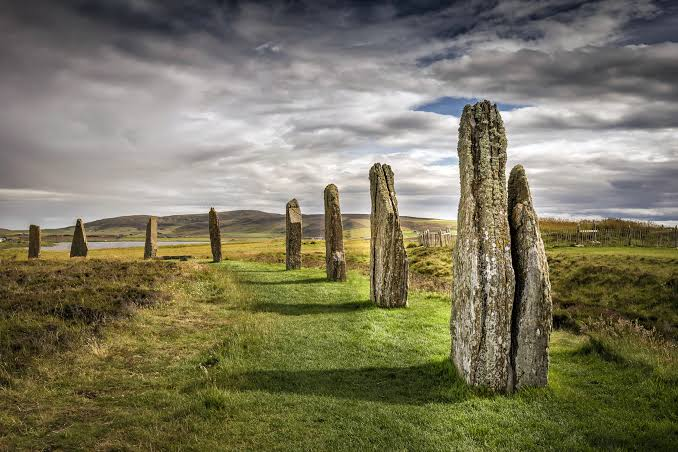
The name Barnston is associated with the prehistoric archaeological landscape of Orkney, although specific site identification and terminology should be treated carefully because several prehistoric cairns and circular monuments across the islands have similar descriptive names.
The broader phenomenon of Bronze Age cairn circles provides important evidence for changing burial traditions after the Neolithic monumental period.
From Neolithic to Bronze Age
The transition from the Neolithic into the Bronze Age brought major social and technological changes.
Communities increasingly used:
copper;
bronze;
new forms of pottery;
and different burial practices.
However, many older traditions continued.
Bronze Age Cairns
A cairn is a mound made primarily from stones.
Bronze Age cairns could function as:
burial monuments;
commemorative structures;
territorial landmarks;
or ceremonial sites.
Circular Design
Circular monuments were particularly common in prehistoric Britain.
A circular form may have had symbolic associations with:
the Sun;
cycles;
seasons;
or community identity.
However, the meaning of the circle cannot be known with certainty.
Burial Practices
Bronze Age burial customs varied.
People could be buried:
individually;
collectively;
in cists;
beneath cairns;
or after cremation.
Cremation became increasingly important in many parts of Britain.
Cists
A stone cist is a small box-like burial structure made from stone slabs.
The deceased or cremated remains could be placed inside before the structure was covered.
Bronze Objects
Some Bronze Age burials contain objects such as:
knives;
axes;
pins;
ornaments;
and weapons.
These objects can provide evidence for technological development and social status.
Orkney's Landscape
Orkney remained an important agricultural region during the Bronze Age.
Communities continued to use:
farmland;
grazing areas;
coastal resources;
and earlier monumental landscapes.
Reuse of Earlier Monuments
Bronze Age communities sometimes reused Neolithic monuments.
This suggests that older monuments retained significance.
People could reinterpret ancestral structures according to changing beliefs.
Environmental Change
During the Bronze Age, climate and vegetation patterns changed.
These changes affected:
agriculture;
grazing;
woodland;
and settlement patterns.
Why Cairn Circles Matter
Cairn circles reveal how communities transformed the landscape through burial and commemoration.
Their construction required labor and organization even when the structures were smaller than earlier monumental complexes.
Conclusion
Bronze Age cairn circles such as those represented in the Orkney archaeological landscape demonstrate that monumental traditions continued after the great Neolithic ceremonial period.
The people of the Bronze Age inherited an already ancient landscape and added their own burial monuments, technologies, and traditions.
Their cairns provide evidence for changing beliefs about death, identity, ancestry, and the landscape.