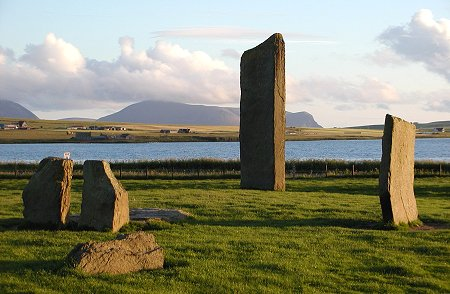
The Stones of Stenness are among the oldest and most dramatic stone monuments in the British Isles.
Located in central Orkney, the surviving standing stones form part of a prehistoric ceremonial landscape that includes the Ring of Brodgar, Maeshowe, the Ness of Brodgar, and Barnhouse.
The monument demonstrates the extraordinary importance of communal ritual in Neolithic Orkney.
One of Britain's Earliest Stone Circles
The Stones of Stenness date to the Neolithic period.
The monument is generally considered earlier than or broadly contemporary with other major Orkney ceremonial structures.
Its massive stones were deliberately positioned within a defined ceremonial space.
The Henge
The monument belongs to the broad category known as a henge.
Henges typically consist of:
an enclosed area;
a ditch;
and an external bank.
However, their exact functions varied considerably.
Massive Stones
The surviving stones are enormous.
Their size would have made transportation and erection a major engineering challenge.
The builders needed to coordinate:
manpower;
ropes;
timber;
stone movement;
and construction planning.
The Central Hearth
Archaeological evidence suggests that activities took place within the ceremonial enclosure.
A large central hearth or stone setting may have been associated with ritual activity.
Ritual Gatherings
The monument could have hosted gatherings involving:
feasting;
ceremonies;
music;
dancing;
storytelling;
and social negotiation.
We cannot reconstruct the exact rituals, but the scale of the monument indicates that communal activity was important.
The Landscape Connection
The Stones of Stenness are visually connected with other major monuments.
This creates an interconnected ceremonial landscape.
People moving across central Orkney would encounter:
standing stones;
burial mounds;
villages;
and monumental enclosures.
Astronomy
Like several Orkney monuments, Stenness has been examined for possible astronomical alignments.
The orientation of stones and entrances may correspond to seasonal solar positions.
However, not every alignment necessarily had an astronomical purpose.
The Importance of Stone
Stone has exceptional durability.
A monument made from stone could survive for thousands of years.
This allowed communities to create enduring landmarks that outlasted individual generations.
Ancestors and Memory
Standing stones may have helped communities maintain connections with the past.
A monument could represent:
ancestral memory;
territorial identity;
shared history;
or collective religious beliefs.
Later History
The monument continued to attract people long after its construction.
Medieval and early modern communities interacted with the stones.
Some stones were removed or damaged over time.
Why Stenness Matters
The Stones of Stenness provide evidence for:
monumental construction;
social organization;
ritual gathering;
landscape planning;
and long-term cultural memory.
Conclusion
The Stones of Stenness demonstrate that Neolithic Orkney was a society capable of monumental communal projects.
The standing stones were not simply isolated objects.
They formed part of a carefully organized landscape containing settlements, tombs, ceremonial centers, and other monuments.