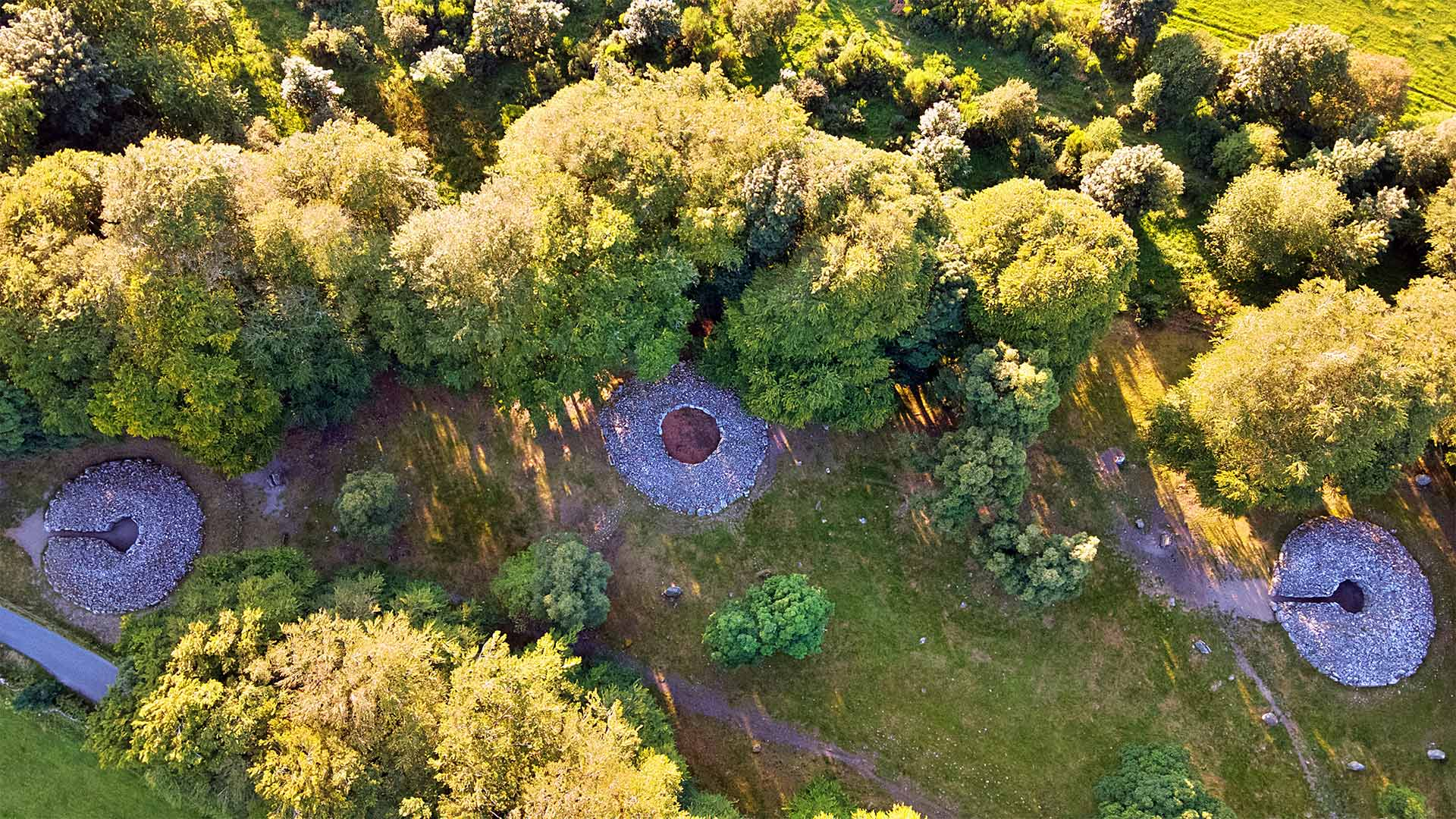
The Clava Cairns, located near Inverness in the Scottish Highlands, form one of Britain's most remarkable prehistoric ceremonial landscapes. Dating primarily to the Bronze Age, approximately 4,000 years ago, the complex contains passage graves, ring cairns, standing stones, kerbs, and other monumental features.
The site is particularly famous for its carefully constructed circular monuments and their possible relationships with the movement of the Sun.
Clava is also important because it demonstrates that Bronze Age communities continued to invest enormous effort in ceremonial architecture long after the Neolithic period had ended.
The Clava Landscape
The monuments stand on a terrace overlooking the River Nairn.
The location provides views across the surrounding Highland landscape.
The builders deliberately transformed this natural setting into a monumental environment.
Passage Graves
Some of the monuments contain passages leading into central chambers.
A passage grave consists of:
an entrance;
a narrow passage;
and an enclosed chamber.
The architecture controls movement between the outside world and the interior.
Ring Cairns
Other monuments consist of circular stone settings surrounded by banks or kerbs.
These are generally known as ring cairns.
Their precise function remains uncertain.
They may have been associated with:
burial;
ritual;
commemorative ceremonies;
or gatherings.
Standing Stones
Large standing stones are also present.
These stones create relationships between individual monuments.
Their positions may have been carefully planned.
Astronomy
One of the most famous features of the Clava complex is its possible relationship with the winter solstice.
The passages of some monuments appear to be aligned toward the southwest, where the setting Sun is visible around the winter solstice.
The Winter Solstice
The winter solstice marks the shortest day of the year in the Northern Hemisphere.
After the solstice, daylight begins gradually increasing again.
For prehistoric agricultural societies, seasonal changes were fundamental.
The Sun could therefore have carried considerable symbolic importance.
Burial
Human remains have been associated with some Clava monuments.
The dead may have been placed within the chambers during particular periods.
However, the exact funerary rituals remain uncertain.
The Role of Ancestors
The monuments may have provided places where communities interacted with ancestral remains.
This could reinforce:
family identity;
lineage;
territorial claims;
and social continuity.
Engineering
The monuments required substantial labor.
Builders had to:
quarry stone;
transport it;
construct chambers;
build walls;
and create massive outer cairns.
Why Clava Is Special
Clava's importance lies in the combination of architecture and astronomy.
The monuments appear to have been deliberately positioned within the landscape rather than built randomly.
Later Cultural Memory
Clava remained visible for thousands of years.
Later generations could have encountered the monuments and developed their own interpretations of them.
The site therefore represents a form of long-term landscape memory.
Conclusion
The Clava Cairns demonstrate the sophistication of Bronze Age communities in northern Scotland.
Their circular monuments, passage graves, standing stones, and possible solar alignments reveal a society deeply concerned with death, ancestry, seasons, and the landscape.
Clava remains one of Scotland's most extraordinary prehistoric ceremonial complexes.