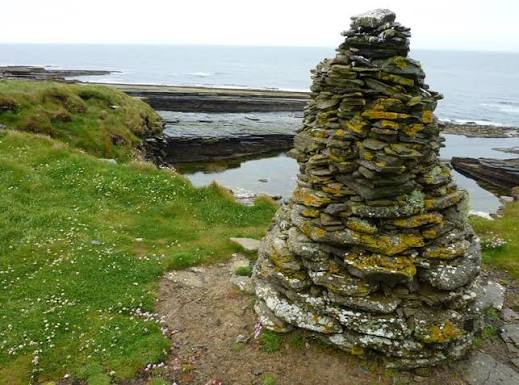
The Crosskirk Broch, located in Caithness in northern Scotland, is an important example of Iron Age monumental architecture.
The broch tradition represents one of the most distinctive architectural developments in northern Britain.
Crosskirk demonstrates the ability of Iron Age communities to construct massive stone towers while maintaining agricultural and maritime economies.
The Broch Tradition
Brochs are primarily found in:
Caithness;
Sutherland;
Orkney;
Shetland;
and the northern Scottish mainland.
They generally date to the Iron Age.
Construction
Crosskirk's builders constructed thick stone walls.
The double-wall technique created a hollow internal structure.
Within these walls, builders could incorporate:
stairways;
galleries;
and small chambers.
Defensive Possibilities
The strength and height of broch architecture suggest defensive considerations.
However, archaeologists increasingly recognize that brochs probably had multiple functions.
They may have served as:
residences;
status symbols;
defensive structures;
or gathering places.
Agriculture
Broch communities were agricultural.
They cultivated cereals and raised livestock.
Animal husbandry was particularly important in the northern Scottish environment.
Iron Technology
Iron tools allowed people to improve:
woodworking;
agriculture;
hunting;
and construction.
Iron weapons also played an important role in Iron Age society.
Coastal Resources
Caithness provided access to the sea.
Fishing and marine gathering could supplement agricultural food supplies.
Social Hierarchy
The monumental scale of a broch may indicate social inequality.
Some individuals or groups may have controlled:
land;
livestock;
trade;
or labor.
Visibility
A tall stone tower would have been highly visible.
It could therefore communicate:
power;
identity;
territorial control;
and prestige.
Why Crosskirk Matters
Crosskirk helps archaeologists understand the relationship between architecture and social organization during the Iron Age.
Conclusion
Crosskirk Broch demonstrates that Iron Age communities in Caithness possessed impressive engineering capabilities.
Its massive stone walls were not simply defensive structures.
The broch likely served as a center of household activity, social identity, and political authority within its surrounding landscape.