
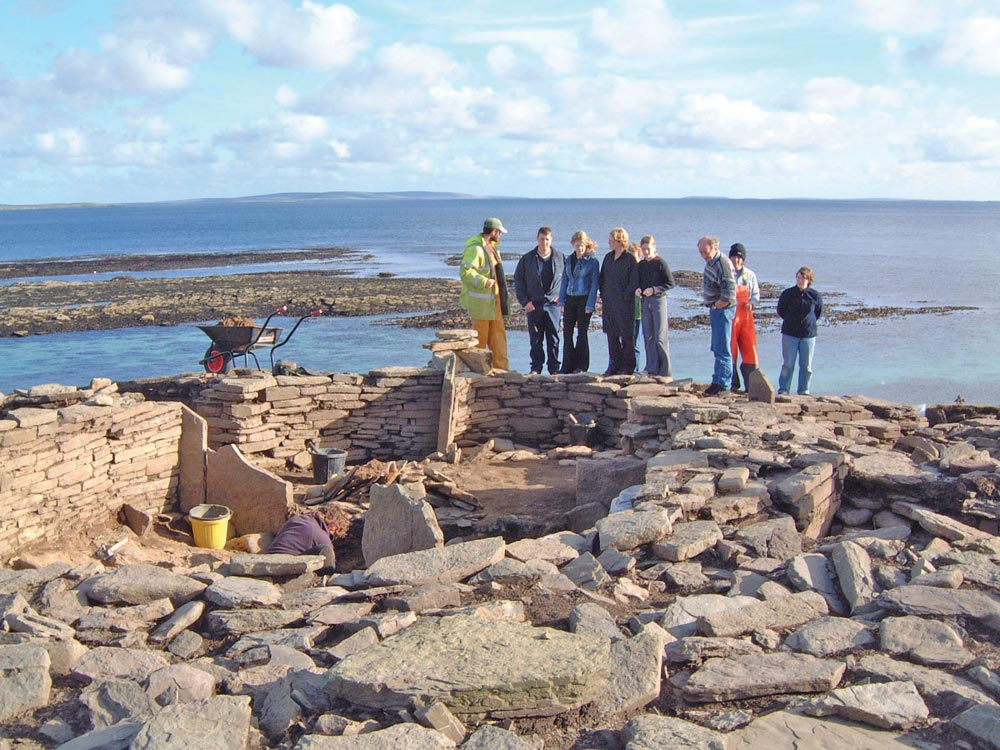
Grobust is part of Westray's exceptionally rich archaeological record and is associated with the island's Neolithic settlement landscape.
Sites such as Grobust are important because they shift attention away from monumental tombs and toward the communities that actually lived, farmed, cooked, worked, and raised families in prehistoric Orkney.
Neolithic Westray
Approximately 5,000 years ago, Westray supported farming communities.
These people practiced a mixed economy involving:
agriculture;
livestock;
fishing;
shellfish gathering;
and hunting.
Houses
Neolithic houses in Orkney were commonly built from stone.
Their walls could be substantial enough to survive for thousands of years.
Domestic Spaces
A typical house might contain:
hearths;
sleeping platforms;
storage compartments;
work areas;
and entrances.
These features provide evidence for household organization.
Agriculture
Cereal cultivation was essential.
Barley was particularly suitable for Orkney's cool climate.
Grinding stones were used to process grain.
Livestock
Animals provided multiple resources.
Cattle and sheep could supply:
meat;
milk;
hides;
and bones.
Marine Resources
The surrounding coastline offered additional food.
People could collect:
shellfish;
fish;
seabirds;
and other marine resources.
Pottery
Pottery fragments reveal food-processing traditions.
Vessels could be used for:
cooking;
storage;
and serving.
Tools
Stone tools were used for:
cutting;
grinding;
woodworking;
and hunting.
Social Organization
A settlement required cooperation.
People had to coordinate:
farming;
construction;
food storage;
livestock management;
and resource gathering.
Why Grobust Matters
The site contributes to the understanding of everyday Neolithic life in Westray.
It demonstrates that prehistoric Orkney was not defined solely by its monumental tombs and stone circles.
Conclusion
Grobust provides evidence for the domestic foundations of Neolithic society.
Its settlement landscape reflects a community that successfully combined farming, livestock management, and marine exploitation.
The site helps reconstruct the everyday world behind Orkney's famous monuments.





