The Roman City With Two Names: Why Cuicul and Djemila Are the Same Ancient Mystery
One of the most important corrections in North African archaeology concerns the name Cuicul.
Cuicul is not a separate Roman city from Djemila.
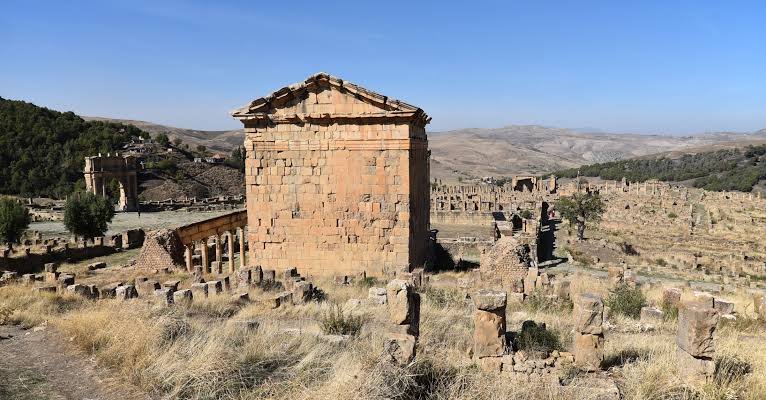
Cuicul is the ancient Roman name of the archaeological site now known as Djemila.
This distinction may appear simple, but it reveals a broader issue in historical writing: ancient places often acquire multiple names over centuries.
Modern languages rename them.
Empires change.
Archaeologists use ancient forms.
Local communities preserve new names.
The result can sometimes make one city appear to be several.
The history of Cuicul is therefore the history already explored through Djemila—but it deserves attention under its original Roman identity.
Cuicul in Roman Numidia
The city developed as part of the Roman province of Numidia.
Its foundation and expansion occurred within the wider process of Roman urbanization in North Africa.
Roman cities were connected through:
Roads.
Military networks.
Administrative systems.
Agricultural economies.
Mediterranean trade.
Cuicul occupied an important place within this network.
A City That Adapted to the Mountains
The mountainous terrain created a challenge.
Roman architects adapted their planning.
The resulting urban landscape demonstrates that Roman engineering was flexible.
Rather than abandoning difficult sites, Roman builders developed infrastructure suited to the available geography.
The Original Colonial Core
The earliest city contained the basic institutions associated with Roman urban life.
These included:
A forum.
Streets.
Public monuments.
Religious buildings.
Residential areas.
As the city grew, the original core became only one part of a larger urban environment.
Expansion Under Later Emperors
Imperial prosperity encouraged new construction.
Monuments were added.
Markets developed.
Baths were expanded.
Triumphal architecture celebrated imperial authority.
The city became more complex.
Constantine and the Late Roman World
The phrase “Constantine Roman City” can be misleading if it suggests that Cuicul was founded by Emperor Constantine.
The city existed centuries before his reign.
However, like many Roman cities, it continued to exist and develop during the period of Constantine and the transformation of the Roman Empire.
The fourth century was a period of major religious and political change.
Christianity increasingly received imperial support.
Urban institutions changed.
New religious architecture appeared.
The Christian Transformation
Churches became major components of late antique urban life.
The conversion of emperors and the increasing influence of Christianity altered the relationship between religion and political power.
Cuicul reflects this transformation.
The city that had originally been designed around Roman civic and pagan institutions became increasingly shaped by Christian architecture.
Archaeological Interpretation
The study of Cuicul/Djemila demonstrates why archaeological interpretation must avoid simple narratives.
A city is not “Roman” in only one sense.
Its history changed.
People changed.
Religions changed.
Buildings changed.
The ruins represent centuries, not one moment.
Why the Two Names Matter
Calling the city Cuicul emphasizes its ancient Roman identity.
Calling it Djemila recognizes its modern Algerian context.
Both names belong to its history.
The site reminds us that ancient cities do not disappear completely.
Sometimes they survive by changing names.
Sometimes their ruins become new landscapes.
And sometimes, centuries later, archaeologists uncover the streets of a city whose original inhabitants would never have imagined that their name would one day be forgotten—and then rediscovered.