Three Civilizations Built This Algerian City—Then the Mediterranean Took It Back
Along Algeria's Mediterranean coast lies Tipasa, an archaeological landscape shaped by thousands of years of cultural contact.
Phoenician traders used the coast.
Punic influence followed.
The Romans transformed the settlement into an important urban center.
Christian communities built churches and cemeteries.
Later political changes altered the city again.
Few sites demonstrate the layered history of North Africa as clearly as Tipasa.
The Phoenician Mediterranean
The Phoenicians were among the great maritime traders of the ancient Mediterranean.
Originating primarily from the eastern Mediterranean, Phoenician communities established commercial relationships and settlements across coastal regions.
Their network eventually extended to North Africa, Iberia, and beyond.
Tipasa's coastal location made it valuable.
A harbor could connect local communities with wider trade routes.
The Punic World
The growth of Carthage transformed the political landscape of North Africa.
Carthage developed from a Phoenician foundation into a major Mediterranean power.
Settlements along the coast participated in a wider Punic commercial and cultural network.
Tipasa became connected with this world.
Roman Conquest and Transformation
After Rome defeated Carthage and expanded into North Africa, coastal settlements increasingly entered the Roman imperial system.
Tipasa was transformed.
Roman institutions appeared.
Urban architecture expanded.
The settlement developed into a municipium and later an important Roman city.
A City Beside the Sea
The location shaped Tipasa's identity.
The Mediterranean was a highway.
Ships carried:
Grain.
Olive oil.
Wine.
Ceramics.
Metals.
Luxury goods.
People.
A coastal city could participate in networks extending across the entire Roman world.
The Roman Urban Landscape
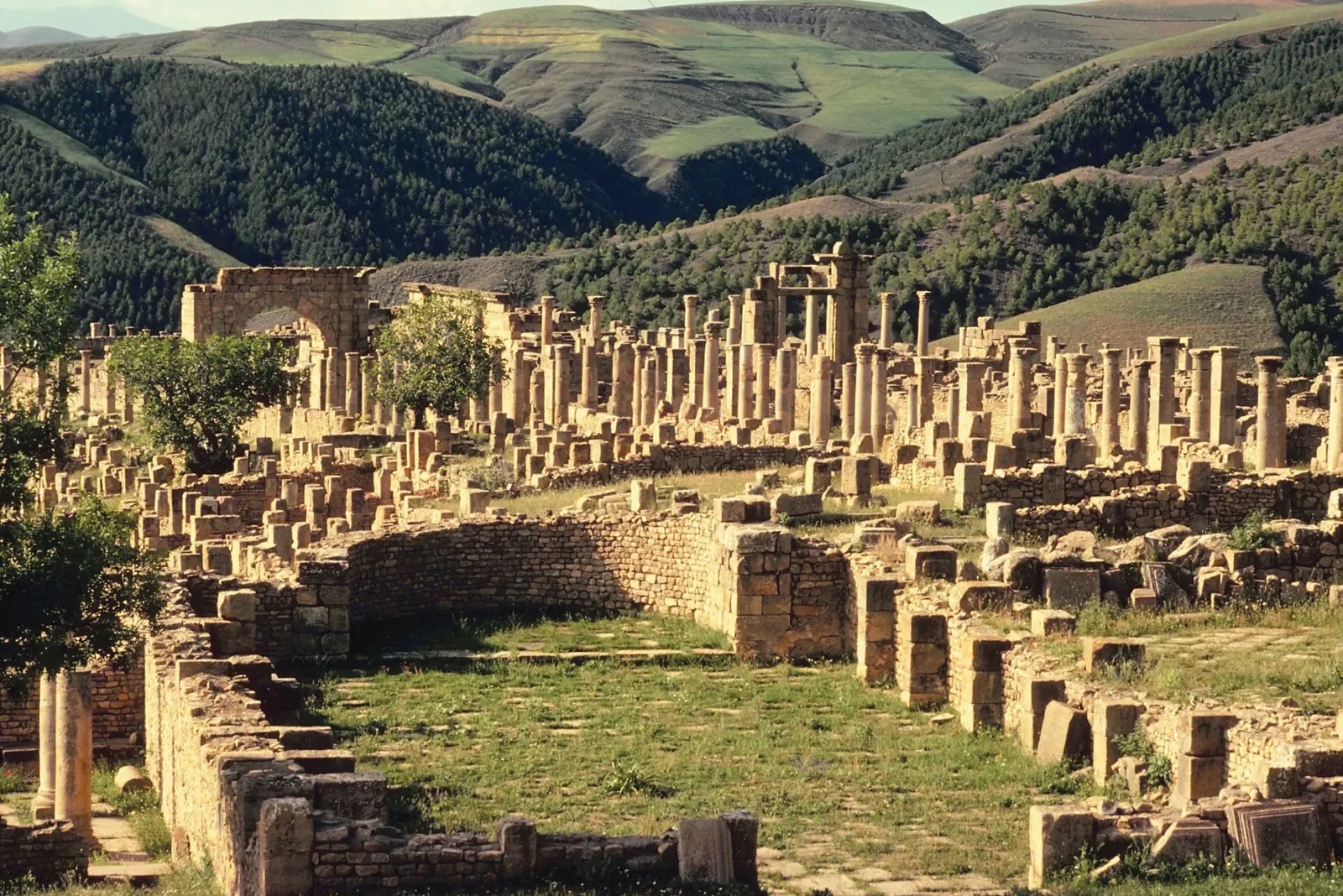
The archaeological remains include evidence of:
Streets.
Houses.
Baths.
Public buildings.
Temples.
Cemeteries.
Christian churches.
The combination of structures demonstrates that Tipasa was not merely a port.
It was a functioning urban community.
Christianity and the Basilica Landscape
Tipasa became particularly important during the Christian period.
Large basilicas and cemeteries demonstrate the growth of Christian communities.
The location contains significant evidence for the transformation of Roman cities during Late Antiquity.
Christianity reshaped urban space.
New religious buildings became important.
Burial practices changed.
The relationship between the living city and the dead also became visible through extensive cemeteries.
Saint Salsa and Religious Memory
Tipasa is associated with the Christian martyr Saint Salsa, whose story became part of local religious tradition.
Her cult demonstrates how local communities created sacred histories connected with particular places.
Such traditions transformed ordinary landscapes into religious geography.
The Vandals and Byzantine Period
The political collapse of western Roman authority led to new forms of rule.
The Vandals established a kingdom in North Africa.
Later, Byzantine forces attempted to restore imperial authority.
Tipasa's history reflects these larger Mediterranean transformations.
The Landscape and the Ruins
Tipasa is unusual because the archaeological remains exist in a coastal environment of extraordinary natural beauty.
But beauty can create conservation problems.
Salt air.
Humidity.
Vegetation.
Tourism.
All can affect ancient stone.
The ruins are therefore constantly exposed to environmental pressure.
Why Tipasa Matters
Tipasa represents the Mediterranean as a space of connection.
The sea did not separate civilizations.
It connected them.
Phoenician sailors, Punic merchants, Roman officials, Christian clergy, and local North African communities all participated in the history of this coastline.
The ruins demonstrate that civilization was not created by one culture replacing another.
Instead, Tipasa accumulated layers.
And beside the Mediterranean, those layers remain visible.