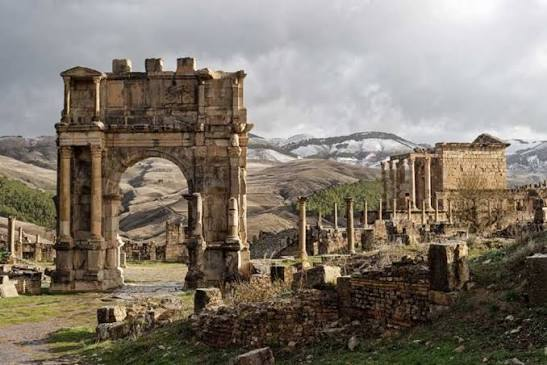
Djemila, known in antiquity as Cuicul, is one of Algeria's most important Roman archaeological sites. Situated in a mountainous region of northeastern Algeria, the city demonstrates how Roman urban planning could be adapted to difficult terrain.
The title “Trajan-Era Mountain City” reflects the settlement's foundation during the Roman imperial period, traditionally associated with the reign of Emperor Nerva or Trajan at the end of the first and beginning of the second century CE.
Unlike Timgad, whose landscape allowed for a highly regular grid, Djemila was built in a more rugged environment.
Its architecture therefore reveals how Roman planners adapted roads and public spaces to the natural contours of the land.
The Foundation of Cuicul
Cuicul began as a Roman colony in the mountainous region of Numidia.
The establishment of a Roman city in such a location demonstrates the expansion of Roman political and economic systems across North Africa.
The settlement provided a center for:
administration;
trade;
agriculture;
and cultural integration.
Over time, the city expanded beyond its original core.
Building a Roman City in the Mountains
Roman urban planning is often associated with straight streets and rectangular blocks.
Djemila demonstrates that these ideals could be modified.
The uneven terrain forced builders to adapt.
Instead of imposing a perfectly uniform grid across the landscape, roads and buildings followed practical possibilities created by slopes and natural features.
This produced an urban landscape that was both recognizably Roman and uniquely adapted to its location.
The Forum and Civic Life
The forum formed the heart of public life.
Residents could gather there for:
commercial activity;
political announcements;
religious ceremonies;
and social interaction.
The buildings surrounding the forum reflected the organization of Roman civic institutions.
Temples and administrative structures gave physical form to Roman authority.
The Arch of Caracalla
Djemila contains monumental structures constructed during later phases of the city's history, including an arch associated with Emperor Caracalla.
Such monuments were important expressions of loyalty and political identity.
They linked a provincial city with the authority of the emperor.
Even residents who never traveled to Rome could experience imperial symbolism within their own urban environment.
Markets and Economic Activity
Markets were essential to the functioning of Roman cities.
Farmers, artisans, merchants, and consumers needed spaces where goods could be exchanged.
The economy of Djemila depended on relationships between the city and its surrounding agricultural territory.
Products could include:
grain;
olives;
livestock;
pottery;
textiles;
and other regional goods.
Roman Baths
Bathhouses were important social institutions.
The construction of a bath required:
reliable water;
furnaces;
drainage;
heating systems;
and skilled labor.
Public baths allowed people from different backgrounds to participate in a shared urban activity.
They were therefore important centers of social life.
Christianity in Djemila
As Christianity spread through North Africa, Djemila developed a substantial Christian presence.
Churches and religious structures became part of the city's architecture.
The transformation from a predominantly pagan Roman religious landscape to a Christian one can be traced archaeologically through changes in building use and the construction of basilicas.
North African Christianity
Roman North Africa was one of the major intellectual centers of early Christianity.
The region produced influential theologians and religious leaders.
However, Christian communities were also divided by theological and political disagreements.
Movements such as Donatism became particularly influential in parts of North Africa.
These conflicts demonstrate the diversity of religious life during late antiquity.
The End of Roman Urban Prosperity
Djemila experienced changes as Roman political authority weakened in North Africa.
The region passed through periods of Vandal and later Byzantine control.
Urban institutions gradually changed, and some areas of the city were abandoned or reused.
The transformation was gradual rather than a single moment of sudden collapse.
Why Djemila Matters
Djemila provides an important example of Roman adaptation.
It demonstrates that Roman urban planning was flexible enough to function in difficult mountain environments.
The site preserves evidence of:
civic architecture;
economic activity;
Roman engineering;
Christianity;
and the long transformation of a provincial city.
Conclusion
Djemila was a Roman mountain city shaped by both imperial planning and local geography.
Its forums, temples, baths, markets, and churches reveal how Roman institutions developed in North Africa, while its irregular terrain demonstrates that Roman urbanism was never simply copied from a standard design.
The ruins of ancient Cuicul preserve the story of a community that changed repeatedly as political and religious transformations reshaped the Mediterranean world.