Wadi Barhat is part of the extraordinary prehistoric rock-art landscape of the central Sahara, where engravings and paintings preserve evidence of societies that lived in an environment radically different from the desert seen today. Across Libya and neighboring regions, prehistoric artists recorded animals, people, hunting scenes, and symbolic forms on exposed rock surfaces.
The title “Cattle Cult Engravings” refers to one of the most important themes in Saharan prehistoric art: the repeated depiction of domesticated cattle. Cattle imagery is particularly significant because it reflects a period when parts of the Sahara supported grasslands, seasonal water sources, and communities whose lives were closely connected to herding.
Rather than being merely decorative, these engravings may provide evidence for changing economic systems, ritual beliefs, social identity, and relationships between humans and animals.
The Green Sahara
The Sahara was not always the immense desert it is today.
During periods of the African Humid Period, roughly between the early Holocene and several thousand years ago, increased rainfall transformed large portions of North Africa.
Grasslands, lakes, wetlands, and seasonal rivers developed across regions that are now extremely arid.
These environmental changes allowed communities to exploit:
wild plants;
fish;
game animals;
and eventually domesticated livestock.
The archaeological record of Saharan rock art is therefore also a record of climate change.
Cattle in Saharan Rock Art
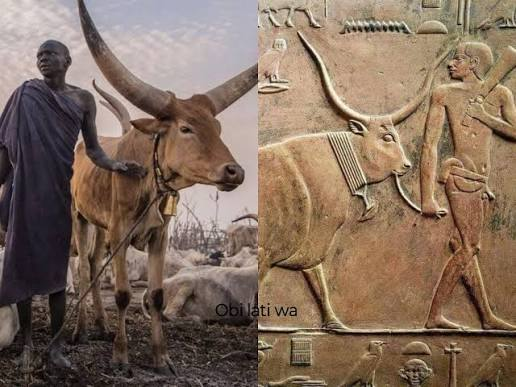
Cattle are among the most recognizable subjects in prehistoric Saharan art.
Artists depicted animals with:
large curved horns;
elongated bodies;
carefully rendered legs;
and sometimes decorative markings.
Some representations appear to show individual animals, while others form groups or appear alongside humans.
The repeated emphasis on cattle suggests that these animals held significance beyond their value as food.
The Meaning of Cattle
Cattle could provide:
milk;
meat;
hides;
bone;
and social wealth.
For herding societies, livestock could also represent status.
A person or family with a large herd possessed an important economic resource.
Animals could therefore become symbols of:
wealth;
fertility;
family identity;
social prestige;
and religious significance.
What Does “Cattle Cult” Mean?
The phrase “cattle cult” should be used cautiously.
Archaeologists cannot directly interview prehistoric artists about the meaning of their images.
However, the extraordinary frequency and careful treatment of cattle in Saharan art has encouraged researchers to consider whether cattle played an important symbolic or ritual role.
Some scholars have proposed connections between cattle imagery and:
fertility;
death;
ancestral beliefs;
ceremonial activity;
or supernatural traditions.
These interpretations remain hypotheses rather than proven facts.
Engraving Techniques
Rock engravings were created through techniques such as:
pecking;
pounding;
scraping;
and incising.
An artist could strike the rock repeatedly with a harder stone to remove small fragments from the surface.
Over time, these individual marks could form detailed outlines.
The amount of labor involved in producing a large animal image may have been considerable.
The Skill of Prehistoric Artists
Saharan engravings demonstrate that prehistoric artists possessed a sophisticated understanding of animal anatomy.
Artists could represent:
horns;
limbs;
backs;
tails;
and body proportions.
Some images are surprisingly naturalistic.
The ability to recognize and reproduce distinctive animal features suggests close observation of the surrounding environment.
Climate Change Recorded in Stone
The cattle engravings are especially valuable because they indirectly document an environment that no longer exists.
Cattle require reliable water and vegetation.
Their presence in large numbers within prehistoric art therefore supports archaeological evidence for a wetter Sahara.
As the African Humid Period ended, rainfall declined.
Lakes and grasslands contracted.
Communities increasingly moved toward areas where water remained available.
The Disappearance of Cattle Art
The changing environment affected both human societies and their artistic traditions.
As aridification progressed, cattle herding became increasingly difficult in many parts of the Sahara.
Pastoral groups developed different strategies, including greater reliance on:
sheep;
goats;
and eventually camel pastoralism.
Rock-art styles changed alongside these economic transformations.
Why Wadi Barhat Matters
The rock art of Wadi Barhat belongs to a much larger prehistoric record documenting human occupation of the Sahara.
It provides evidence for:
pastoralism;
changing climates;
animal symbolism;
artistic traditions;
and the transformation of human societies.
Conclusion
Wadi Barhat's cattle imagery provides a remarkable glimpse into a greener Sahara.
The engravings preserve the memory of communities whose lives were closely connected with herding and whose artists repeatedly represented cattle on the walls of the desert.
Whether these animals were primarily economic resources, symbols of social identity, religious beings, or a combination of all three remains an open question.
What is certain is that the images preserve evidence of a prehistoric world in which cattle and humans lived within landscapes that climate change would eventually transform beyond recognition.