
• MAIN PAGE
  • LATEST NEWS
    • Lost Cities
    • Archaeology's Greatest Finds
    • Underwater Discoveries
    • Greatest Inventions
    • Studies
    • Blog
  • PHILOSOPHY
  • HISTORY
  • RELIGIONS
    • Africa
    • Anatolia
    • Arabian Peninsula
    • Balkan Region
    • China - East Asia
    • Europe
    • Eurasian Steppe
    • Levant
    • Mesopotamia
    • Oceania - SE Asia
    • Pre-Columbian Civilizations of America
    • Iranian Plateau - Central Asia
    • Indus Valley - South Asia
    • Japan
    • The Archaeologist Editor Group
    • Scientific Studies
    • Aegean Prehistory
    • Historical Period
    • Byzantine Middle Ages
    • Predynastic Period
    • Dynastic Period
    • Greco-Roman Egypt
  • Rome
  • PALEONTOLOGY
  • About us
Menu

The Archaeologist

  • MAIN PAGE
  • LATEST NEWS
  • DISCOVERIES
    • Lost Cities
    • Archaeology's Greatest Finds
    • Underwater Discoveries
    • Greatest Inventions
    • Studies
    • Blog
  • PHILOSOPHY
  • HISTORY
  • RELIGIONS
  • World Civilizations
    • Africa
    • Anatolia
    • Arabian Peninsula
    • Balkan Region
    • China - East Asia
    • Europe
    • Eurasian Steppe
    • Levant
    • Mesopotamia
    • Oceania - SE Asia
    • Pre-Columbian Civilizations of America
    • Iranian Plateau - Central Asia
    • Indus Valley - South Asia
    • Japan
    • The Archaeologist Editor Group
    • Scientific Studies
  • GREECE
    • Aegean Prehistory
    • Historical Period
    • Byzantine Middle Ages
  • Egypt
    • Predynastic Period
    • Dynastic Period
    • Greco-Roman Egypt
  • Rome
  • PALEONTOLOGY
  • About us

An artist’s reconstruction of a Marathousa 1 paleolithic woman producing a digging stick from a small alder tree trunk with a small stone tool. This kind of wood was used for the Marathousa 1 digging stick. Usewear analysis of stone tools at Marathousa 1 show evidence of woodworking.

Earliest hand-held wooden tools found in Greece date back 430,000 years

February 2, 2026

An international research team has identified the earliest known hand-held wooden tools used by humans, dating back around 430,000 years. The discovery comes from the Marathousa 1 archaeological site in central Greece’s Peloponnese and is described in a study published in PNAS, jointly led by Professor Katerina Harvati of the University of Tübingen and Dr. Annemieke Milks of the University of Reading.

The findings include two deliberately shaped wooden objects—one made from alder and the other from willow or poplar—representing the oldest hand-held wooden tools ever discovered. This pushes back evidence of such tool use by at least 40,000 years, significantly expanding understanding of early human technology.

The site, which was once located along the shore of a lake, also yielded stone tools and the remains of an elephant and other animals, suggesting it served as a butchering location. Early humans occupied the area during the Middle Pleistocene period, a crucial phase in human evolution marked by increasingly complex behaviors.

“The Middle Pleistocene was a critical phase in human evolution, during which more complex behaviors developed,” said Professor Harvati. “The earliest reliable evidence of targeted technological use of plants also dates from this period.”

The discovery highlights the importance of perishable materials like wood—rarely preserved in the archaeological record—in shaping early human survival strategies and technological innovation.
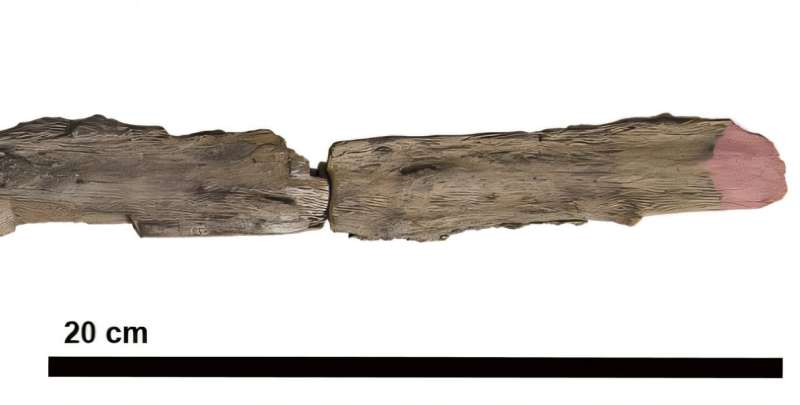
The functional end of 940/673-39, View 3. The pink highlighted area shows where the wood fibers show micro-damage, likely from use.

Worked stone tools and bone artifacts from the site had already demonstrated the technical skill and wide range of activities practiced by the people who once lived there, prompting researchers to examine the associated wooden finds more closely.

“Unlike stone, wooden objects require very specific conditions to survive over long periods of time,” explained Dr. Annemieke Milks, a leading specialist in early wooden tools. “We carefully examined all wooden remains under microscopes and identified chopping and carving marks on two objects—clear evidence that they had been deliberately shaped by early humans.”

Meticulous examination

The research team identified two wooden artifacts that showed unmistakable signs of human modification. One was a small piece of alder trunk bearing clear shaping marks as well as wear traces, suggesting it may have been used for digging along the lake’s edge or for stripping bark from trees.

The second artifact, a very small fragment made from willow or poplar, also showed signs of deliberate working and possible use. A third find—a larger piece of alder wood marked with a grooved pattern—was initially considered a potential tool, but closer analysis revealed that the marks were likely caused by the claws of a large carnivore, possibly a bear, rather than by human activity.

Together, the findings highlight both the sophistication of early human tool-making and the importance of rare wooden artifacts in reconstructing ancient behavior.


← Two rare 5th millennium BC fetal burials in Iran reveal variable prehistoric practicesWhat Archaeologists Won’t Admit About Bulgaria’s Megaliths →
Featured
image_2026-02-02_193127488.png
Feb 2, 2026
Two rare 5th millennium BC fetal burials in Iran reveal variable prehistoric practices
Feb 2, 2026
Read More →
Feb 2, 2026
image_2026-02-02_192613796.png
Feb 2, 2026
Earliest hand-held wooden tools found in Greece date back 430,000 years
Feb 2, 2026
Read More →
Feb 2, 2026
image_2026-02-01_214736694.png
Feb 1, 2026
What Archaeologists Won’t Admit About Bulgaria’s Megaliths
Feb 1, 2026
Read More →
Feb 1, 2026
image_2026-02-01_214431999.png
Feb 1, 2026
5 Most Massive Unexplained Ancient Walls
Feb 1, 2026
Read More →
Feb 1, 2026
image_2026-02-01_214147078.png
Feb 1, 2026
The Oldest Generation Ever Photographed | Authentic Daguerreotypes of People Born in the 1700s
Feb 1, 2026
Read More →
Feb 1, 2026
image_2026-02-01_213829766.png
Feb 1, 2026
PH Skip navigation Search Avatar image The Baalbek Stones: How Did an Ancient Civilisation Move These Enormous Stones?
Feb 1, 2026
Read More →
Feb 1, 2026
read more

Powered by The archaeologist