“Finding figurines in place inside a royal tomb has not happened in the Tanis necropolis since 1946,”
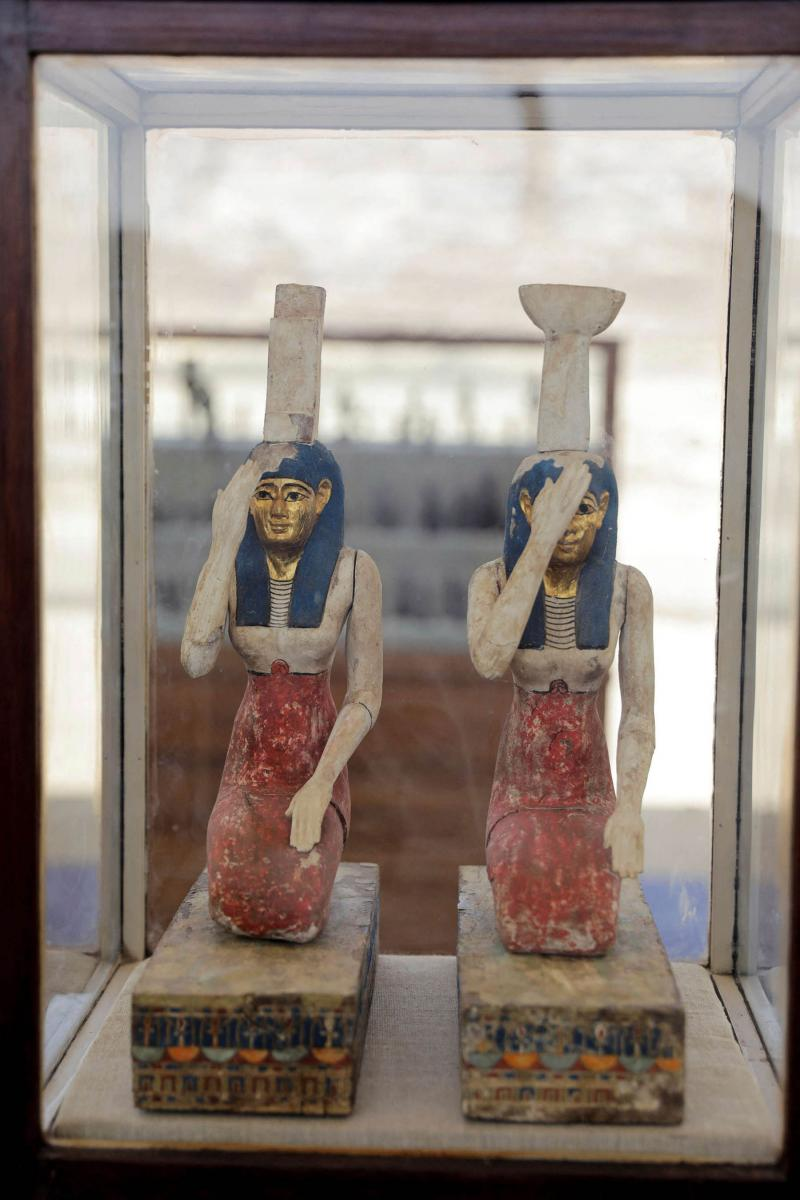
Figurines that are around 2500 years old, from the newly-discovered burial site near Egypt’s Saqqara necropolis, are displayed during a presentation in Giza, Egypt.
Archaeologists working in the ancient Egyptian city of Tanis have uncovered an extraordinary collection of 225 funerary figurines inside a royal tomb a rare discovery that has also resolved a long-standing historical puzzle.
French Egyptologist Frédéric Payraudeau announced that this is the first time since 1946 that figurines have been found in their original position inside a royal tomb at the Tanis necropolis. He added that such a discovery is almost unheard of even in the Valley of the Kings near Luxor, where most tombs were plundered long ago. Only the tomb of Tutankhamun, uncovered in 1922, offered a similar wealth of untouched burial goods.
The breakthrough occurred on October 9, as Payraudeau’s team was excavating the final corner of a narrow burial chamber containing a massive, unidentified sarcophagus. The first sight of several small figurines clustered together immediately signaled that something exceptional had been found.
Realizing the significance, the team extended work beyond their usual hours, setting up lights and continuing through the night. Over the next ten days, they carefully removed all 225 ushabti—small, green-colored servant figurines meant to assist the deceased in the afterlife.
The figurines were arranged with deliberate precision: placed in a star-like pattern along the sides of a trapezoid-shaped shaft and organized in neat horizontal rows at the bottom. More than half are female—a highly unusual detail, according to Payraudeau.
Tanis, located in the Nile Delta, served as Egypt’s capital during the 21st Dynasty, beginning around 1050 BCE. With the Valley of the Kings abandoned due to widespread looting during earlier reigns, Tanis became the new burial site for royal families.
The discovery of the royal emblem on the figurines provided a crucial clue about the identity of the person buried in the sarcophagus. They belonged to Pharaoh Shoshenq III, who ruled from 830 to 791 BCE. This finding was surprising, as his name appears on the walls of a different tomb at Tanis—one containing the largest sarcophagus at the site.
Payraudeau noted that constructing a tomb in ancient Egypt was always uncertain, since a ruler could not guarantee that their successor would honor their burial plan. Political turmoil may explain the discrepancy: Shoshenq III’s long reign was marked by a violent struggle for power between Upper and Lower Egypt. It is possible he was not interred in his intended tomb, or that his remains were moved later, though relocating a massive granite sarcophagus into such a confined space seems unlikely.