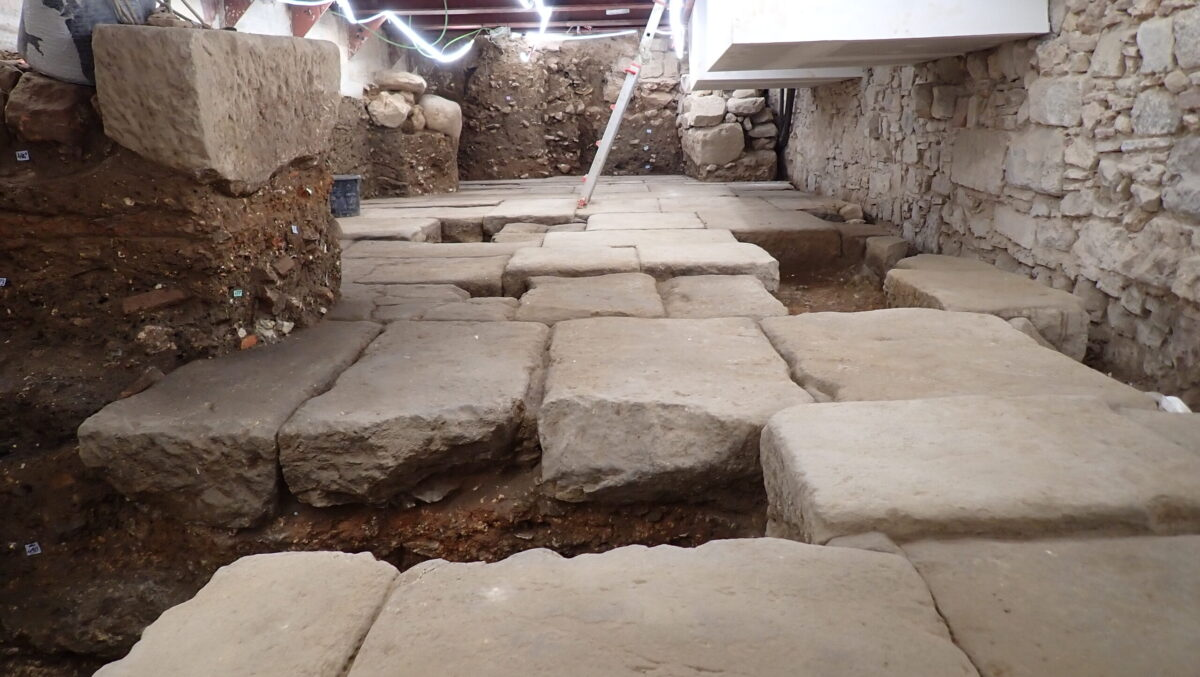
A remarkable archaeological discovery beneath a hotel in Barcelona is prompting historians to reconsider the layout of the ancient Roman city of Barcino. During renovation work at Gran Hotel Barcino, archaeologists uncovered a monumental stone pavement that once formed part of the city’s forum—the civic and political center of Roman life nearly 2,000 years ago.
The pavement was found more than two meters below modern street level and dates back to the early decades of the Roman colony, between 15 and 10 BC. Specialists believe it is the earliest example of monumental public paving ever discovered in Barcelona. The find provides new evidence that could significantly change how scholars understand the urban design of Roman Barcino.
Discovery Beneath a Historic Hotel
The discovery took place during expansion work at the Gran Hotel Barcino on Carrer d’Hèrcules, located in the city’s Gothic Quarter. The original construction plan included installing a new elevator shaft, a routine task that required a preventive archaeological inspection.
When workers reached a depth of roughly 2.5 meters, archaeologists discovered large stone slabs forming an ancient paved surface. What began as a small excavation area of about six square meters quickly expanded to approximately 80 square meters after experts realized the importance of the structure.
The excavation eventually lasted more than two years, from June 2023 to July 2025, and revealed one of the most significant archaeological remains of Roman Barcelona uncovered in decades.
Stone from Montjuïc
At the center of the site is a monumental pavement made from stone quarried from Montjuïc, the hill overlooking the city that has provided building materials since ancient times.
The discovery suggests that the forum of Roman Barcino may have extended further than previously believed, offering historians new insights into the city’s earliest urban development and the monumental architecture that once defined its public spaces.
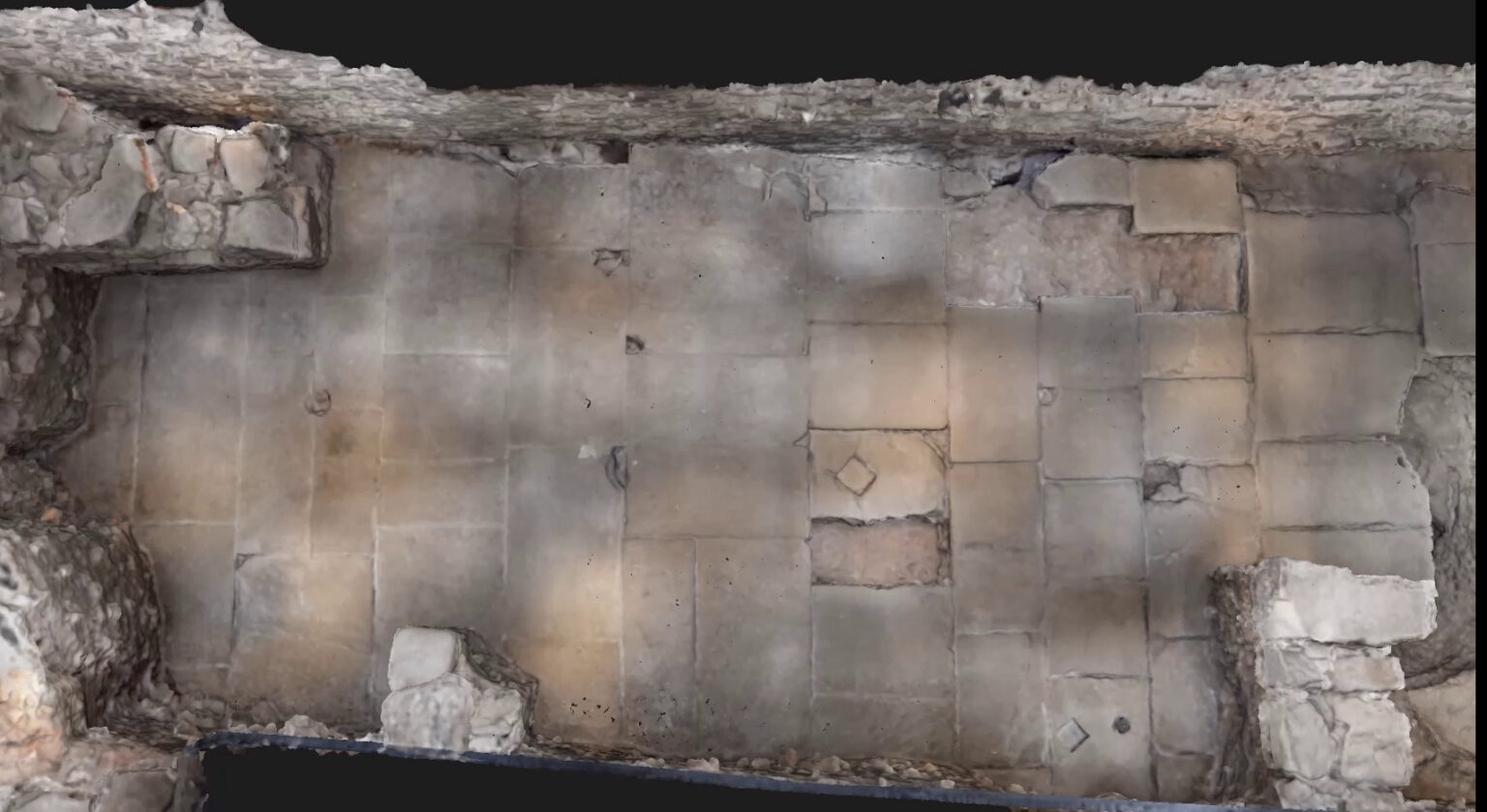
The “Sala Gran,” where archaeologists uncovered a large section of the monumental Roman forum pavement beneath the Gran Hotel Barcino in Barcelona.
Engineering the Heart of a Roman City
The newly uncovered pavement beneath Gran Hotel Barcino covers roughly 42 square meters and is made up of large rectangular stone slabs carefully cut and positioned to create a stable and durable surface.
Some of the blocks measure up to 149 centimeters long and 118 centimeters wide, with thicknesses ranging between 18 and 35 centimeters. This variation was intentional. Roman builders adjusted the thickness of the stones to compensate for irregularities in the natural bedrock beneath the site, ensuring the finished pavement remained level and structurally sound.
Large, precisely fitted slabs like these were usually reserved for important civic areas in Roman cities—spaces designed to impress residents and visitors. Archaeologists involved in the excavation noted that the size and quality of the construction strongly suggest the pavement formed part of a major public space within Barcino, the ancient Roman colony that once occupied the area now known as Barcelona.
The slabs are arranged in rows running northwest to southeast, a pattern that aligns parallel with the Decumanus, the main east–west street typical of Roman urban planning. This alignment may prove crucial for understanding how the city was originally designed.
A Possible Shift in the City’s Layout
Roman cities were usually structured around two main streets: the Cardo, which ran north to south, and the Decumanus, which ran east to west. The intersection of these two roads typically marked the location of the forum—the central square where government, trade, and religious activities took place.
For many years, historians believed that the forum of Barcino was aligned parallel to the Cardo and located near the modern Palau de la Generalitat de Catalunya and Plaça de Sant Jaume.
However, the orientation of the newly discovered pavement suggests a different interpretation. Because the slabs run parallel to the Decumanus and perpendicular to the Cardo, archaeologists now believe the forum may actually have been aligned along the east–west axis.
If this interpretation is confirmed, it would mean the forum’s layout was effectively rotated by 90 degrees compared to what historians previously thought.
Such a change could significantly reshape scholars’ understanding of the spatial organization of Roman Barcelona, including how its public buildings and civic spaces were arranged nearly two thousand years ago.
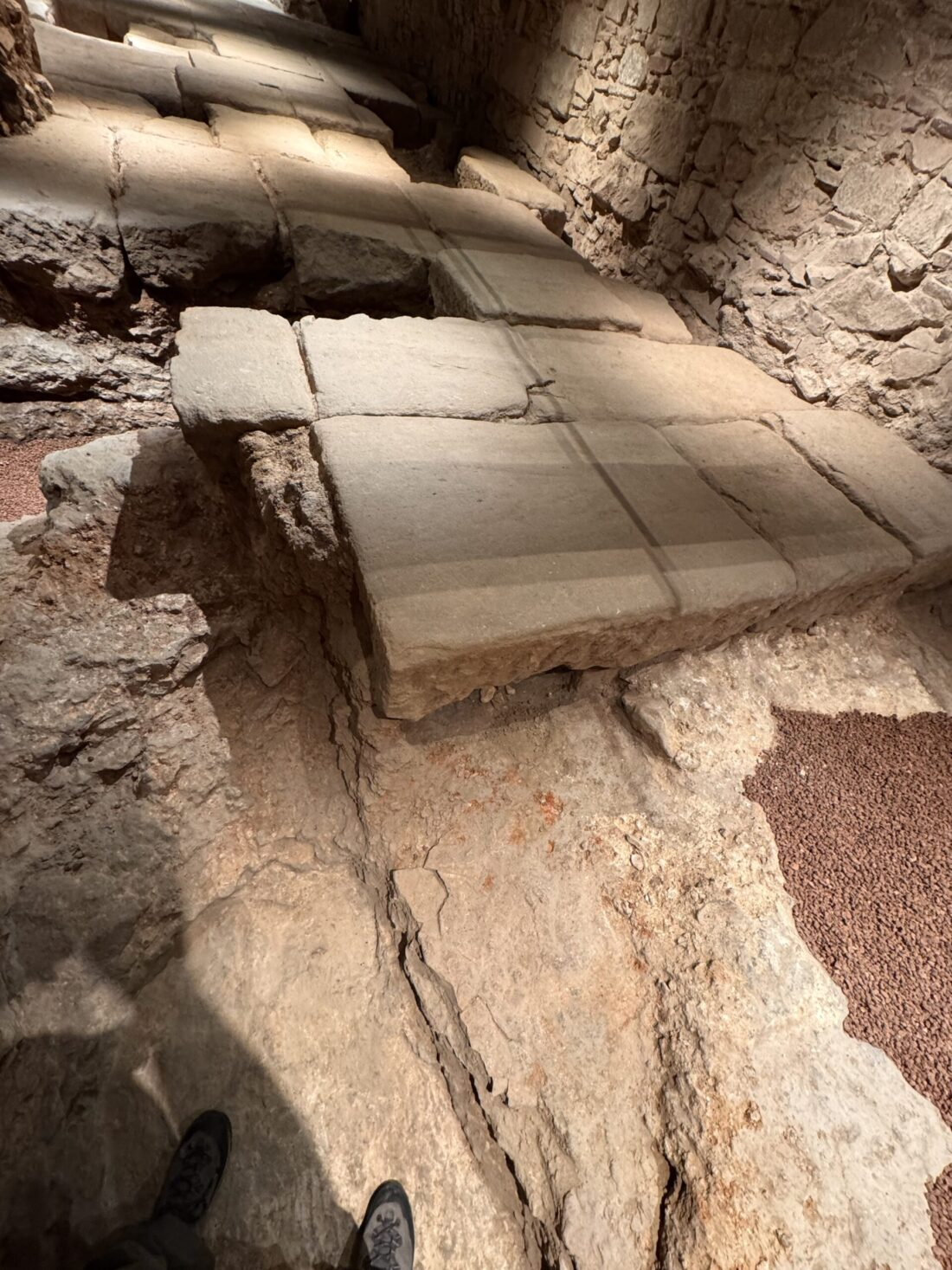
Roman pavement discovered beneath the Gran Hotel Barcino.
Beyond the Pavement: A Complex Urban Landscape
The excavation beneath Gran Hotel Barcino uncovered far more than the monumental pavement. Archaeologists also discovered a substantial structure made from Roman concrete, along with two square wells that extend more than 2.6 meters deep.
These wells were connected by a siphon system—a hydraulic mechanism used by Roman engineers to control and regulate water flow between reservoirs. The presence of this infrastructure suggests the area may once have been part of a sophisticated water management system, possibly linked to a fountain or decorative feature within the forum of Barcino.
During the excavation, researchers also recovered more than 150 fragments of imported marble. The stone originated from quarries across the Mediterranean, including Carrara, several regions of Greece, the Aegean Islands, Anatolia, and Egypt. These materials indicate that the forum area was once decorated with high-quality architectural elements, reflecting the importance and prosperity of the city during the Roman period.
Layers of History
The site also preserves evidence from later centuries. Archaeologists identified signs of the forum’s decline during the early 5th century AD, a period when the civic functions of the plaza began to disappear amid the political upheavals that marked the final centuries of the Late Roman Empire.
Subsequent layers reveal how the area was reused over time. Researchers documented remains of domestic buildings from late antiquity, medieval alterations to the site, and even a grain storage silo dating to the Gothic period.
Preserving the Past in a Modern City
Rather than removing the remains, the owners of the Gran Hotel Barcino modified their construction plans to preserve the archaeological discoveries.
The ancient pavement and associated structures have now been stabilized and incorporated into the building’s underground level. The remains will stay in their original position and can be viewed within the hotel’s facilities.
Although access will mainly be limited to hotel guests, city officials in Barcelona have indicated that guided visits may occasionally be organized in cooperation with local archaeological authorities, allowing the public to see this important piece of the city’s Roman past.
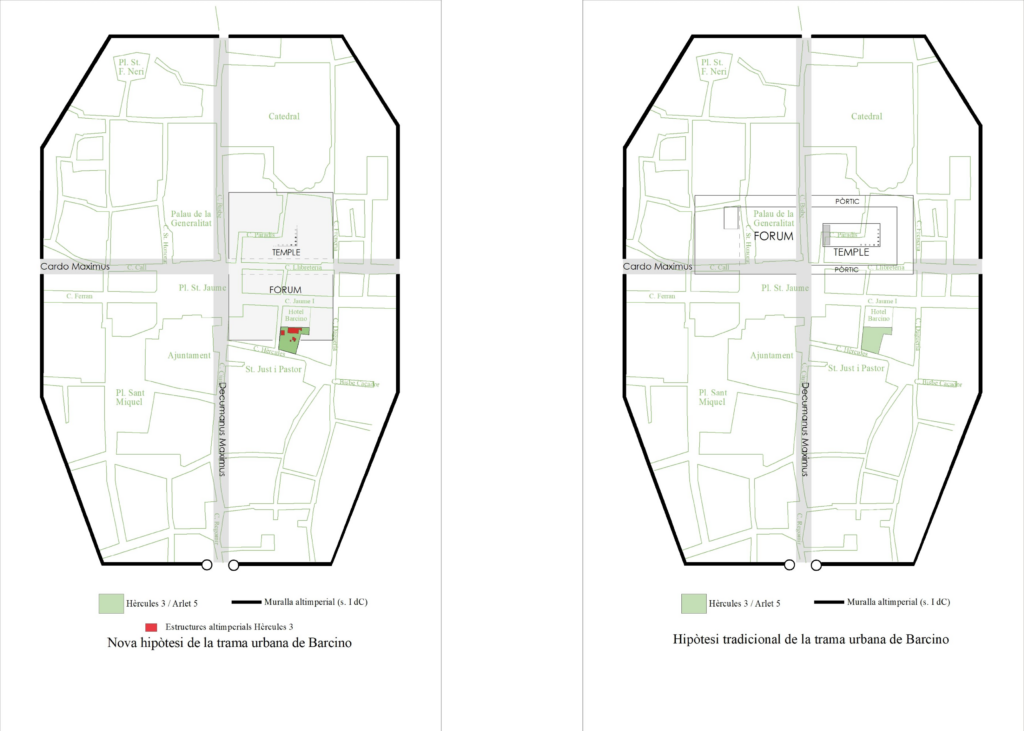
Left: New hypothesis of the forum of Barcino. Right: Traditional hypothesis of the forum of Barcino.
A New Chapter for the Origins of Barcelona
The discovery beneath Gran Hotel Barcino highlights the importance of preventive archaeology in cities with long and layered histories. In historic urban centers like Barcelona, construction projects often reveal buried remains that help scholars better understand the city’s ancient past.
Barcelona’s Roman origins trace back to the colony of Iulia Augusta Faventia Paterna Barcino, established during the reign of Augustus more than two thousand years ago. The settlement was built on Mons Taber, a small hill close to the Mediterranean coast. At the heart of this Roman colony stood the forum, which functioned as the central space for political gatherings, commerce, and religious activities.
Until recently, the most visible surviving structure from this ancient plaza was the Temple of Augustus. Four tall columns from the temple still stand today, hidden inside a courtyard in the city’s historic center.
The newly discovered pavement now provides the first clear physical evidence of the forum’s original ground surface. Its orientation may also reveal that the forum was laid out differently than historians previously believed.
For archaeologists, the find represents an important breakthrough—one that could literally reshape the map of Roman Barcelona and deepen our understanding of how the city developed during the early Roman period.