The First Americans: Uncovering the Coastal Origins of the New World
For decades, textbooks and documentaries have told the same story: the first humans arrived in the Americas by crossing a frozen land bridge in the north. But growing evidence is rewriting that narrative, revealing a journey not across ice, but along the sea.
This is the story of the Kelp Highway, a thriving coastal corridor that may have carried humans from Asia to the Americas long before inland routes were even passable.
A Route Fueled by the Sea
Imagine a coastline rich with life: kelp forests swaying beneath the waves, schools of fish darting through tidal pools, shellfish clinging to rocky outcrops, seabirds circling overhead, and marine mammals gliding along the currents. For early humans, these coastal ecosystems provided food, shelter, and a navigable route spanning thousands of miles.
Archaeologists now believe that these seafaring pioneers relied on sophisticated maritime skills, using boats, fishing tools, and knowledge of tides and currents to sustain themselves. Rather than trudging through inland ice and snow, they moved quietly along the edge of the continent, following the rhythms of the ocean.
Evidence Beneath the Waves
Rising sea levels since the last Ice Age have swallowed much of this early history, leaving many ancient coastal campsites hidden beneath the ocean. But modern science is uncovering remarkable evidence:
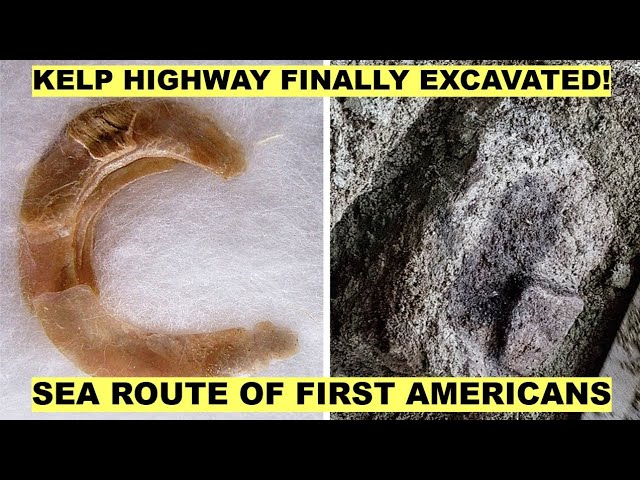
Cedros Island, Mexico: Fishhooks, tools, and midden deposits showing advanced maritime practices.
Submerged landscapes off Oregon and California: Evidence of deep-water fishing and resource exploitation.
British Columbia: Ancient footprints preserved in mudflats and tidal zones, capturing moments of daily life more than 11,500 years ago.
From hooks used to catch fish to tools designed for processing agave into nets and lines, the first Americans were not just hunters—they were engineers, innovators, and maritime explorers.
A Maritime Culture, Long Overlooked
For centuries, inland migration theories dominated our understanding of human colonization in the Americas. But the Kelp Highway hypothesis shines a light on a coastal-first strategy, emphasizing adaptation, ingenuity, and environmental knowledge. These early seafarers were capable of navigating complex shorelines, exploiting a wide variety of marine resources, and thriving in a changing climate long before the first inland settlements.
Their story reminds us that history is not fixed—it evolves with each new discovery. And in this case, the first Americans were not just travelers of land; they were masters of the water’s edge, whose remarkable journeys have remained hidden beneath the waves for thousands of years.
🎥 Watch the video below to explore the first Americans’ maritime route and uncover the submerged history of the New World: