New Findings Expose Göbekli Tepe’s Biggest Secret — A Hidden Method That Shouldn’t Exist
More than 12,000 years ago — long before agriculture, long before metal tools, long before cities — something extraordinary was built on a hilltop in what is now modern-day Turkey.
It’s called Göbekli Tepe.
And it continues to challenge everything we think we know about early human civilization.
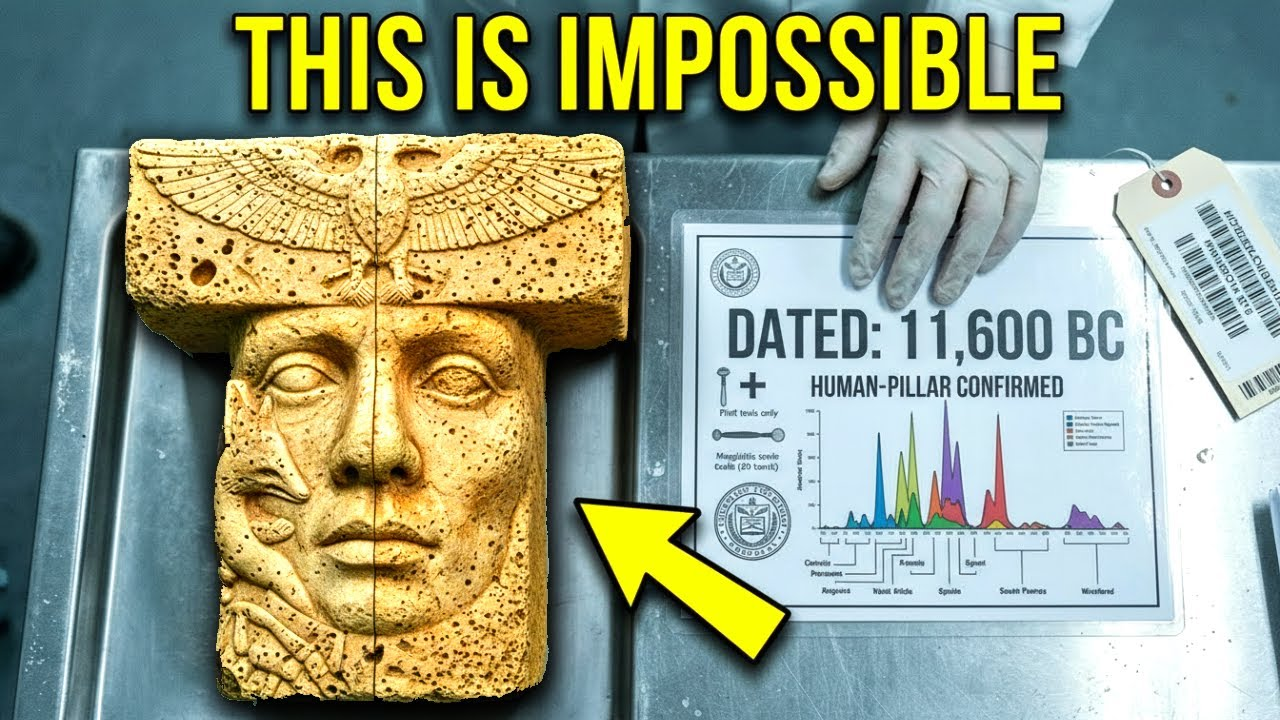
Discovered in the 20th century and excavated beginning in the 1990s, Göbekli Tepe predates Stonehenge by thousands of years. Its massive T-shaped limestone pillars — some weighing up to 20 tons — were quarried, carved, transported, and arranged in carefully designed circular enclosures by people we still label as “hunter-gatherers.”
That alone rewrote history.
But new findings are raising even bigger questions.
A Level of Planning That Feels Impossible
Recent chemical analyses of the stone, studies of unfinished monoliths in nearby quarries, and increasingly precise mapping of the site suggest something unsettling:
This wasn’t random ritual architecture.
It was meticulously planned.
The enclosures appear to follow intentional geometric layouts. Pillars align in ways that hint at advanced spatial understanding. Animal carvings — foxes, vultures, snakes, boars — aren’t scattered decoration. They may follow symbolic patterns or narrative sequencing.
For a society that supposedly had no permanent settlements, no farming base, and no metal tools, the scale of coordination required is staggering.
Who organized the labor?
How were 20-ton pillars moved without wheels or draft animals?
And how was such precision achieved using only stone tools?
Modern engineers can replicate parts of the process — but only with careful planning and large coordinated teams. The idea that small, nomadic bands accomplished this 12,000 years ago forces us to rethink what “primitive” really means.
The Deliberate Burial
Then there’s the most mysterious detail of all.
Göbekli Tepe wasn’t destroyed by invaders.
It wasn’t abandoned and left to decay.
It was deliberately buried.
The enclosures were carefully filled in with rubble and sediment, sealing the pillars underground for millennia. This act preserved the carvings in astonishing condition — but it also raises a haunting question:
Why build something monumental… only to hide it?
Was it ritual closure? Cultural transition? A symbolic ending? Or something else entirely?
Rethinking Early Civilization
For decades, the dominant narrative of human history was simple:
First came agriculture.
Then permanent settlements.
Then religion and monumental architecture.
Göbekli Tepe flips that sequence.
It suggests that large-scale ritual gatherings may have come first — and that the need to support those gatherings may have encouraged the development of agriculture.
If that’s true, then our origin story as a species is fundamentally different from what we were taught.
Religion before farming.
Monuments before villages.
Complex symbolic systems before cities.
That isn’t just surprising.
It’s revolutionary.
A Missing Chapter of Human History?
With every new excavation season, fresh anomalies appear — subtle differences in material composition, unexplained construction techniques, patterns in the layout that hint at knowledge we don’t fully understand.
None of this requires supernatural explanations.
But it does require humility.
Göbekli Tepe forces us to confront a simple possibility: our ancestors may have been far more socially and intellectually sophisticated than we ever gave them credit for.
And there may still be entire chapters of early human history waiting beneath the soil.
🎥 Watch the video below to explore Göbekli Tepe’s biggest secret, the hidden construction methods, and the discoveries that are reshaping our understanding of early civilization: