Introduction
Roman building materials often preserve evidence that is absent from more elaborate monuments. Roof tiles, floor tiles, bricks, and other ceramic products sometimes carry stamps identifying workshops, producers, military units, estates, or administrative authorities. These markings can help archaeologists reconstruct production systems, construction networks, and the movement of materials across the Roman world.
The idea of forgotten Roman tile stamps in a barn in the Peloponnese provides an opportunity to examine the relationship between rural architecture and ancient industrial activity. The Peloponnese contains extensive evidence of Roman occupation, including settlements, villas, roads, agricultural installations, and public buildings. However, a particular barn containing Roman stamped tiles should not be treated as a documented find without excavation records or reliable provenance.
Roman tile production in the Peloponnese
Roman construction relied heavily on fired clay products. Tiles protected roofs from rain, bricks formed walls and foundations, and specialized ceramic components were used in heating systems, drains, and water installations.
The Peloponnese had access to clay deposits, fuel sources, agricultural labor, and established settlements that could support local production. Some workshops supplied nearby communities, while larger production centers could serve wider regional markets.
The Roman period in Greece did not produce a single uniform building tradition. Local construction practices continued alongside Roman architectural techniques, and the combination varied according to wealth, location, and available materials.
Understanding Roman tile stamps
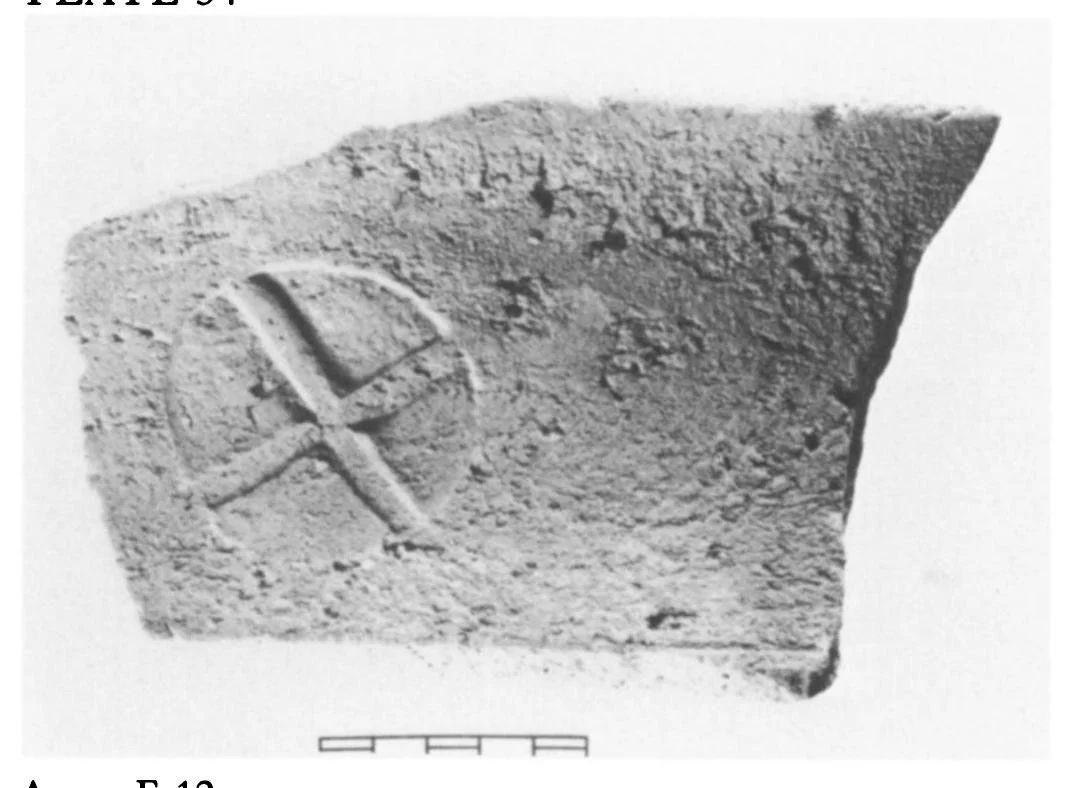
A tile stamp is a mark impressed or applied to a ceramic object before firing. It may contain letters, abbreviations, symbols, or combinations of these elements.
Some stamps identify a workshop or individual producer. Others may refer to an estate, property owner, official, or institution responsible for production or distribution.
Military tile stamps are particularly useful in regions where Roman troops were involved in construction. However, a stamp bearing a military name does not automatically prove that the tile was manufactured at a nearby military installation. Materials could be transported, reused, or distributed through administrative networks.
The interpretation of a stamp depends on its lettering, archaeological context, parallels, and date.
Why a barn might contain Roman tiles
Rural buildings frequently incorporate reused construction materials. Stone blocks, roof tiles, bricks, and columns can be salvaged from abandoned structures and adapted for later agricultural use.
A barn in the Peloponnese might therefore contain Roman tiles because they were collected from a nearby ruin, reused in a roof or wall, or stored as building material. Their presence would not necessarily indicate that the barn itself dates to Roman times.
An especially important distinction is between a primary archaeological deposit and secondary reuse. Tiles discovered in their original roof collapse can help reconstruct a Roman building. Tiles placed in a later barn may preserve useful information about Roman production, but their original context has been disturbed.
What stamps can reveal about production
When interpreted carefully, tile stamps can contribute to the study of ancient economic organization.
A repeated workshop stamp may indicate standardized production or an established manufacturing operation. Variations in lettering could help researchers distinguish production batches, workshop phases, or different officials.
The distribution of stamped tiles across multiple sites may reveal trade and transport patterns. If similar marks occur in several settlements, archaeologists can investigate whether those communities obtained materials from the same production center.
Nevertheless, identical stamps do not always mean that tiles were produced in the same location. Stamps can be copied, reused, or associated with broader administrative systems.
Dating and identifying the tiles
Dating Roman tiles requires more than reading a stamp. Lettering styles can provide clues, but many inscriptions are difficult to date precisely and may have remained in use over extended periods.
Archaeologists compare stamps with securely dated examples from excavated sites. They also examine clay composition, firing characteristics, tile dimensions, and manufacturing marks.
The surrounding archaeological context is essential. A tile recovered from a sealed Roman construction layer is more informative than one found loose in a modern agricultural building.
Scientific methods such as petrographic analysis can help identify the mineral composition of the clay. Chemical analysis may provide additional evidence for grouping tiles from similar production sources, although results must be interpreted alongside geological reference samples.
Reconstructing a rural Roman building
Stamped tiles can help researchers reconstruct the original structures from which they came. Roof tiles may indicate roofing systems, while bricks and other ceramic components can reveal wall construction or heating arrangements.
If several fragments preserve matching dimensions, profiles, or manufacturing marks, archaeologists may be able to estimate the original arrangement of the roof or building.
A concentration of tiles near a Roman villa or agricultural installation could indicate a roofed storage building, workshop, or residential structure. Yet the function of a building cannot be established from tiles alone. Foundations, drainage features, tools, storage vessels, and environmental evidence are also necessary.
Reuse and the long life of Roman materials
One reason Roman tiles survive in rural landscapes is their durability. Fired clay can remain recognizable long after the buildings that contained it have disappeared.
Later communities often reused ancient materials because they were readily available and required less effort than producing new construction components. This practice can create complex archaeological deposits in which objects from different periods appear together.
A barn containing Roman tiles might therefore preserve a history of several construction phases: an ancient building, its abandonment, the recovery of materials, and their later incorporation into agricultural architecture.
Conservation and documentation
If stamped tiles are discovered in a barn, their location should be recorded before they are moved. Photographs should show the stamp, the tile's dimensions, its condition, and the surrounding architectural context.
Loose fragments should be stored in a stable environment and protected from unnecessary cleaning or abrasion. Aggressive cleaning can damage shallow impressions and surface traces that may be important for identification.
The discovery should be reported to the appropriate Greek archaeological authorities. Unauthorized removal or sale of archaeological material can create legal and ethical problems, while proper documentation helps preserve its historical value.
Conclusion
Roman tile stamps offer a valuable source of information about manufacturing, construction, labor, and regional exchange in the Peloponnese. Even fragments reused in later barns can preserve evidence of ancient production systems.
The key to interpreting such finds is understanding their context. A stamped tile can identify a workshop or production network, but its presence in a later building does not establish where it was originally used. Careful recording, comparative analysis, and archaeological supervision are essential for turning an intriguing rural discovery into reliable historical evidence.