Introduction
Simple measuring instruments played an important role in ancient construction, navigation, craft production, and everyday practical work. Among the oldest and most widely used tools is the plumb line: a cord or string carrying a small weight that hangs vertically under gravity. Although its design is uncomplicated, the instrument allows builders and craftspeople to establish vertical alignment with considerable accuracy.
The possibility of discovering ancient Cycladic plumb lines in a storeroom on Kimolos raises interesting questions about technology and everyday life in the prehistoric Aegean. Kimolos is one of the Cycladic islands, a region known for its distinctive Bronze Age material culture, maritime connections, and stone-working traditions. However, a particular collection of ancient plumb lines in a Kimolos storeroom should be treated as hypothetical unless supported by archaeological documentation.
Kimolos and the Cycladic archaeological landscape
Kimolos belongs to the western Cyclades, an island group situated in the central Aegean Sea. Its geological environment includes volcanic formations and mineral resources, while its coastal geography connects it with neighboring islands such as Milos.
The Cyclades were important during the Bronze Age because of their maritime position and access to materials such as obsidian, metals, and stone. Communities maintained connections through exchange, craft production, and movement across the Aegean.
Cycladic archaeology is especially recognized for marble figurines, pottery, settlements, burial practices, and evidence of maritime exchange. These remains provide a broader context for investigating the practical technologies that supported construction and production.
Understanding the ancient plumb line
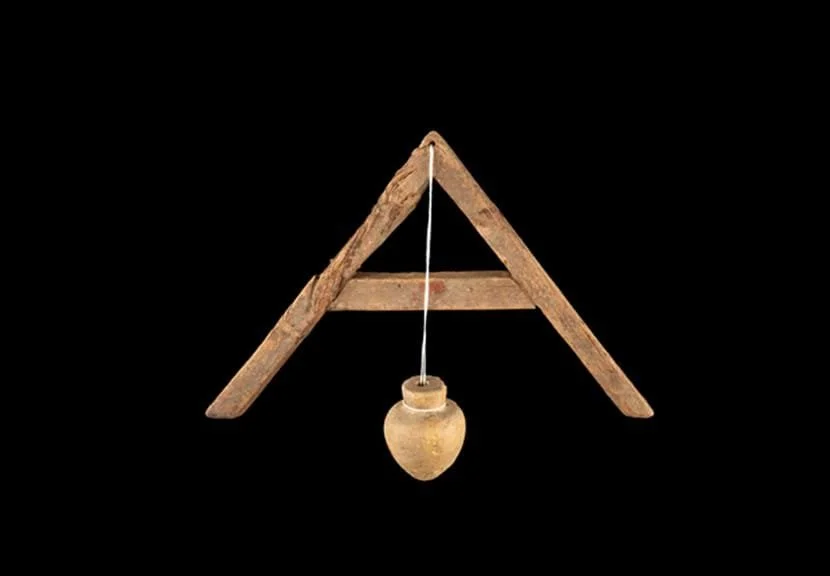
A traditional plumb line consists of three basic elements: a cord, a weighted object, and a point from which the cord can hang freely.
Gravity pulls the weight downward, causing the cord to settle along a vertical line. Builders can use this alignment to check walls, posts, columns, and other upright structures.
The weighted component may be made from stone, metal, ceramic, or another dense material. Its shape can vary, but it must be heavy enough to keep the cord taut and stable.
A small stone or metal object with a hole near one end might appear suitable for use as a plumb weight. Yet the presence of a perforation does not establish this function. The object could also have served as a pendant, spindle whorl, fishing weight, or component of another tool.
Possible materials and manufacturing techniques
The materials available to ancient Cycladic communities could support the manufacture of simple measuring tools.
Stone weights could be shaped by grinding, pecking, or polishing. Metal examples could be cast or hammered into suitable forms, depending on the period and the available technology.
A perforation might be drilled or formed during manufacture. Researchers would examine the hole's shape, wear, symmetry, and relationship to the object's overall design.
The cord itself would be less likely to survive than the weight. Organic fibers can deteriorate in many archaeological environments, leaving only the durable component behind.
Consequently, an object interpreted as a plumb weight may preserve only part of the original instrument.
The role of measuring tools in Cycladic construction
Ancient communities needed practical methods for constructing stable buildings, organizing spaces, and aligning structural elements. Even relatively simple structures benefit from reliable vertical and horizontal measurements.
A plumb line could help builders position upright posts, check wall faces, and maintain vertical alignment during construction. It might also have been useful in stone-working or the installation of architectural elements.
However, identifying a specific measuring technique in prehistoric Cycladic architecture requires evidence. The existence of well-built structures does not automatically establish which tools were used or whether they followed a standardized system.
Archaeologists can investigate possible construction practices through tool marks, building dimensions, repeated architectural arrangements, and comparisons with other ancient technologies.
Why a storeroom deposit would be significant
A storeroom can preserve evidence of how objects were collected, organized, maintained, and used. If several possible plumb weights were discovered together, their grouping might suggest that they belonged to a workshop, construction activity, or household collection.
Yet the location alone would not establish their function. A storeroom could contain objects accumulated over several generations, including items that had been repaired, reused, or transferred from other buildings.
Researchers would need to establish whether the objects were deposited together during a single event or collected gradually. Differences in material, wear, and manufacturing technique could indicate that they came from different periods or activities.
The surrounding pottery, tools, architectural remains, and organic materials would help reconstruct the deposit's history.
Distinguishing plumb weights from other objects
One of the main challenges would be distinguishing a plumb weight from other perforated or weighted objects.
A spindle whorl, for example, also requires a central hole, but its shape and mass distribution are suited to spinning fiber. A fishing weight may have a groove or perforation for attachment to a line. A pendant may have decorative features and evidence of suspension.
A possible plumb weight would need to be evaluated through its balance, shape, suspension point, and practical performance.
Experimental archaeology could help. Researchers might create replicas and test whether they hang steadily and provide a useful vertical reference. Such experiments would not prove the original function, but they could establish whether the proposed interpretation is mechanically plausible.
Archaeological and scientific examination
The first step in investigating a supposed collection would be careful documentation of the storeroom and its contents. Each object should be photographed, measured, mapped, and recorded before cleaning or removal.
Microscopic analysis could identify manufacturing marks and patterns of wear around suspension holes. Material analysis could determine whether the weights were made from local stone, imported material, or metal alloys.
If the deposit included organic remains, radiocarbon dating might help establish its chronology. Ceramic objects found in the same undisturbed layer could provide additional dating evidence.
The interpretation should also consider the possibility of later reuse. An ancient-looking stone weight could have been used for a much more recent purpose, especially in a storeroom with a long history of occupation.
The wider significance of simple ancient technology
Plumb lines illustrate how practical knowledge can exist without complicated machinery. Their operation depends on a basic physical principle, but their effective use requires experience and an understanding of measurement.
Studying such tools helps archaeologists move beyond monumental architecture and examine the everyday work that made construction possible.
A securely identified Cycladic example could contribute to discussions about building practices, technical knowledge, and the circulation of practical objects across island communities. Comparisons with other Aegean and Mediterranean examples might reveal similarities in design and function.
It would also remind researchers that small, unassuming artifacts can provide valuable information when their archaeological context is preserved.
Conservation and responsible documentation
If suspected ancient plumb weights were found in a storeroom, they should not be polished, drilled, or subjected to informal testing. Cleaning may remove residues, while physical experiments could damage fragile surfaces.
The objects should be handled carefully and reported to the appropriate Greek archaeological authorities. Their location, condition, and association with other materials should be recorded.
Conservation specialists can determine suitable storage conditions according to the material. Stone and metal objects may require different treatments, particularly if metal corrosion or salt contamination is present.
Proper documentation protects both the objects and the historical information that accompanies them.
Conclusion
Plumb lines demonstrate the practical importance of simple measuring instruments in ancient societies. In the Cyclades, where maritime activity, stone-working, and settlement construction shaped everyday life, possible measuring tools could provide valuable evidence of technical knowledge.
A collection discovered in a Kimolos storeroom would be especially interesting if its objects could be securely dated and identified through archaeological context, manufacturing analysis, and functional testing. Until such evidence is available, the proposed Cycladic plumb lines should remain a research possibility rather than a confirmed discovery.
The broader lesson is that even a small weighted object can reveal important details about how ancient communities measured, built, worked, and organized their surroundings.