Introduction
The Minoan civilization of Bronze Age Crete is known for its palatial architecture, maritime connections, craft production, and sophisticated systems of storage and administration. Archaeological discoveries at Malia, one of the major Minoan palace centers, have contributed substantially to the understanding of these societies.
An unusual proposed discovery of "Minoan oil-pump parts" in a rubble pit raises an important archaeological question: what kinds of equipment were used to extract, transfer, and store liquids in Bronze Age Crete? The phrase oil pump, however, should be treated cautiously. Modern mechanical pumps are not an appropriate default model for interpreting ancient ceramic, wooden, or stone components. No specific Malia rubble-pit assemblage should be considered confirmed without published archaeological documentation.
Malia as a Minoan center
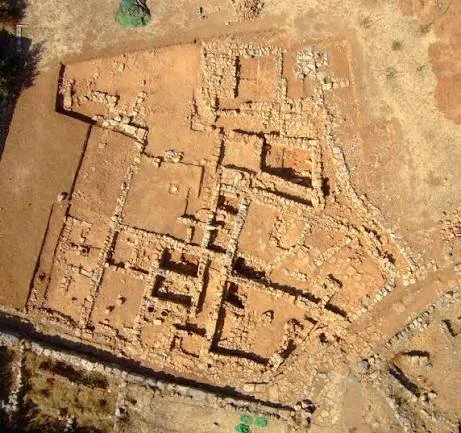
Malia is located on the northern coast of Crete and was one of the major centers of Minoan civilization. Its palace complex, surrounding settlement, workshops, and burial areas provide evidence of organized production and social activity.
The site developed over several phases during the Bronze Age. Like other Minoan centers, it experienced architectural changes, destruction, rebuilding, and shifts in the organization of settlement.
These phases are important because objects recovered from rubble may belong to different periods. A fragment in a destruction deposit could be contemporary with the building's final use, but material in later fill might have been moved from an earlier structure.
Olive oil in Minoan society
Olive cultivation and oil production were important parts of the ancient Mediterranean economy. Olive oil could be used for cooking, lighting, bodily care, religious offerings, and trade.
Minoan storage vessels and administrative records demonstrate the importance of agricultural products, although the exact scale and organization of production varied across time and place.
The presence of large storage jars does not, by itself, prove that oil was produced inside the building where they were found. Containers could have held several types of commodities, and residues or associated evidence are needed to identify their original contents.
How ancient olive oil was extracted
Olive oil production generally involved several stages: harvesting, crushing or grinding the fruit, separating liquid from solid material, and collecting the oil.
Ancient systems relied on mechanical pressure and gravity rather than modern powered pumps. Crushing equipment could include stone installations, while pressing arrangements used weights, beams, baskets, or other mechanisms depending on the period and region.
The precise equipment used at a particular Minoan site must be established through archaeological evidence. Later Greek and Roman presses should not automatically be projected backward onto Bronze Age Crete.
A component described as a pump part might instead belong to a pressing installation, a vessel, a drainage system, or another type of mechanical device.
The problem with the term "oil pump"
A pump is a device that moves liquid by creating a pressure difference or using a mechanical lifting system. To identify an ancient object as part of a pump, researchers would need evidence of its mechanical function.
Possible clues might include a piston-like component, a fitted cylinder, a valve arrangement, or repeated wear associated with movement. However, such features would have to be interpreted in relation to the object's material and archaeological context.
A hollow ceramic tube, for example, could be part of a drain, conduit, or vessel system rather than a pump. A wooden fragment might have belonged to a press or lifting mechanism, but its function cannot be determined from shape alone.
For this reason, "liquid-handling equipment" or "possible olive-processing components" may be more appropriate descriptions until the evidence is conclusive.
Understanding a rubble pit at Malia
A rubble pit is a secondary deposit unless evidence shows otherwise. It may contain construction debris, discarded household objects, broken pottery, or material collected during building renovations.
The contents of a pit can therefore combine objects from different activities and periods. A Minoan component recovered from rubble may have originated in a nearby workshop or building but been discarded later.
Archaeologists examine the pit's stratigraphy, sediment composition, and relationship to surrounding structures. They also record whether objects are complete, fragmented, burnt, weathered, or deliberately arranged.
These observations help distinguish construction waste from domestic refuse, industrial debris, and later fill.
Scientific approaches to identifying oil-processing equipment
Residue analysis can help determine whether a vessel or surface was exposed to olive products. Organic residue studies may identify lipid compounds that survive in pottery or other materials.
Such results must be interpreted carefully because fats and oils can degrade, mix, or become contaminated. The identification of plant-derived oils may also require comparison with other possible substances.
Microscopic examination can reveal wear patterns, while experimental archaeology can test whether a proposed component would function as part of a pressing or liquid-transfer mechanism.
Researchers may reconstruct a model using replicas of the suspected components, but experimental success does not automatically prove that the original object was used in the same way.
Connecting equipment with Minoan production
If genuine olive-processing equipment were identified at Malia, it could help clarify how agricultural production was organized around the palace and settlement.
A large installation might indicate processing beyond the needs of a single household. Smaller equipment could point to local domestic production or specialized activity.
The relationship between production and storage is especially important. Processing equipment, storage vessels, access routes, and drainage systems can collectively reveal how commodities moved through a building.
Administrative evidence from Minoan Crete also provides a broader context for understanding agricultural resources. However, written records and archaeological installations must be compared carefully rather than assumed to describe the same operation.
Why the discovery would matter
An unusual mechanical component could expand understanding of Minoan engineering and the practical technology of Bronze Age Crete. It could also encourage researchers to reconsider objects previously classified as ordinary architectural or household fragments.
The most important contribution would not necessarily be proof of a sophisticated pump. It might instead reveal a specialized arrangement for handling, pressing, or transferring agricultural liquids.
Such a discovery would be valuable precisely because it could refine existing interpretations of Minoan production technology.
Conclusion
Malia provides a rich archaeological setting for studying Minoan agriculture, craft production, and technological practice. Olive oil was an important commodity in the ancient Mediterranean, but the identification of particular mechanical components requires strong evidence.
The expression "Minoan oil-pump parts" should therefore remain provisional until the objects' construction, wear, residues, and archaeological context are examined. A careful investigation could determine whether they belonged to an olive-processing installation, a liquid-transfer system, or an entirely different form of equipment.