Introduction
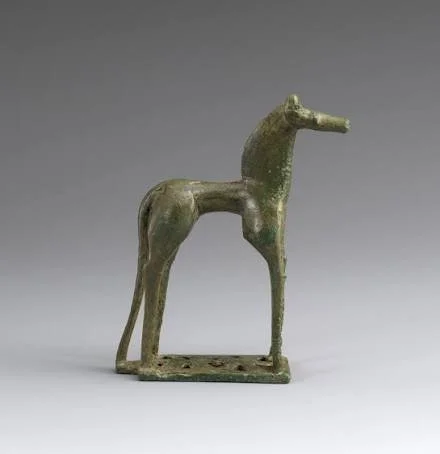
Small clay animals from ancient Greece offer a glimpse into childhood, domestic life, craftsmanship, and religious symbolism. Among the most recognizable are miniature horses, which could have served as toys, offerings, decorative objects, or representations of animals familiar to everyday life. During the Geometric period, approximately 900–700 BCE, horse imagery became particularly prominent in Greek art, appearing on pottery, bronze objects, and other forms of material culture.
The idea of hidden Geometric toy horses inside a ceiling in Messenia is intriguing, but it should be treated as a hypothetical archaeological scenario rather than a documented discovery. Messenia, in the southwestern Peloponnese, has a long history of settlement, and its archaeological landscape includes evidence from prehistoric communities through the Classical and later periods. A supposed ceiling deposit of miniature horses would require careful examination to establish its date, original function, and relationship to the building.
Messenia during the Geometric period
The Geometric period followed the collapse of the Mycenaean palace systems and preceded the emergence of the Greek city-states in their later forms. Communities reorganized their settlements, burial practices, production activities, and social structures.
In Messenia, the period is important for understanding the development of local communities after the Mycenaean world. Archaeological evidence from the wider region can help researchers examine settlement continuity, agricultural activity, burial customs, and connections with other parts of the Peloponnese.
The horse was a meaningful animal in early Greek society. It could represent wealth, status, military capability, and elite identity. Although horses were not equally accessible to all households, their images circulated through artistic and ritual traditions.
Miniature horses in ancient Greek material culture
Small horse figurines were produced in several materials, including clay and bronze. Their size and construction varied, from simplified figures with minimal anatomical detail to more carefully modeled animals.
A clay miniature might have been made by hand, formed from a small lump of clay, or assembled from separate body and leg components. Some figures were decorated with incised lines or painted geometric patterns.
The term "toy horse" requires caution. A miniature horse could have been used by a child, but its small size alone does not establish that function. It might instead have been a votive offering, a grave good, or a symbolic object.
Archaeologists therefore examine wear, breakage, manufacturing quality, find context, and comparison with other objects before assigning a likely purpose.
Why a ceiling deposit would be unusual
A ceiling is not a conventional archaeological context for ancient figurines. Objects can become trapped in roof spaces when buildings collapse, when roof materials are replaced, or when later occupants reuse an abandoned structure.
A miniature horse found in a ceiling could have entered the deposit in several ways. It might have been placed deliberately in a roof cavity, fallen from an upper floor, become trapped during construction, or been incorporated into later building material.
The distinction matters because the date of an object and the date of the building containing it may be very different. A Geometric figurine could be redeposited in a much later structure.
Possible meanings of miniature horses
If a group of Geometric horse figurines were identified in a domestic setting, several interpretations would deserve consideration.
A play-related interpretation would become more convincing if the objects showed repeated handling, simplified forms, or evidence of modification consistent with children's use. A ritual interpretation might be considered if the figurines appeared alongside other offerings or in a location associated with household religious practice.
The horse also had a wider symbolic role. In Greek visual culture, it could communicate social prestige and connections to aristocratic life. A miniature representation might therefore have expressed aspirations or identity even when it was not intended as a literal toy.
Archaeological methods for examining the objects
The first step would be to document the exact location and construction of the ceiling deposit. Researchers would need to determine whether the objects were embedded in original roofing material or introduced during later repairs.
Ceramic analysis could establish the clay composition, firing conditions, and manufacturing technique. Petrographic examination might help identify the geological origin of the clay, although a local source would not automatically prove local manufacture.
Stylistic comparison with securely dated Geometric figurines would help establish a probable date. However, decoration alone is not sufficient. Archaeologists would also need to consider stratigraphy and associated finds.
Residue analysis could occasionally reveal traces of substances that contacted an object, while microscopic examination might identify abrasion or surface modification. These methods would help assess use without assuming that every miniature animal was a child's possession.
The importance of building archaeology
A ceiling deposit cannot be understood separately from the building in which it occurs. Researchers would need to study roof construction, timber supports, plaster layers, repair phases, and the relationship between the ceiling and the walls.
If the structure had undergone several renovations, the objects might belong to a later phase than their archaeological appearance initially suggests. Reused clay, stone, and timber materials are common sources of chronological confusion.
Building archaeology is particularly important in long-lived settlements, where ancient objects can be incorporated into later domestic architecture.
What would establish a genuine discovery?
A credible report would include the excavation location, stratigraphic records, photographs, measurements, material descriptions, and evidence supporting the proposed date. It would also explain why the figurines are interpreted as toys rather than votive objects or decorative pieces.
Without this documentation, the phrase "hidden Geometric toy horses in a Messenia ceiling" should remain an evocative research subject, not a confirmed archaeological event.
Conclusion
Miniature horses offer valuable evidence for studying ancient Greek childhood, artistic traditions, household practices, and the symbolic importance of horses. In Geometric-period Messenia, such objects could contribute to a broader understanding of communities during a period of social transformation.
A ceiling deposit would be especially interesting because it raises questions about building history, object reuse, and the movement of artifacts between generations. Its interpretation, however, would depend on secure archaeological documentation rather than the appearance or age of the figurines alone.