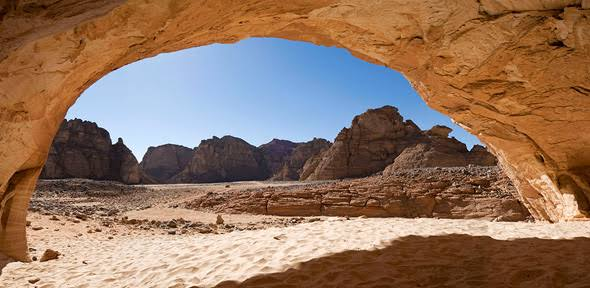
The Gilf Kebir is a vast plateau in southwestern Egypt, near the Libyan border, whose cliffs and valleys preserve some of the most spectacular prehistoric rock art in the Sahara.
The region became internationally famous after the discovery and popularization of the “Cave of Swimmers,” whose paintings appear to depict human figures in positions that resemble swimming.
The cave's imagery has inspired enormous public fascination, particularly because the surrounding landscape is now one of the driest places on Earth.
The paintings provide compelling evidence that the region once supported human communities under dramatically wetter environmental conditions.
The Discovery of the Cave
The Cave of Swimmers became famous after being documented by explorers in the early twentieth century, particularly through the work of Hungarian explorer László Almásy.
The cave later became widely known through popular literature and film, especially after appearing in discussions surrounding The English Patient.
However, the archaeological importance of the site goes far beyond its cinematic reputation.
The Meaning of the Figures
The most famous paintings depict small human forms whose arms and legs appear extended.
Because their bodies resemble swimming positions, they became known as “swimmers.”
However, archaeologists cannot prove that the artists intended to depict people swimming.
Alternative interpretations have suggested:
floating;
dancing;
ritual postures;
or symbolic representations of the dead.
The true meaning remains uncertain.
A Once-Wetter Sahara
The surrounding desert provides the most important context.
During earlier climatic periods, the region received significantly more rainfall.
Seasonal water sources supported:
vegetation;
wildlife;
and human settlement.
The existence of people in the Gilf Kebir therefore reflects a dramatically different environment.
Rock Art as Environmental Evidence
Artists depicted animals and humans on the cave walls.
These images may include species associated with wetter environments.
The presence of such animals provides indirect evidence for the former ecology of the Sahara.
Rock art therefore functions as a kind of environmental archive.
How Prehistoric Artists Made the Paintings
The artists used mineral pigments and other naturally available materials.
Common prehistoric pigments included:
red ochre;
yellow ochre;
white mineral pigments;
and dark charcoal-like substances.
Pigments could be:
brushed;
rubbed;
blown;
or applied directly with fingers.
The persistence of these materials for thousands of years demonstrates the remarkable stability of the dry cave environment.
The Human Figures
The human representations at Gilf Kebir vary in style.
Some figures appear elongated or highly simplified.
Others are more naturalistic.
This variation suggests that artists were not necessarily attempting photographic realism.
Instead, they may have been communicating:
identity;
movement;
ritual;
or symbolic meaning.
The “Swimmers” and Death
One particularly interesting interpretation connects the figures with ritual or funerary ideas.
Some researchers have suggested that the unusual body positions might represent people undergoing a transformation or traveling into another realm.
This cannot be proven.
Nevertheless, the possibility highlights a major problem in prehistoric art interpretation: images may have meanings that are impossible to recover completely without written explanations.
The Gilf Kebir as a Cultural Landscape
The Cave of Swimmers is only one part of a much larger archaeological region.
The Gilf Kebir contains numerous:
rock shelters;
engravings;
painted caves;
campsites;
and stone artifacts.
Together, these remains demonstrate repeated human occupation.
Why Did People Leave?
The same climatic changes that created the prehistoric Sahara eventually transformed it.
Rainfall decreased.
Water sources became increasingly scarce.
Grasslands disappeared.
Communities were forced to migrate toward:
oases;
permanent water sources;
and the Nile Valley.
The abandonment of the Gilf Kebir was therefore part of a much larger environmental transformation.
Why the Cave Is Important
The Cave of Swimmers is important because it provides evidence for:
prehistoric human occupation;
Saharan climate change;
symbolic art;
human movement;
and changing relationships between people and water.
Conclusion
The Cave of Swimmers is one of the most evocative archaeological sites in the Sahara.
Its paintings preserve images created by people who lived in an environment radically different from today's desert.
Whether the famous figures truly depict swimmers remains uncertain, but their existence demonstrates that water once played a central role in a landscape now defined by extreme aridity.
The cave is therefore not simply an artistic mystery. It is evidence of a vanished ecological world.