Nabta Playa is one of the most remarkable prehistoric archaeological sites in the Egyptian Sahara. Located in the Western Desert approximately 100 kilometers west of Abu Simbel, the site contains stone arrangements dating back thousands of years and provides evidence for complex pastoral communities living in an environment that was once much wetter than the modern desert.
Nabta Playa is particularly famous for a prehistoric stone arrangement often described as an astronomical calendar.
The site is important not because it proves that prehistoric Egyptians possessed a fully developed astronomical science comparable to later pharaonic astronomy, but because it demonstrates that early pastoral communities carefully observed the sky and incorporated celestial cycles into their cultural practices.
A Lake in the Desert
Today, Nabta Playa is an extremely dry landscape.
Thousands of years ago, seasonal rainfall created a shallow lake in the region.
This water source attracted:
cattle herders;
wild animals;
plants;
and mobile human communities.
The presence of water transformed the desert into a temporary ecological refuge.
The African Humid Period
Nabta Playa existed during the African Humid Period, when the Sahara received substantially more rainfall than it does today.
Seasonal monsoon systems extended farther north.
Rainfall created temporary lakes and grasslands.
Communities could therefore live in areas that would later become inhospitable.
Pastoral Communities
Archaeological evidence indicates that people associated with Nabta Playa practiced cattle herding.
Cattle were valuable because they provided:
milk;
meat;
hides;
and social wealth.
Herding required knowledge of:
seasonal water availability;
grazing conditions;
animal health;
and movement across the landscape.
The Stone Circle
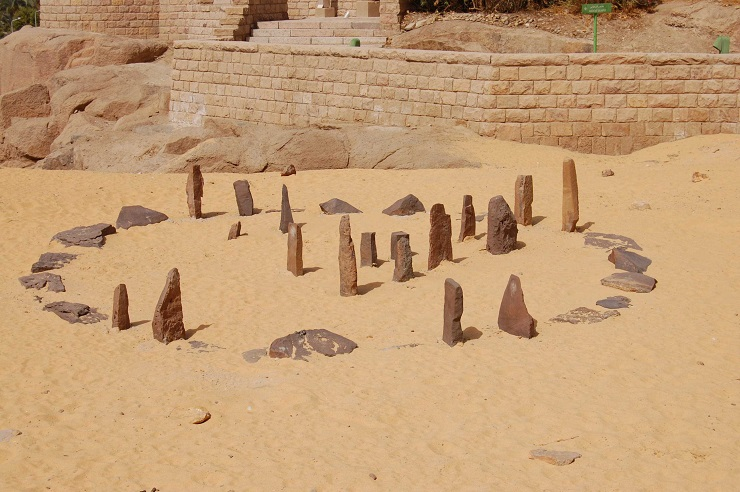
Nabta Playa is famous for a stone arrangement consisting of upright stones organized within a larger archaeological landscape.
Some stones appear to have been deliberately positioned according to astronomical orientations.
Researchers have proposed that the arrangement may have been connected with:
the summer solstice;
seasonal changes;
or the rising and setting positions of celestial objects.
Was It Really a Calendar?
Calling the structure a “calendar” is useful as a general description but should not be interpreted too literally.
We do not possess written records explaining how the stones were used.
Researchers can identify astronomical alignments, but determining their exact function is more difficult.
The stones may have served several purposes simultaneously.
Possible functions include:
marking seasonal changes;
organizing ritual activities;
identifying important celestial events;
or reinforcing social traditions.
Astronomy Before Civilization?
Nabta Playa demonstrates that sophisticated astronomical observation does not require cities or writing.
Humans have always depended on predictable environmental cycles.
Pastoralists could benefit from knowing:
when seasonal rains might arrive;
when particular stars appeared;
and how the annual cycle changed.
The sky provided a reliable reference system when landscapes were constantly changing.
The Summer Solstice
One of the most frequently discussed astronomical relationships at Nabta Playa concerns the summer solstice.
The solstice marks the point in the year when the Sun reaches its northernmost or southernmost position relative to Earth's equator.
For prehistoric communities dependent on seasonal rainfall, the timing of the Sun's annual cycle could have had practical and symbolic significance.
The Importance of Sirius
Some interpretations have proposed connections between Nabta's astronomical orientations and Sirius, the brightest star in the night sky.
Sirius later became enormously important in Egyptian religious and calendrical traditions because its annual heliacal rising was associated with the coming Nile flood.
However, the precise relationship between Sirius and Nabta Playa remains debated.
It is important not to project fully developed later Egyptian astronomical concepts backward onto a much earlier community.
Cattle Burials
One of Nabta Playa's most unusual discoveries involves cattle remains.
Some cattle were deliberately buried or deposited in ways that appear different from ordinary food refuse.
This has encouraged archaeologists to consider whether cattle had ritual importance.
The evidence reinforces the possibility that cattle represented more than simple economic resources.
Social Organization
Constructing a stone monument requires cooperation.
People had to:
identify suitable stones;
transport them;
position them;
and maintain the site.
Such work implies some level of communal organization.
However, it does not necessarily indicate a centralized state.
Small mobile communities can organize impressive projects through cooperation and shared beliefs.
Climate Change and Abandonment
As the African Humid Period ended, the region became increasingly dry.
Seasonal lakes disappeared or became less reliable.
Pastoral groups had to move toward environments where water remained available.
Many communities eventually concentrated closer to the Nile Valley.
The environmental transformation of Nabta Playa therefore forms part of the larger story of desertification in North Africa.
Did Nabta Influence Ancient Egypt?
The relationship between Nabta communities and later Egyptian civilization is an important area of research.
The chronological gap and differences between archaeological traditions make direct claims difficult.
Nevertheless, the broader movement of people, animals, technologies, and ideas between the Sahara and Nile Valley is undeniable.
Nabta Playa demonstrates that complex cultural traditions existed in the Western Desert before the rise of pharaonic civilization.
Why Nabta Playa Matters
Nabta Playa is important because it provides evidence for:
prehistoric pastoralism;
early monumental construction;
astronomical observation;
ritual behavior;
and adaptation to changing climate.
Conclusion
Nabta Playa's stone monuments preserve evidence of an ancient community that watched the sky while living beside a now-vanished desert lake.
Its inhabitants were pastoralists rather than pyramid-building pharaohs, yet they were capable of organizing communities, managing livestock, constructing monuments, and observing seasonal celestial cycles.
The site offers a powerful reminder that scientific observation and monumental construction existed long before writing and centralized states.