Wadi Sura, located in Egypt's Western Desert within the Gilf Kebir region, contains one of the most extraordinary collections of prehistoric rock art in the Sahara.
The area became particularly famous because of the discovery of Wadi Sura II, a large rock shelter containing thousands of painted and engraved images.
The site has sometimes been called the “Cave of Beasts”, a name inspired by its extraordinary collection of human and animal figures.
Its art provides evidence of a prehistoric society that lived in a wetter Sahara and developed a complex symbolic relationship with animals, humans, and possibly ritual activities.
Wadi Sura I and Wadi Sura II
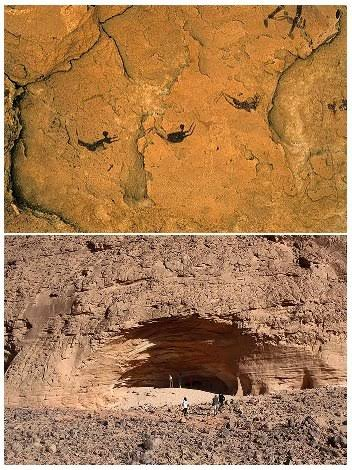
The first famous site in the region was the Cave of Swimmers, known as Wadi Sura I.
A second site, Wadi Sura II, was discovered and documented later.
Wadi Sura II is significantly larger and contains an enormous number of images.
The paintings include:
humans;
cattle;
giraffes;
ostrich-like birds;
antelope;
and unusual composite or unidentified figures.
The “Beasts”
One of the most intriguing aspects of Wadi Sura II is the presence of strange animal forms.
Some figures appear to combine characteristics of different animals or lack clear anatomical identities.
These images have led researchers to consider whether they represent:
mythical beings;
supernatural entities;
masked humans;
or animals depicted in symbolic ways.
There is no definitive answer.
Human Figures
Human figures appear throughout the shelter.
Some are represented in dynamic poses.
Others are associated with animals or unusual forms.
The repeated use of particular body postures suggests that the artists may have been communicating social or ritual meanings.
However, without written records, interpretations remain provisional.
The Importance of Dogs
Among the remarkable images are representations resembling dogs.
These may provide evidence concerning early relationships between humans and domesticated or semi-domesticated animals.
Dogs could have been used for:
hunting;
protection;
companionship;
or symbolic purposes.
Their depiction alongside humans may reveal something about how people understood animal-human relationships.
Cattle and Pastoralism
Cattle are also represented.
Their presence reinforces evidence for prehistoric pastoralism in the region.
Pastoral communities depended on livestock for:
food;
milk;
hides;
and social wealth.
Cattle may also have played ritual roles.
The repeated representation of livestock suggests that animals were deeply embedded in the social and symbolic world of these communities.
The Environment Behind the Art
The modern desert can make the existence of prehistoric pastoral communities seem surprising.
But during the African Humid Period, the Gilf Kebir region experienced substantially wetter conditions.
Seasonal rainfall produced:
grasslands;
waterholes;
and temporary lakes.
Human groups could therefore move through the region while following water and grazing resources.
Dating the Paintings
Dating rock art is difficult.
Researchers use multiple approaches, including:
stylistic comparison;
archaeological context;
pigment analysis;
and radiocarbon dating where suitable organic material survives.
Different images within the same shelter may have been created at different times.
The walls therefore represent a sequence of artistic activity rather than one single event.
The Meaning of the Rock Art
The central mystery of Wadi Sura II is not simply what the images depict, but why they were created.
Possible purposes include:
ritual activity;
storytelling;
social identity;
religious symbolism;
hunting-related beliefs;
or communication between generations.
It is possible that different images had different purposes.
The End of the Pastoral Landscape
As the Sahara dried, the environment changed.
Communities could no longer depend on the same seasonal water and grazing systems.
The population gradually shifted toward more reliable water sources.
This environmental change explains why Wadi Sura became a record of a vanished human landscape.
Why Wadi Sura Matters
Wadi Sura II provides evidence for:
prehistoric pastoralism;
symbolic behavior;
rock-art traditions;
human-animal relationships;
and climate change.
Its enormous collection of images makes it one of the most significant prehistoric art sites in the eastern Sahara.
Conclusion
Wadi Sura II preserves a remarkable visual archive created by prehistoric communities in a once-green Sahara.
Its mysterious beasts, human figures, cattle, and other animals reveal a symbolic world that modern researchers can only partially reconstruct.
The site is a reminder that the Sahara was once a populated landscape filled with water, vegetation, animals, and human communities—and that climate change transformed this world into the desert we know today.