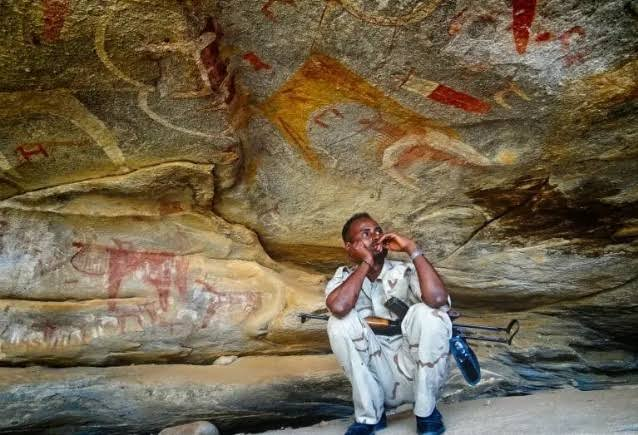
Karinhegane is a prehistoric rock-art site in Somaliland that provides important evidence for early pastoral communities in the Horn of Africa.
Its engravings and paintings contain images of animals and humans, creating a visual record of prehistoric life.
The site is especially significant for understanding how communities adapted to the development of livestock herding and how animals became incorporated into artistic and symbolic traditions.
Rock Art as Historical Evidence
Before writing systems existed, humans communicated through images.
Rock art can preserve information about:
animals;
people;
hunting;
herding;
clothing;
and ritual practices.
However, images are not equivalent to written records.
Their meanings must be reconstructed through archaeological comparison.
The Pastoral Landscape
Karinhegane belongs to a period when livestock herding was becoming increasingly important in the Horn of Africa.
Pastoral communities depended on the movement of animals through landscapes with highly seasonal rainfall.
Their survival required detailed environmental knowledge.
Cattle and Livestock
Cattle representations are particularly valuable.
A herd could represent:
food security;
wealth;
social identity;
and marriage resources.
In many pastoral societies, livestock remains economically and socially significant even today.
The prehistoric images therefore may reflect an important continuity in the relationship between people and animals.
Engraving Techniques
Artists could create images by:
pecking;
scratching;
incising;
or abrading the rock.
Repeated strikes gradually removed the darker weathered surface.
Freshly exposed rock would appear lighter.
Over time, natural weathering changed the appearance of the engraving.
Human-Animal Relationships
The association of people and animals in rock art can be particularly revealing.
If a human figure is consistently shown near cattle, the composition may reflect:
herding;
ritual;
ownership;
or symbolic relationships.
The precise interpretation remains uncertain.
The Importance of Water
Pastoralism depends heavily on water.
Seasonal rainfall determines where grass grows and where livestock can survive.
Communities needed to know the locations of:
wells;
seasonal streams;
springs;
and grazing areas.
Rock-art sites may have been positioned near important routes or landscape landmarks.
Climate Change
The Horn of Africa experienced major fluctuations in rainfall during the Holocene.
These changes influenced the distribution of vegetation and livestock.
Pastoral communities adapted through mobility.
When water sources became less reliable, herders could move toward more favorable areas.
Social Identity
Rock art may have helped communities express identity.
Repeated artistic conventions could distinguish one group from another.
A particular animal style or symbolic motif might communicate:
group membership;
ritual affiliation;
or shared ancestry.
Why Karinhegane Matters
Karinhegane contributes to a larger archaeological record documenting the emergence and development of pastoral societies in the Horn of Africa.
It helps researchers understand:
early livestock economies;
artistic traditions;
environmental adaptation;
and symbolic behavior.
Conclusion
Karinhegane's engravings provide a lasting record of a pastoral world that existed thousands of years ago.
The animals carved into stone are more than images of wildlife.
They may represent wealth, identity, ritual, survival, and the deep relationship between people and livestock.
Through these engravings, the prehistoric inhabitants of Somaliland left behind evidence of a society whose economic and symbolic life revolved around animals and the landscapes that sustained them.