Laas Geel is one of the most important prehistoric rock-art complexes in the Horn of Africa. Located near Hargeisa in Somaliland, the site consists of numerous rock shelters and granite outcrops covered with exceptionally well-preserved paintings.
The artwork is generally associated with early pastoral communities and is often dated broadly to the fifth or fourth millennium BCE, although the chronology remains an area of archaeological research.
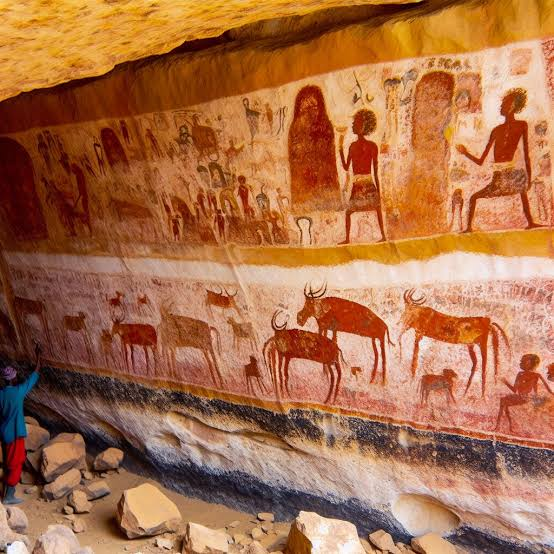
Laas Geel is especially famous for its vivid representations of humans and cattle.
The paintings provide evidence for communities living in a landscape where herding, ritual activity, and symbolic art were already highly developed thousands of years ago.
The Discovery of Laas Geel
The site was documented by researchers in 2002 during an archaeological survey.
The discovery attracted considerable international attention because of the extraordinary preservation of the paintings.
The dry climate of Somaliland helped protect the pigments from the moisture and biological deterioration that affects rock art in wetter environments.
The Cattle Figures
Cattle are among the most striking images at Laas Geel.
Artists depicted animals with:
large horns;
carefully outlined bodies;
and distinctive markings.
Some cattle appear to be associated directly with human figures.
This relationship may provide clues about the importance of herding in the society that created the paintings.
Pastoralism
The archaeological context of the Horn of Africa contains extensive evidence for ancient pastoralism.
Herding communities depended on:
cattle;
sheep;
goats;
and other livestock.
Animals provided:
milk;
meat;
hides;
and wealth.
Livestock could also serve as indicators of social status.
The Human Figures
Human figures at Laas Geel are unusually stylized.
Some appear to wear elaborate clothing or body decorations.
Others are shown standing near cattle.
The artists used strong outlines and carefully chosen shapes to create recognizable figures.
The contrast between the human and animal forms may have been intentional.
Ritual Interpretation
Researchers have proposed that some of the images may have had ritual significance.
The relationship between humans and cattle could represent:
fertility;
pastoral identity;
religious beliefs;
or social status.
However, the exact meaning cannot be established with certainty.
Rock art should not automatically be interpreted as literal documentation of everyday life.
Some images may represent symbolic or supernatural concepts.
Dating the Paintings
Dating Laas Geel is challenging.
The paintings cannot always be dated directly because mineral pigments do not necessarily contain suitable organic material for radiocarbon dating.
Archaeologists therefore use:
stylistic comparisons;
archaeological deposits;
environmental evidence;
and regional chronology.
The paintings are generally placed within the early pastoral period of the Horn of Africa.
A Green Horn of Africa
Like the Sahara, the Horn of Africa experienced major environmental changes.
Earlier periods had more reliable rainfall and vegetation than many areas experience today.
This supported larger pastoral populations.
Over time, climatic variability affected the availability of water and grazing land.
Connections Across Northeast Africa
The pastoral traditions represented at Laas Geel belong to a much larger history of livestock-based societies across northeastern Africa.
Researchers study connections between:
the Horn of Africa;
the Nile Valley;
the eastern Sahara;
and the Red Sea region.
Animal domestication and pastoral practices spread through complex networks of movement and interaction.
Why the Paintings Survived
The preservation of Laas Geel is partly a result of its geological and climatic setting.
The paintings are located under natural rock overhangs that protect them from:
direct rainfall;
erosion;
and excessive sunlight.
The arid environment further limits biological growth.
Threats to Laas Geel
Despite their impressive survival, the paintings remain vulnerable.
Threats include:
physical contact;
vandalism;
uncontrolled tourism;
environmental deterioration;
and political instability.
Once pigments are damaged, restoration cannot truly recreate the original archaeological information.
Why Laas Geel Matters
Laas Geel provides an extraordinary window into prehistoric life in the Horn of Africa.
It demonstrates:
early pastoralism;
sophisticated artistic expression;
human-animal relationships;
ritual possibilities;
and environmental change.
Conclusion
Laas Geel's paintings are among the most remarkable examples of prehistoric African rock art.
The artists who created them left behind vivid images of cattle and people that have survived for thousands of years.
Their work demonstrates that prehistoric societies in the Horn of Africa possessed complex artistic traditions and deeply meaningful relationships with their animals and environment.