Located along the bustling highway that cuts through the Tlacolula Valley east of Oaxaca City, the archaeological site of Lambityeco preserves an incredibly vivid, domestic, and elite chapter of late Zapotec history. Flourishing during the Epiclassic and Early Postclassic periods between 600 and 900 CE—an era marked by the gradual fragmentation and political collapse of the great mountaintop metropolis of Monte Albán—Lambityeco grew into a wealthy, highly specialized commercial city. The site’s name translates from the Zapotec language to "Mound of the Salt Altar," a direct reference to the economic engine that fueled this city: its massive, sophisticated salt-production industry, which allowed the local ruling elite to accumulate immense wealth and construct some of the most artistically opulent royal tombs in the region.
Lambityeco was a premier producer of salt, a critical, high-value commodity in Mesoamerica used for food preservation, dietary health, and ritual practices. The ancient inhabitants achieved this by exploiting the highly saline groundwater of the valley floor, pumping the brine into large, shallow clay pans where it was left to evaporate under the blazing Oaxacan sun, leaving behind pure crusts of white mineral salt. This lucrative monopoly allowed the lords of Lambityeco to fund an intensive artistic Renaissance, characterized not by massive stone pyramids, but by elite residential palaces built around private courtyards, beneath which lay highly sophisticated, beautifully adorned subterranean royal tombs.
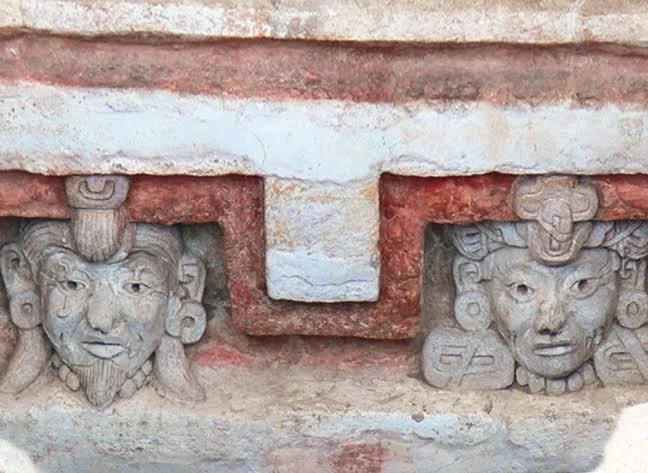
The epicenter of this artistic wealth is Structure 195, a grand elite residential compound that houses Tomb 6. This tomb stands as an absolute masterpiece of Mesoamerican funerary architecture and high-relief modeling. Unlike the stone-carved reliefs common across Oaxaca, the artisans of Lambityeco mastered the use of a fine, durable lime stucco, modeling life-sized, three-dimensional portraits of their rulers directly onto the exterior facades and lintels of the tomb entrances. These stucco sculptures are renowned for their intense, uncompromising realism, capturing the distinct physical traits, wrinkles, and unique hairstyles of specific historical individuals.
Adorning the frieze of Tomb 6 are two monumental stucco busts depicting Lord 1 Earthquake and his wife, Lady 10 Reed, who governed Lambityeco during its economic height. The figures are rendered with incredible care; Lord 1 Earthquake is shown holding a human femur bone in his hand—a classic Zapotec symbol of ancestral lineage and inherited political authority—while wearing an elaborate woven headdress. Lady 10 Reed’s portrait displays her hair meticulously braided with thick cotton cords, a traditional hairstyle that is still worn by indigenous Zapotec women in the valley today, creating an unbroken cultural bridge across more than a thousand years of history.
Inside the tomb chamber, archaeologists discovered a wealth of funerary offerings that underscore the intense ancestral cult that dominated Zapotec religion. The Zapotecs believed that death was not an end, but a transition into a supernatural ancestral state where deceased rulers could directly intercede with the gods of rain and lightning on behalf of their living descendants. To facilitate this journey, Tomb 6 was packed with beautifully painted ceramic effigy vessels, jade beads, obsidian blades, and delicate miniature vessels containing remnants of sacred offerings, all designed to sustain the royal spirits in the afterlife.
Lambityeco stands today as a unique archaeological monument to economic specialization and ancestral devotion. While nearby Monte Albán commands attention for its sheer scale, Lambityeco shines for its intimate, human-scale look into the lives of the merchants and aristocrats who kept Zapotec culture alive after the fall of the capital. The stunning stucco faces of Lord 1 Earthquake and Lady 10 Reed remain looking out across the salt flats, a permanent monument to a society that transformed mineral wealth into enduring, high-fidelity art.