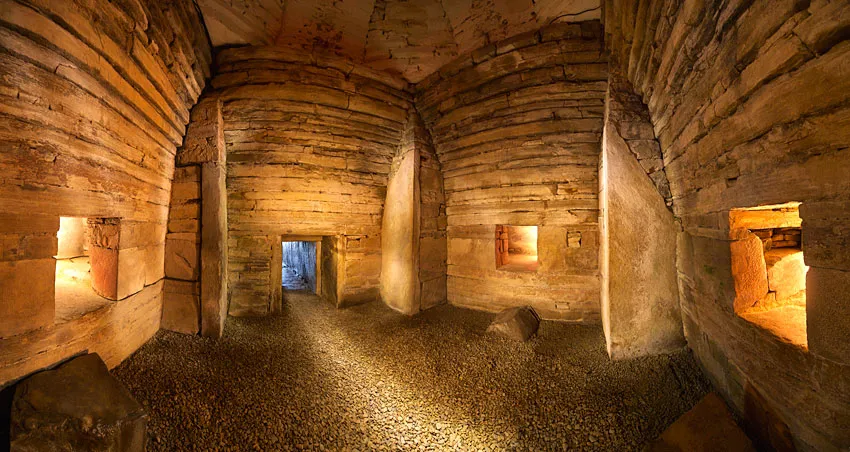
Maeshowe is one of the greatest prehistoric monuments in Scotland and one of the most sophisticated Neolithic passage graves in Europe.
Constructed approximately 5,000 years ago, the monument was deliberately designed so that sunlight from the setting winter sun could enter its long passage and illuminate the central chamber.
Its architecture demonstrates extraordinary knowledge of stone construction, geometry, landscape orientation, and possibly astronomy.
The Construction of Maeshowe
Maeshowe consists of a large artificial mound covering a central stone chamber.
A long passage leads from outside into the interior.
The builders constructed the monument using enormous stone slabs.
The Passage
The entrance passage is unusually long and carefully aligned.
During the winter solstice period, the setting Sun shines down the passage and illuminates the interior chamber.
This alignment is one of Maeshowe's most famous features.
The Winter Solstice
The winter solstice occurs when the Sun reaches its southernmost apparent position in the sky.
In the Northern Hemisphere, it marks the shortest day and longest night of the year.
For agricultural societies, seasonal cycles were extremely important.
The solstice could have represented:
the turning of the year;
renewal;
death and rebirth;
or the return of increasing daylight.
We cannot know exactly what the builders believed, but the deliberate alignment demonstrates that seasonal sunlight mattered.
Astronomical Knowledge
Maeshowe demonstrates that Neolithic builders carefully observed the movement of the Sun.
They did not need modern astronomy to recognize predictable seasonal patterns.
By observing:
sunrise;
sunset;
shadows;
and the position of the Sun on the horizon,
people could establish reliable seasonal markers.
Engineering
The construction of Maeshowe was a major engineering achievement.
Workers had to:
quarry stone;
transport massive slabs;
build stable walls;
create a roof;
construct the mound;
and maintain the alignment of the passage.
The Central Chamber
The central chamber is relatively small compared with the enormous mound outside.
The chamber was built with large upright slabs.
Some stones weigh several tons.
Funerary Function
Maeshowe is generally interpreted as a funerary monument.
However, its precise use remains debated.
Human remains were apparently present historically, but the monument was disturbed long before modern archaeological excavation.
The Meaning of the Mound
The mound would have been highly visible across the surrounding landscape.
Its size transformed it into a major landmark.
People approaching the area could identify the monument from a distance.
A Monument in a Sacred Landscape
Maeshowe was not isolated.
It sits within the broader Neolithic landscape of central Orkney.
Nearby monuments include:
the Ring of Brodgar;
the Stones of Stenness;
Barnhouse;
and the Ness of Brodgar.
This suggests that the entire landscape was organized around ceremonial activity.
Viking Graffiti
Maeshowe was entered by Vikings in the twelfth century.
They carved numerous runic inscriptions into the walls.
These inscriptions provide fascinating evidence of medieval interaction with the much older monument.
The Vikings did not build Maeshowe, but they recognized it as an extraordinary ancient structure.
What the Graffiti Reveals
The runes include:
names;
statements;
references to treasure;
and personal messages.
They demonstrate that Maeshowe continued to attract visitors thousands of years after its construction.
Preservation
The thick stone and earth structure helped preserve the monument.
However, modern conservation requires careful management of:
humidity;
visitor access;
stone surfaces;
and structural stability.
Why Maeshowe Matters
Maeshowe demonstrates that Neolithic communities possessed sophisticated knowledge of:
astronomy;
architecture;
engineering;
geometry;
and landscape planning.
Conclusion
Maeshowe is one of the clearest examples of prehistoric architecture deliberately connected to the movement of the Sun.
Its winter-solstice alignment, monumental mound, massive stones, and central chamber demonstrate an extraordinary combination of engineering and symbolism.
The monument continued to attract people for thousands of years, as shown by the Viking inscriptions carved into its walls.
Maeshowe therefore connects several historical periods within a single structure: Neolithic engineering, prehistoric ritual, and medieval Norse exploration.