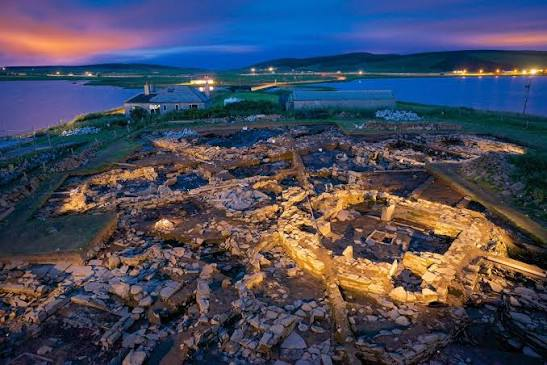
The Ness of Brodgar is one of the most remarkable archaeological discoveries in Britain.
Located between the Lochs of Harray and Stenness in Orkney, the site contains the remains of a large Neolithic complex occupied approximately 5,000 years ago.
The scale and sophistication of the architecture have led archaeologists to consider it a major ceremonial and social center.
A Vast Neolithic Complex
The Ness of Brodgar contains:
monumental stone buildings;
decorated stonework;
painted walls;
pottery;
animal remains;
tools;
and evidence of repeated ceremonial activity.
The scale is unusual for prehistoric Britain.
The Location
The Ness lies on a narrow strip of land between two major bodies of water.
This position may have been significant.
The surrounding landscape includes several monumental sites.
These include:
Maeshowe;
the Ring of Brodgar;
the Stones of Stenness;
and Barnhouse.
Monumental Architecture
The buildings at the Ness are much larger and more complex than ordinary houses.
Some structures contained:
massive walls;
carefully laid floors;
internal chambers;
decorated stones;
and large entrances.
Why Build Such Large Structures?
Large buildings require enormous investments of labor.
Communities had to organize:
quarrying;
transportation;
construction;
food supply;
and maintenance.
This suggests that the site had considerable social importance.
Painted Stone
Some stones at the Ness of Brodgar preserve traces of red and yellow pigment.
Painted architecture is extremely rare in British prehistory.
The use of color may have helped create a visually striking ceremonial environment.
Animal Feasting
Large quantities of animal bone have been discovered.
These include remains of:
cattle;
sheep;
deer;
and other animals.
Some deposits appear to represent large-scale feasting.
Feasting and Social Organization
Feasts can serve important social purposes.
They can:
strengthen alliances;
celebrate rituals;
reinforce political relationships;
redistribute food;
and establish community identity.
The evidence suggests that food consumption at the Ness could have been part of major communal events.
Pottery
Large quantities of pottery have been recovered.
Some vessels belong to the Grooved Ware tradition.
Their presence links the Ness to other major Neolithic sites in Britain.
Stone Tools
Archaeologists have discovered tools associated with:
woodworking;
food preparation;
hunting;
and craft production.
These artifacts reveal the range of activities carried out at the site.
A Ritual Center
The Ness was probably not simply a village.
Its monumental buildings and location among major ceremonial monuments suggest that it functioned as an important gathering place.
People may have traveled considerable distances to participate in ceremonies.
The Broader Landscape
The surrounding monuments form one of Europe's most impressive prehistoric ceremonial landscapes.
The arrangement of:
settlements;
tombs;
standing stones;
and circles
suggests that the landscape itself was carefully organized.
Abandonment
The Ness of Brodgar was eventually abandoned.
Some buildings were deliberately closed or filled.
This raises fascinating questions about ritual termination.
A building could be destroyed or buried as part of a ceremony rather than simply left to decay.
Why the Site Matters
The Ness of Brodgar has changed our understanding of Neolithic Britain.
It demonstrates that prehistoric communities could create:
monumental architecture;
ceremonial centers;
large-scale feasts;
artistic environments;
and complex social institutions.
Conclusion
The Ness of Brodgar is one of the clearest indications that Neolithic Orkney was a major center of cultural innovation.
Its enormous buildings, painted stones, feasting deposits, and relationship with nearby monuments reveal a society capable of organizing large communities around shared ceremonial activities.
The site transforms our understanding of prehistoric Britain from a landscape of isolated farming villages into one containing sophisticated ceremonial centers and interconnected communities.