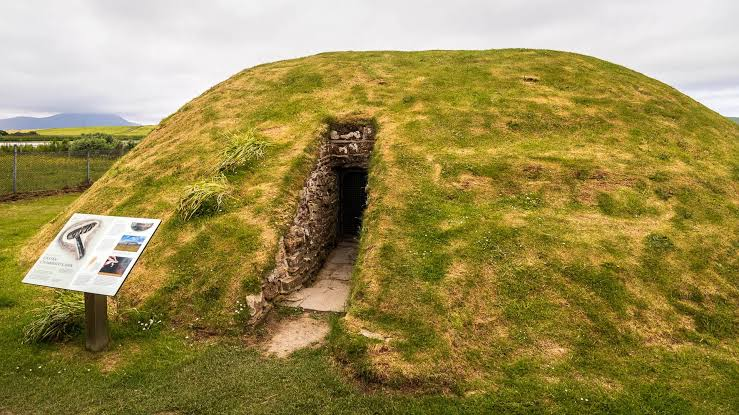
The Unstan Chambered Cairn is one of the most distinctive Neolithic funerary monuments in Orkney, Scotland. Located near the shores of the Loch of Stenness on Mainland Orkney, the monument is particularly important because its architecture combines characteristics associated with different types of chambered tombs.
Dating to the Neolithic period, Unstan provides valuable evidence for how prehistoric communities in Orkney developed different approaches to burial, monument construction, and relationships with the dead.
A Monument of the Orkney Neolithic
Around 5,000 years ago, Orkney was home to farming communities that constructed substantial stone buildings and monumental structures.
These communities:
cultivated crops;
raised livestock;
exploited marine resources;
produced pottery;
constructed houses;
and built elaborate funerary monuments.
The Unstan cairn belongs to this broader tradition of monumental construction.
What Is a Chambered Cairn?
A chambered cairn is a stone-built funerary monument containing an internal burial chamber.
The chamber was generally covered by a mound of stones.
Unlike an ordinary grave, the structure could be reused and visited by members of the community.
This suggests that the monument served as a long-term place of remembrance.
Why Unstan Is Considered a Hybrid
Unstan is architecturally unusual because it combines features associated with different Orkney tomb traditions.
Its chamber includes characteristics of what archaeologists classify as Maeshowe-type and Orkney-Cromarty-type structures.
This makes the monument especially valuable for studying the evolution of Neolithic funerary architecture.
The Importance of Architecture
Architecture provides clues about prehistoric cultural relationships.
If monuments in different areas share architectural features, it may indicate:
cultural interaction;
movement of people;
shared religious traditions;
or the spread of architectural ideas.
Unstan demonstrates that prehistoric builders were not necessarily following a single standardized design.
The Burial Chamber
The internal chamber provided a controlled space for the deposition of human remains.
The dead may have been placed inside over an extended period.
This suggests that the monument could function as a collective ancestral space.
Collective Burial
Neolithic chambered tombs often contain the remains of several individuals.
This differs from the modern expectation of one grave per individual.
The monument could instead represent:
a family;
a lineage;
a community;
or a group with shared ancestry.
The Dead and Ancestors
The construction of a permanent monument around human remains suggests that the dead remained important to the living.
The tomb could serve as a physical connection between:
ancestors → living community → landscape.
It may have helped reinforce identity and continuity.
Pottery Connections
Unstan is also associated with a distinctive pottery tradition commonly known as Unstan Ware.
These vessels are important because pottery styles allow archaeologists to compare settlements and monuments.
Unstan Ware has been identified at several Orkney sites.
What Was the Pottery Used For?
The vessels may have been used for:
food preparation;
storage;
serving;
or ritual activities.
Their exact function varied.
The discovery of pottery within funerary contexts also raises the possibility that vessels formed part of ceremonies connected with the dead.
The Landscape Around Unstan
The monument stands within a remarkable prehistoric landscape.
Nearby are:
the Stones of Stenness;
the Ring of Brodgar;
Maeshowe;
and other prehistoric monuments.
This concentration demonstrates that the area was an important center of Neolithic activity.
Why Was So Much Monument Building Concentrated Here?
The area around the Lochs of Harray and Stenness provided:
fertile land;
water;
good visibility;
abundant stone;
and access to major travel routes.
It may also have held considerable symbolic significance.
Why Unstan Matters
Unstan is valuable because it demonstrates that Neolithic communities experimented with architectural forms.
Instead of constructing identical monuments, they adapted existing traditions to local circumstances.
Conclusion
The Unstan Chambered Cairn is a remarkable example of Neolithic experimentation in architecture and funerary practice.
Its hybrid design demonstrates that prehistoric communities were connected through shared traditions while still developing distinctive local expressions.
The monument therefore provides insight into how Neolithic Orcadians understood death, ancestry, architecture, and their place within the wider landscape.