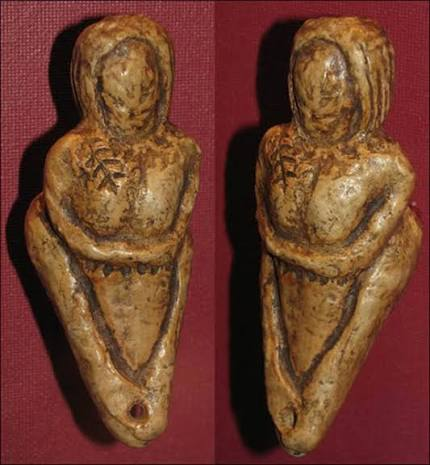
Situated along the Angara River near Lake Baikal in south-central Siberia, the twin sites of Mal'ta and Buret' constitute one of the most famous and culturally unified Upper Paleolithic complexes in the world, dating to approximately 24,000 years ago.
While contemporary Western European sites produced the famously voluptuous, abstract "Venus" figurines made of limestone or clay, Mal'ta and Buret' yielded a massive, distinct assemblage of ivory human statuettes that present a completely different approach to the human form.
The Clothed Venus Paradox
The absolute defining feature of the Mal'ta-Buret' figurines is that they are not naked. While European counterparts like the Venus of Willendorf emphasize exaggerated, bare fertility markers, many of the Siberian ivory statuettes are depicted wearing complete, high-definition winter survival suits:
The Tailored Parka: The carvers used fine, repetitive crescent strokes to engrave the surface of the ivory, clearly illustrating heavy, insulated fur parkas complete with tight-fitting hoods that wrap around the face.
The Slender Profile: Morphologically, the figurines are remarkably slender and elongated, featuring straight legs, flat torsos, and distinct, tapering feet designed to allow the statuettes to be pushed vertically into soft clay or snow banks during ritual ceremonies.
The Rare Depiction of Faces
Unlike the completely faceless, hair-wrapped visages of Western European Paleolithic art, several Mal'ta-Buret' carvings feature explicit facial rendering. The artists carefully carved distinct eyes, prominent noses, mouths, and even individual cheeks.
This inclusion of facial features suggests that these figurines did not merely function as abstract symbols of generic fertility; they may have represented specific ancestors, lineage mothers, or personal protective spirits within a highly structured, localized animistic belief system that dominated the Baikal basin during the depths of the Ice Age.