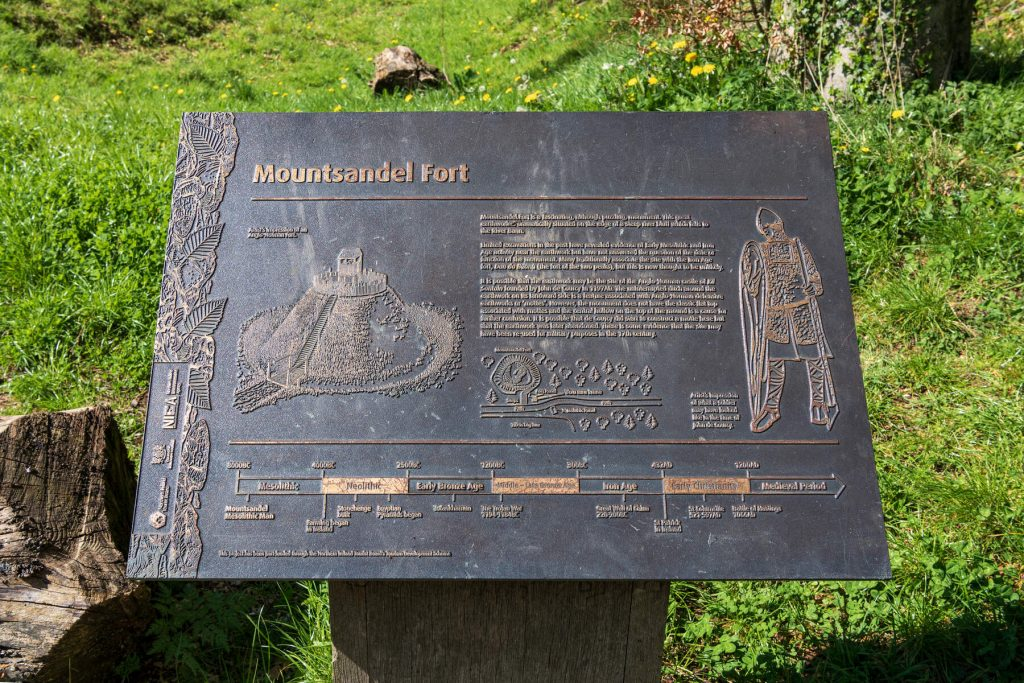
Mount Sandel, located near Coleraine in County Londonderry, Northern Ireland, is one of the most important Mesolithic archaeological sites on the island of Ireland.
Dating to approximately 9,000 years ago, the site provides evidence for some of the earliest known settled human activity in Ireland.
Its importance comes from evidence of repeated occupation, circular dwellings, hearths, stone tools, food remains, and the exploitation of the nearby River Bann.
Ireland After the Ice Age
Following the end of the last Ice Age, Ireland underwent major environmental change.
As temperatures increased:
forests expanded;
wetlands developed;
rivers became productive;
and animal populations changed.
Human groups entered and established themselves within this changing landscape.
The Mesolithic in Ireland
The Irish Mesolithic economy depended largely on wild resources.
People exploited:
fish;
shellfish;
birds;
mammals;
nuts;
and wild plants.
They possessed sophisticated knowledge of local environments.
The Mount Sandel Settlement
Archaeological excavations revealed evidence of circular structures.
These likely represented temporary or semi-permanent houses.
The buildings appear to have contained:
central hearths;
living areas;
working spaces;
and activity zones.
Their presence demonstrates that Mesolithic communities were capable of constructing planned dwellings.
The River Bann
The site's location near the River Bann was extremely advantageous.
Rivers provided:
fish;
water;
transportation;
plants;
and access to different ecological environments.
Fish could form an important part of the local diet.
Fishing Technology
Archaeologists have recovered evidence associated with fishing and aquatic resource exploitation.
The ability to harvest fish efficiently allowed communities to obtain reliable protein without depending entirely on large-game hunting.
Hazelnuts
One particularly important resource in Mesolithic Ireland was the hazelnut.
Hazelnuts are energy-rich and can be collected seasonally in large quantities.
They can also be stored.
Charred hazelnut shells found at archaeological sites provide evidence of plant gathering and food processing.
Stone Tools
Mount Sandel's inhabitants manufactured stone tools for:
cutting;
scraping;
woodworking;
hunting;
and processing animal products.
Tool technology demonstrates adaptation to the local environment.
Seasonal Settlement
The settlement may not have been permanently occupied throughout the year.
Mesolithic communities often practiced seasonal mobility.
Different environments offered different resources at different times.
People could therefore move between:
riverbanks;
forests;
wetlands;
and coastal areas.
Fire and Cooking
Hearths provide evidence of domestic activity.
Fire was essential for:
cooking;
warmth;
light;
and tool production.
Burned plant and animal remains can reveal what people consumed.
Social Cooperation
Building circular dwellings required coordinated labor.
People had to gather:
timber;
reeds;
branches;
and other construction materials.
This demonstrates organized community activity.
A Changing Environment
The forests surrounding Mount Sandel changed as the climate warmed.
Species such as:
birch;
hazel;
pine;
oak;
and other woodland plants
expanded during different stages.
Human communities adapted their subsistence strategies accordingly.
Why Mount Sandel Matters
Mount Sandel provides rare evidence for early settlement in Ireland.
It demonstrates that Mesolithic inhabitants were capable of:
constructing houses;
exploiting river resources;
gathering plant foods;
producing specialized stone tools;
and organizing repeated occupation.
Conclusion
Mount Sandel provides a remarkable picture of early Holocene Ireland.
Approximately 9,000 years ago, people were already building shelters and repeatedly occupying a riverside settlement while exploiting fish, plants, woodland animals, and other resources.
The site challenges the idea that hunter-gatherers were simply wandering groups without permanent connections to particular places.
Instead, Mount Sandel shows that Mesolithic communities could establish strong relationships with productive landscapes.