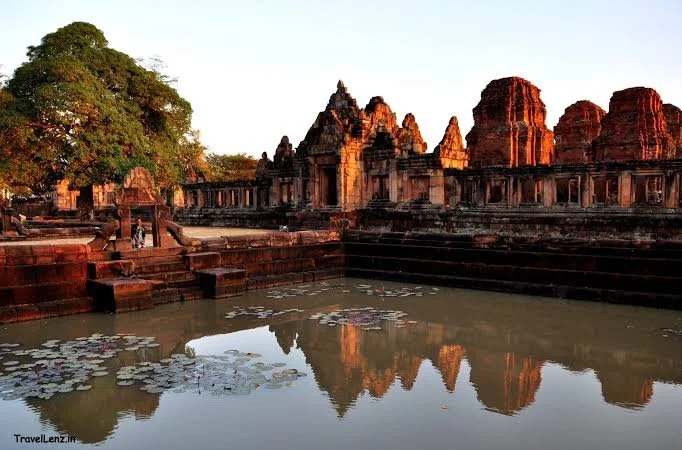
Situated at the base of the Phnom Rung volcano in Buriram Province, northeastern Thailand, Prasat Muang Tam is an elegant example of 10th-century Khmer provincial temple architecture. Built primarily during the late 10th and early 11th centuries under the patronage of local elites aligned with the Angkorian court, this Hindu sanctuary was dedicated to Shiva. While smaller than its mountain-top neighbor, Phnom Rung, Muang Tam stands out for its layout, which balances monumental stone masonry with an advanced, symbolic water management network.
The central sanctuary consists of five brick towers (prasats) arranged in a unique two-row layout (three in the front, two in the back) resting on a shared laterite platform. The central, largest tower, which historically housed a sacred stone lingam, is missing its upper tiers but retains exquisitely carved sandstone lintels depicting Hindu deities like Indra riding his elephant, Airavata. This central sacred core is tightly bounded by an inner galleries enclosure featuring intricately carved windows and entry gates (gopuras).
The defining feature of Muang Tam is its outer water network. The central courtyard is wrapped by four large, L-shaped holy ponds, separated by paved causeways that align with the main cardinal directions. Each basin is lined with stepped laterite blocks and bordered by an ornate, continuous sandstone balustrade sculpted in the likeness of a multi-headed serpent, the Naga. These ponds served a dual purpose: practically, they acted as urban reservoirs that collected monsoon rainwater from the temple’s stone roofs to supply the surrounding settlement during dry spells. Spiritually, they transformed the sanctuary into a physical model of Hindu cosmology, with the central brick towers representing the peaks of Mount Meru and the surrounding ponds symbolizing the primordial oceans that encircle the universe.