Resting at the base of Mount Phu Kao in Champasak Province, southern Laos, Wat Phu is an exceptional Khmer archaeological complex that predates Angkor Wat. The site's location was chosen due to a striking natural feature: the summit of Phu Kao displays a prominent, 15-meter-tall monolithic rock formation that resembles a natural Shiva lingam. Recognizing this as a direct sign of divine presence, early Khmer rulers transformed the mountain into a sacred landscape, naming it Shrestapura and developing a terraced temple complex that operated for over a thousand years.
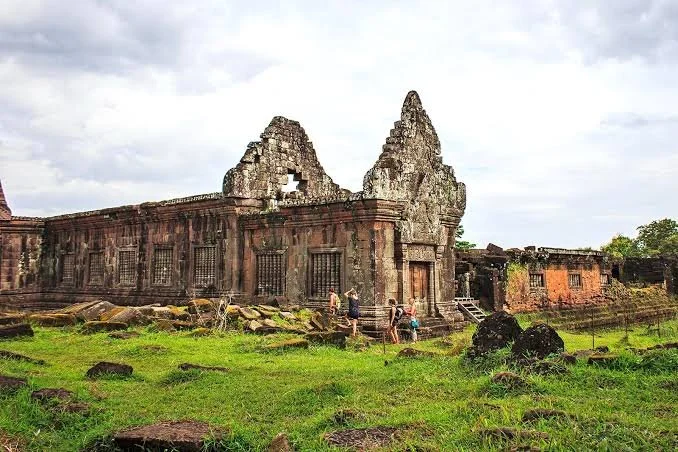
The architecture of Wat Phu is organized along a dramatic, 1.4-kilometer oriental axis that rises up the steep lower slopes of the mountain. Visitors enter through a lower plain dominated by two massive, rectangular stone pavilions—popularly called the Northern and Southern Palaces—dating to the 11th-century Baphuon style. From these palaces, a processional causeway flanked by stone pillars leads pilgrims up a series of steep laterite staircases, framed by ancient frangipani trees, to reach the main sanctuary terrace perched high on the cliffside.
The upper terrace houses the primary sanctuary building, a sandstone structure covered in detailed carvings of Krishna, Vishnu, and Shiva. Directly behind this sanctuary, a natural mountain spring flows from the rocky cliff face. Khmer engineers built a system of stone channels to collect this water, routing it straight through the inner sanctum to continuously bathe the central stone lingam before draining down to the lower plains to irrigate the agricultural fields below. This integration of geology, hydrology, and architecture allowed Wat Phu to transition smoothly from an early Hindu shrine into a Buddhist place of worship, remaining an active pilgrimage site to this day.