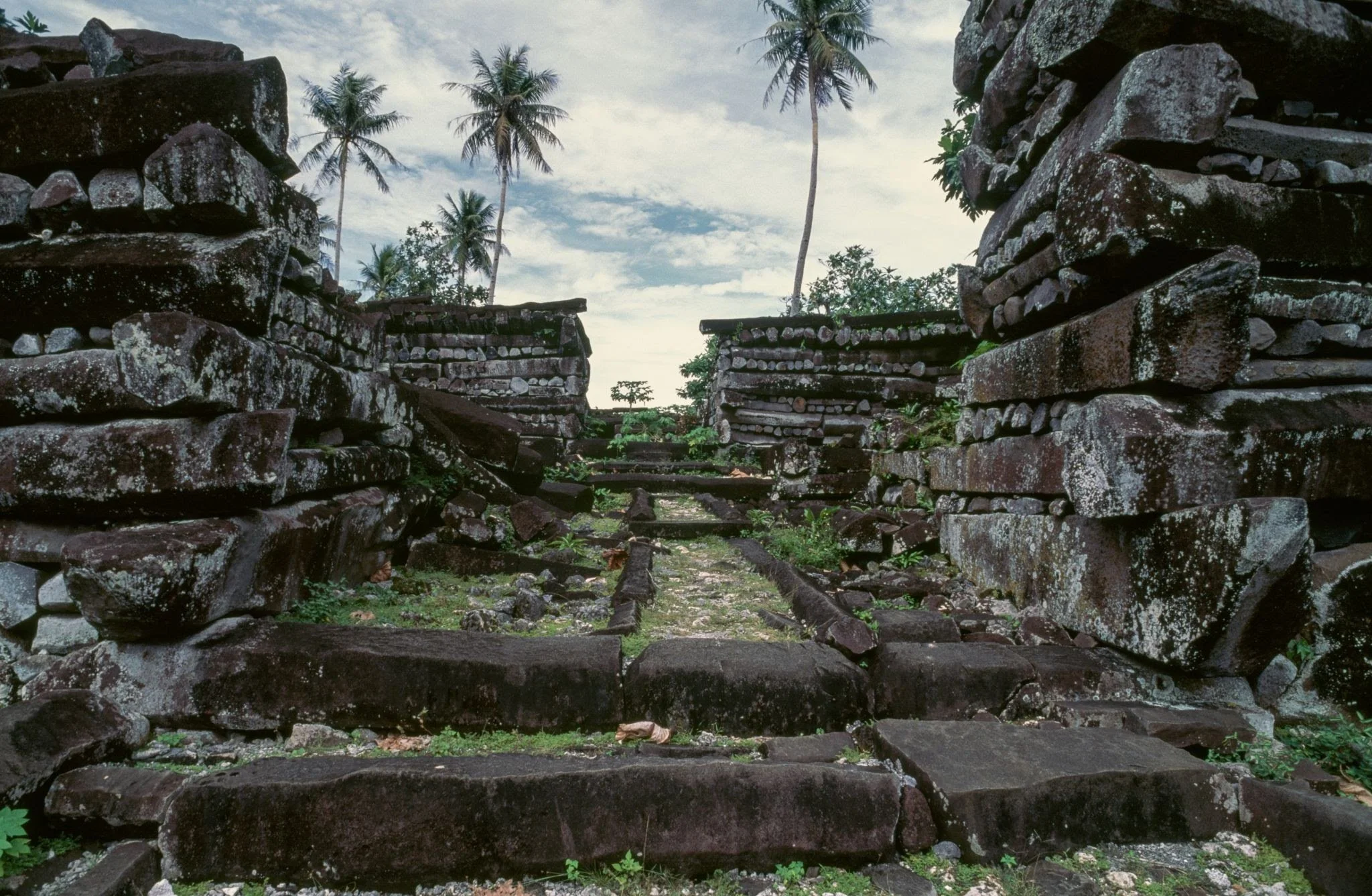
Resting off the eastern shore of the island of Pohnpei in Micronesia, the ruined city of Nan Madol is an engineering feat of the ancient Pacific. Known as the "Venice of the Pacific," this archaeological complex consists of 92 artificial islets constructed directly on top of a live coral reef flats, linked together by an intricate network of tidal canals. Serving as the ritual, residential, and political headquarters of the Saudeleur Dynasty from roughly 1200 to 1600 CE, the entire city was constructed out of hundreds of thousands of massive, naturally formed columnar basalt rocks.
The construction process relied on a sophisticated understanding of logistics and lever mechanics. The building blocks of the city are prismatic, five- to eight-sided basalt columns that formed naturally in volcanic vents on the opposite side of Pohnpei. Prehistoric builders quarried these dense, heavy boulders—some weighing up to 50 tons—and transported them across miles of open ocean lagoon without metal tools, draft animals, or pulleys. While local legends attribute the movement of the stones to twin sorcerers who flew them through the air, experimental archaeology suggests laborers used large bamboo rafts to float the blocks during high tide, then systematically maneuvered them into place using wood levers and coconut-fiber ropes.
The layout of Nan Madol was designed to isolate and protect the ruling elite. The islets are organized into two primary zones: Madol Powe, the sacerdotal sector housing mortuary complexes and burial tombs, and Madol Pah, the administrative core containing palatial residences and food storage depots. The largest and most spectacular islet, Nandauwas, is bounded by exterior walls standing over 8 meters tall and 5 meters thick, built by stacking the basalt columns horizontally in an interlocking, Lincoln-log style grid. This massive stone configuration resisted the destructive force of Pacific typhoons and tidal surges, providing a permanent, secure monument to Saudeleur dynastic rule.