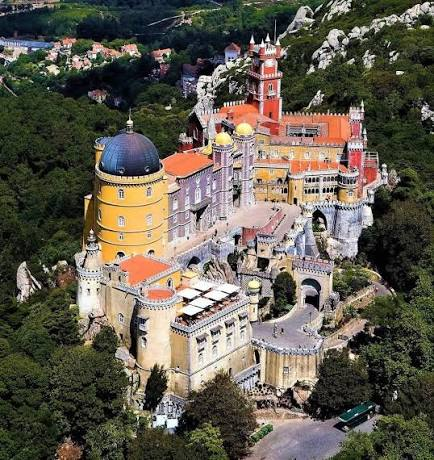
Sintra, located among the wooded hills northwest of Lisbon, is one of Portugal's most historically layered landscapes. Although it is internationally famous for its Romantic-era palaces and nineteenth-century architecture, the history of Sintra extends far deeper into the medieval past. Before the establishment of the Portuguese kingdom, the region formed part of the Islamic world of al-Andalus, and archaeological evidence preserves traces of centuries of Muslim occupation.
The title “Mudejar Sintra: Portugal's Islamic Palace Remains” refers to this important Islamic heritage, although the term Mudéjar requires some clarification. Historically, Mudéjars were Muslims who continued living under Christian rule in Iberia after the reconquest of their territories. Sintra's Islamic-period architecture belongs primarily to the earlier era of Muslim rule, while later artistic traditions in Iberia incorporated Islamic decorative influences into Christian societies.
Sintra's archaeological and architectural history therefore represents a long process of cultural transformation involving Roman settlement, Islamic administration, the Portuguese Reconquista, medieval monarchy, and later architectural reinvention.
Sintra Under Islamic Rule
Following the Muslim conquest of the Iberian Peninsula in the early eighth century, much of modern Portugal became incorporated into the political and cultural world of al-Andalus.
Sintra occupied a strategically valuable location.
The surrounding hills provided:
elevated defensive positions;
access to agricultural land;
proximity to the Atlantic coast;
and connections with the wider region around Lisbon.
The settlement became known in Arabic sources and formed part of the network of fortified communities that helped control the territory.
For several centuries, the region experienced political changes involving different Islamic dynasties and regional authorities.
The Moorish Castle
The most visible surviving symbol of Islamic Sintra is the Castelo dos Mouros, or Moorish Castle.
The fortification occupies a dramatic ridge above the town and follows the natural contours of the mountain.
Its location provided extensive views across the surrounding landscape.
A fortress built in such a position could monitor movement through nearby valleys and help protect the settlement below.
The castle's defensive system included:
stone walls;
towers;
elevated observation points;
and controlled access routes.
The difficult terrain itself formed part of the fortification.
Islamic Military Architecture
Medieval fortresses were not simply collections of walls.
Their design responded directly to geography.
At Sintra, steep slopes reduced the number of directions from which an enemy could approach easily.
Walls were therefore positioned to reinforce natural obstacles.
Towers allowed defenders to observe and respond to approaching threats, while narrow routes made large-scale attacks more difficult.
Water was also essential.
A fortress could not survive a prolonged siege without access to reliable supplies, making wells and water-storage systems strategically important.
Archaeological Remains of the Islamic Settlement
The visible castle represents only part of Islamic Sintra.
Archaeological excavations have revealed evidence of settlement associated with the fortified landscape.
These discoveries help historians reconstruct:
domestic life;
food production;
craft activity;
trade;
and military organization.
Pottery is particularly valuable.
Islamic-period ceramics can provide evidence about chronology, trade connections, and everyday activities.
Fragments of cooking pots, storage jars, tableware, and imported ceramics can reveal the economic relationships of a settlement.
From Islamic Rule to Portuguese Control
Sintra was incorporated into the expanding Portuguese kingdom during the twelfth century.
The Christian conquest of the region did not erase everything that had existed before.
Instead, existing settlements, roads, agricultural systems, and defensive structures were gradually incorporated into the new political order.
The Moorish Castle continued to be used and modified.
This process demonstrates an important reality of medieval conquest: political control could change rapidly, while landscapes and built environments often remained in use for generations.
The National Palace and Islamic Influence
The Palácio Nacional de Sintra became an important royal residence after the Portuguese conquest.
The palace as it exists today contains architectural elements from multiple periods.
Some features reflect Gothic, Manueline, Renaissance, and later Portuguese traditions, while decorative styles also demonstrate the continuing influence of Islamic artistic practices.
Iberian architecture frequently crossed religious and political boundaries.
Techniques associated with Islamic builders and artisans could continue to influence Christian architecture.
Decorative traditions involving:
geometric patterns;
glazed tiles;
carved plaster;
wooden ceilings;
and complex surface ornamentation
remained influential long after the end of Muslim political rule.
What Is Mudéjar Architecture?
Mudéjar architecture developed primarily in Christian-controlled regions of medieval Iberia where Islamic artistic traditions continued to influence building and decoration.
It often combined Christian architectural forms with techniques and motifs associated with Islamic craftsmanship.
Characteristic features can include:
intricate geometric decoration;
brickwork;
decorative tile;
carved plaster;
horseshoe arches;
and elaborate wooden ceilings.
The broader importance of Mudéjar art is that it demonstrates how cultural traditions can survive political conquest.
A change of rulers does not automatically eliminate the skills, artistic knowledge, or aesthetic preferences of the people living within a region.
Sintra as a Cultural Landscape
Sintra's history cannot be understood through a single monument.
The region contains layers representing different periods:
prehistoric occupation;
Roman influence;
Islamic settlement;
medieval Portuguese rule;
royal architectural development;
Romantic-era transformation;
and modern heritage preservation.
Each generation reused, modified, or reinterpreted the landscape.
The Islamic fortress, for example, later became part of a Portuguese national historical landscape and was extensively restored during the nineteenth century.
Restoration and the Problem of Authenticity
Many historic monuments are not preserved exactly as they were originally built.
The Moorish Castle underwent major restoration during the nineteenth-century Romantic period.
Restorers often attempted to create an image of what they believed a medieval castle should look like.
This raises important questions for historians.
Which walls are genuinely medieval?
Which sections were reconstructed?
How much should modern conservation attempt to restore a monument?
Archaeologists and conservation specialists must carefully distinguish original evidence from later interventions.
Why Islamic Sintra Matters
The Islamic heritage of Sintra demonstrates that Portugal's history was shaped by centuries of interaction between different civilizations.
The region was connected to the wider Islamic world of al-Andalus before becoming part of the Portuguese kingdom.
Its importance lies in the evidence it provides for:
Islamic military architecture;
medieval settlement;
cultural exchange;
the Portuguese Reconquista;
and the survival of Islamic artistic traditions.
Conclusion
The Islamic remains of Sintra represent an essential chapter in Portugal's medieval history.
The Moorish Castle and associated archaeological evidence reveal a fortified landscape that developed within the political world of al-Andalus and later became part of the expanding Portuguese kingdom.
Rather than viewing Sintra's Islamic past as a completely separate historical episode, it is better understood as one layer in a continuous cultural landscape. Islamic architecture, settlement patterns, artistic traditions, and technical knowledge continued to influence the region even after political control changed.
Sintra therefore stands as a reminder that European history was never culturally isolated. Its monuments preserve the legacy of centuries of interaction between Islamic and Christian societies.