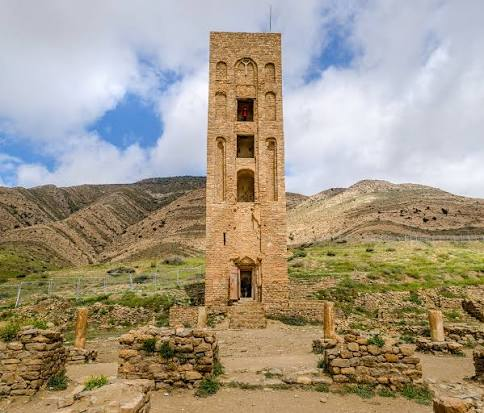
Qal'at Bani Hammad is one of the most important medieval archaeological sites in North Africa. Located in the mountainous region of present-day Algeria, the ruins preserve the remains of a fortified city founded during the eleventh century and associated with the Hammadid dynasty.
The description “11th-Century Aghlabid City” needs historical qualification. Qal'at Bani Hammad was not an Aghlabid city. The Aghlabids ruled parts of Ifriqiya primarily between the ninth and early tenth centuries, while Qal'at Bani Hammad was founded in 1007 CE by Hammad ibn Buluggin and became the capital of the Hammadid dynasty, a branch that emerged from the Zirid political world.
This distinction is important because Qal'at Bani Hammad represents a later phase of medieval Islamic history in the Maghreb.
The Foundation of the Hammadid Capital
Qal'at Bani Hammad was founded by Hammad ibn Buluggin in the early eleventh century.
The choice of location was strategic.
The city was built in a mountainous environment where natural terrain could contribute to defense.
A fortified capital allowed the Hammadid rulers to establish political independence and protect their authority.
The city became an important center of administration, military power, religious activity, and trade.
A Fortified Mountain City
The name Qal'at means fortress or citadel.
The city's defensive position was therefore central to its identity.
The surrounding terrain helped protect the settlement, while walls and gates provided additional security.
A medieval capital required more than a fortress.
It also needed:
housing;
water systems;
markets;
religious institutions;
administrative buildings;
and storage facilities.
Qal'at Bani Hammad developed into a substantial urban center.
The Great Mosque
One of the most important structures at the site was the Great Mosque.
Mosques served as religious centers, but they could also function as important social and political spaces.
The architecture of a major congregational mosque reflected the resources available to the ruling state.
The Great Mosque at Qal'at Bani Hammad included a large prayer area and a prominent minaret.
The surviving remains provide evidence for the architectural traditions of medieval North Africa.
The Palace Complexes
The rulers of Qal'at Bani Hammad constructed elaborate palace complexes.
These included courtyards, water features, decorative spaces, and areas for official activity.
Palaces were designed to communicate power.
Their architecture demonstrated that the ruler controlled:
skilled labor;
building materials;
artistic production;
and the resources necessary for large-scale construction.
The use of gardens and water features was especially significant in Islamic palace architecture.
Water could represent both luxury and the ideal of a cultivated paradise.
The Palace of the Sea
Among the most famous structures associated with Qal'at Bani Hammad is the Palace of the Sea, known for its large water basin.
The palace complex illustrates the importance of water in elite architecture.
In a region where water management required considerable effort, the ability to construct ornamental pools and hydraulic systems was a visible expression of wealth and authority.
Water features could serve:
practical purposes;
cooling;
decoration;
and ceremonial symbolism.
Urban Life
Qal'at Bani Hammad was not simply a royal fortress.
It supported a population of administrators, soldiers, artisans, merchants, religious scholars, and families.
Urban life depended on networks of production and exchange.
The city required regular supplies of:
food;
water;
fuel;
construction materials;
and manufactured goods.
Markets connected the city with surrounding agricultural and pastoral communities.
Trade and Mediterranean Connections
The Hammadid state participated in the wider commercial world of medieval North Africa.
Trade routes connected inland settlements with the Mediterranean coast and trans-Saharan networks.
Goods could move through these systems over enormous distances.
Possible trade items included:
textiles;
metals;
ceramics;
agricultural products;
luxury goods;
and materials brought across the Sahara.
The circulation of goods also encouraged the movement of artistic ideas and technological knowledge.
Why Was the City Abandoned?
Political and military pressures eventually contributed to the decline of Qal'at Bani Hammad.
The Hammadid rulers later shifted their political center toward the coast, establishing Béjaïa as an important capital.
The movement of the capital changed the strategic importance of the mountain city.
Over time, Qal'at Bani Hammad was abandoned.
Its ruins nevertheless remained an extraordinary archaeological record of Hammadid urban life.
The Importance of Archaeological Preservation
The ruins provide evidence for medieval architecture that cannot always be reconstructed from written sources.
Archaeologists study:
foundations;
walls;
ceramic fragments;
water systems;
decorative remains;
and the spatial organization of buildings.
Each type of evidence contributes to the reconstruction of the lost city.
Why Qal'at Bani Hammad Matters
The site is one of the most important surviving examples of a medieval Islamic capital in North Africa.
It provides evidence for:
Hammadid political power;
fortified urban planning;
mosque architecture;
palace design;
hydraulic engineering;
and artistic traditions.
Its importance extends beyond Algeria because it illustrates the development of Islamic urbanism across the medieval Maghreb.
Conclusion
Qal'at Bani Hammad was a Hammadid, not an Aghlabid, capital—a distinction that is essential for understanding its true historical context.
Founded in the eleventh century, the fortified mountain city became a major political and cultural center whose mosques, palaces, water systems, and defensive structures reflected the power of its rulers.
Although abandoned centuries ago, its ruins continue to reveal the sophistication of medieval North African urban civilization.