The Ring of Brodgar is one of the most spectacular prehistoric stone circles in Britain.
Located on the Orkney Mainland between the Lochs of Harray and Stenness, the monument forms part of the extraordinary Heart of Neolithic Orkney landscape.
Its enormous circular arrangement of standing stones demonstrates the ability of Neolithic communities to organize labor, transport heavy materials, and create monuments with powerful visual and symbolic effects.
The Stone Circle
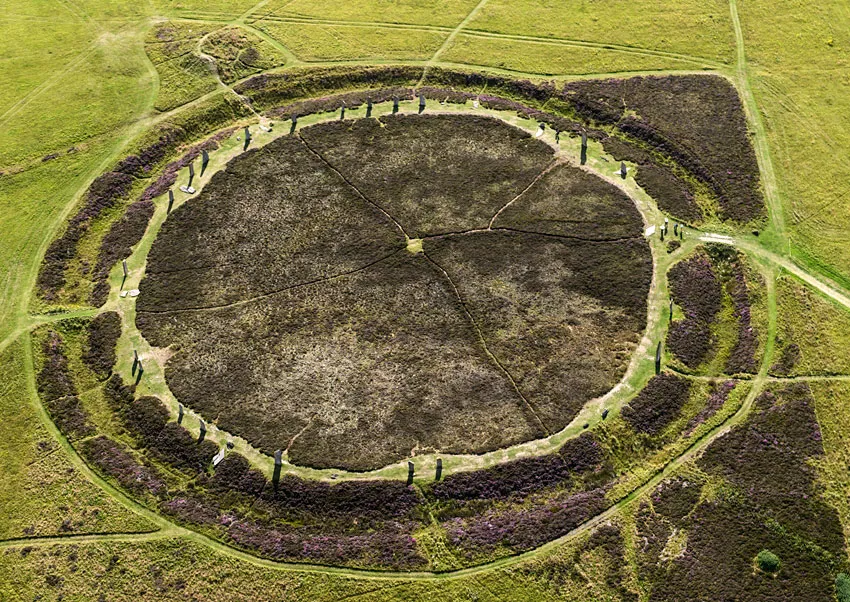
The Ring of Brodgar originally contained many standing stones arranged in a large circle.
Although some stones have fallen or disappeared, a substantial number survive.
The circle is surrounded by a large ditch.
The Ditch
The ditch was excavated into the underlying rock.
Creating it required enormous quantities of labor.
The ditch may have helped define the monument as a special or separate space.
Monumental Labor
Moving and erecting standing stones was difficult.
Workers needed to:
locate suitable stones;
extract or transport them;
move them across the landscape;
prepare the ground;
raise them;
and stabilize them.
This required cooperation among many people.
Why Make a Circle?
The exact purpose of the Ring of Brodgar remains uncertain.
Possibilities include:
ceremonial gatherings;
seasonal rituals;
astronomical observation;
social meetings;
or religious ceremonies.
The monument may have served several purposes simultaneously.
Astronomy
Researchers have investigated possible astronomical relationships at Brodgar.
The positions of stones and surrounding monuments may relate to:
the Sun;
the Moon;
seasonal events;
and horizon positions.
However, identifying intentional astronomical alignments requires careful statistical analysis.
The Surrounding Landscape
The Ring of Brodgar forms part of a remarkable cluster.
Nearby are:
the Stones of Stenness;
Maeshowe;
the Ness of Brodgar;
and Barnhouse.
The proximity of these sites suggests that the area was a major ceremonial center.
Visibility
The monument is highly visible across the surrounding landscape.
Standing stones can serve as powerful landmarks.
Their visibility may have helped people identify gathering places and establish relationships between different communities.
Ritual Space
The ditch and circle could have separated the interior from the surrounding landscape.
Entering the monument may therefore have involved a transition from ordinary space into a ceremonial environment.
Neolithic Community
The builders were farming communities.
They cultivated crops and raised animals while continuing to exploit marine resources.
The monument demonstrates that agricultural societies could devote substantial labor to activities that were not directly related to food production.
Preservation
Orkney's harsh climate presents conservation challenges.
Wind, rain, frost, and biological growth can affect the stones and surrounding archaeological deposits.
Modern preservation therefore requires careful management.
UNESCO Recognition
The Ring of Brodgar is part of the Heart of Neolithic Orkney World Heritage Site.
Its importance is recognized internationally because of the extraordinary concentration of prehistoric monuments in the region.
Why the Ring Matters
The monument demonstrates:
engineering skill;
social cooperation;
ritual organization;
landscape planning;
and cultural continuity.
Conclusion
The Ring of Brodgar is one of the most powerful surviving monuments of Neolithic Britain.
Its immense circular arrangement, surrounding ditch, and relationship with nearby tombs and settlements reveal a society capable of organizing large-scale communal projects.
Although its exact purpose remains unknown, the monument clearly occupied an important place within the ceremonial landscape of Neolithic Orkney.