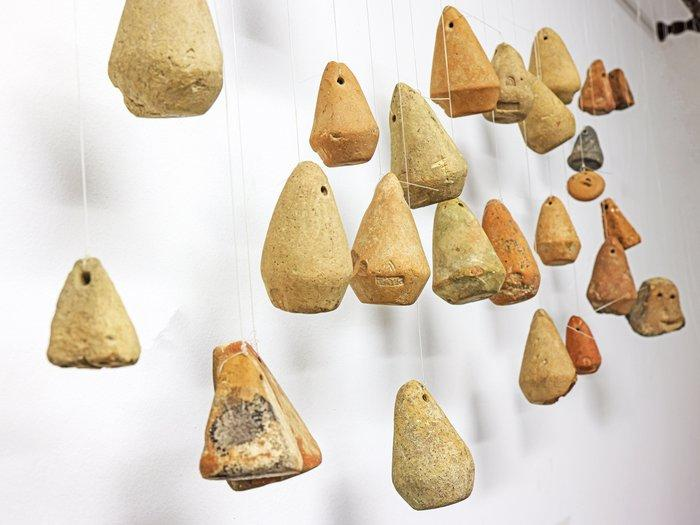
Loom weights and ancient textile production
Loom weights are archaeological objects associated with certain types of vertical looms. They helped maintain tension in the warp threads during weaving, allowing textile producers to create fabrics with different structures and thicknesses.
Textile production was an important activity in ancient households and economic systems. Clothing, blankets, sacks, and other woven products were necessary for everyday life, and the production of textiles could involve considerable labor and specialized knowledge.
Loom weights are particularly valuable because textiles rarely survive in ordinary archaeological environments. Although fabrics often decay, the tools used in their production can remain preserved in pottery, stone, or other durable materials.
The significance of a farm discovery
A group of loom weights found on a farm in Epirus could potentially suggest textile production within a rural household. However, the discovery would need to be carefully evaluated because loom weights might have been moved, reused, collected, or incorporated into later structures.
Their shapes, sizes, materials, and markings could help researchers compare them with examples from other archaeological sites. Differences in weight might reflect the requirements of particular weaving techniques, although variation can also result from manufacturing differences or the use of different loom configurations.
Textile production and household economies
Textile work was often connected with household economies and the organization of labor. It could be carried out by individuals or groups within a household, and the finished products might be used locally or exchanged.
The presence of weaving equipment could therefore contribute to discussions about domestic labor, economic independence, household responsibilities, and craft specialization.
In rural contexts, textile production may have been integrated with agricultural activities. Families could combine farming, animal husbandry, and weaving to meet their material needs or produce goods for exchange.
Archaeological interpretation
The most important evidence would be the relationship between loom weights and the surrounding structures. If they were discovered together with spindle whorls, textile tools, storage vessels, or workshop features, the interpretation of a weaving area would become stronger.
A hypothetical loom-weight assemblage from an Epirus farm would help illustrate how textile production may have continued as an important part of rural life across different historical periods. It would also emphasize that archaeological evidence for household crafts can provide insight into economic activities that are often poorly represented in written records.