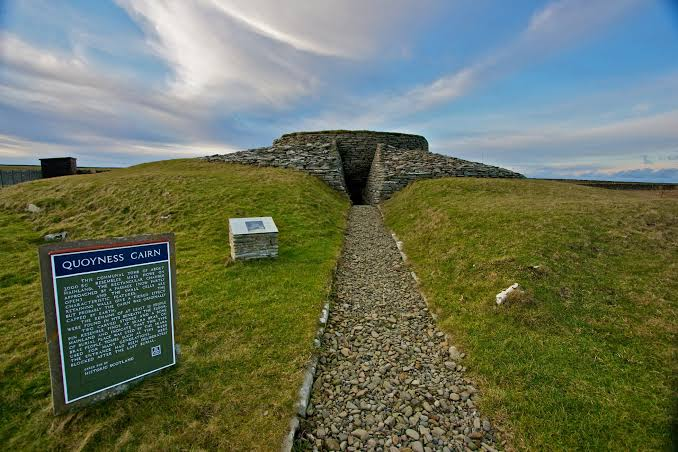
The Quoyness Chambered Cairn, located on the island of Sanday in Orkney, is an important Neolithic passage tomb.
Its architectural design is associated with the Maeshowe-type tradition, making it valuable for understanding the development and distribution of sophisticated funerary architecture across prehistoric Orkney.
The Island of Sanday
Sanday is one of Orkney's northern islands.
Its landscape includes:
fertile farmland;
beaches;
dunes;
wetlands;
and coastal resources.
The island offered diverse opportunities for prehistoric communities.
The Chambered Cairn
Quoyness consists of a stone-built cairn covering a central burial chamber.
A passage provides access to the interior.
The architecture required substantial engineering knowledge.
Maeshowe-Type Architecture
Maeshowe-type tombs generally feature:
long entrance passages;
substantial central chambers;
and carefully constructed stone walls.
These monuments demonstrate a sophisticated approach to architectural design.
The Central Chamber
The central chamber could contain human remains.
The space may have been reused repeatedly.
This suggests that the tomb was connected to long-term ancestral traditions.
Human Remains
The discovery of human remains within chambered cairns provides evidence for communal burial practices.
Individuals may have been deposited over generations.
The monument could therefore preserve the remains of a community's ancestors.
Ritual Access
The passage controlled entry.
This means that people could not simply walk into the central chamber casually.
Entering required deliberate movement.
This may have created a ritual experience.
Solstice Connections
Some Maeshowe-type tombs show evidence of astronomical orientation.
The alignment of entrances may have been connected with the seasonal movement of the Sun.
Whether Quoyness itself had a precise astronomical function requires careful archaeological analysis.
Construction Materials
Local stone formed the primary building material.
The availability of stone made durable architecture possible on Sanday.
Coastal Environment
The tomb's location within an island landscape also connected it to:
the sea;
farmland;
settlements;
and other monuments.
The placement of the tomb therefore contributed to the cultural organization of the landscape.
Why Quoyness Matters
Quoyness demonstrates that sophisticated monumental traditions extended beyond central Mainland Orkney.
Its architecture shows that island communities participated in broader cultural systems.
Conclusion
Quoyness Chambered Cairn is a powerful example of Neolithic funerary architecture on Sanday.
Its Maeshowe-type design demonstrates that prehistoric communities across Orkney shared architectural ideas while adapting them to their own local landscapes.
The tomb preserves evidence of collective burial, ritual movement, engineering skill, and the importance of ancestors in Neolithic society.