Introduction
Nomadic and mobile pastoral communities have often left archaeological traces that are less substantial than those associated with permanent settlements. Their camps may have consisted of portable shelters, temporary hearths, animal enclosures, storage pits, and other features designed for repeated use rather than long-term construction.
Winter camps are particularly important because cold-season conditions can influence mobility, livestock management, access to water, and the availability of food. Reconstructing these camps can help archaeologists understand how mobile communities organized their lives and adapted to seasonal environments.
The challenge is that temporary settlements may leave only scattered and ambiguous traces. A few hearths, postholes, animal bones, or artifact concentrations can have several possible explanations. Reliable reconstruction therefore depends on combining spatial analysis, environmental evidence, experimental archaeology, and careful comparison with historically documented forms of mobility.
Why Winter Camps Matter
Seasonal mobility is not simply movement from one place to another. It is often a planned strategy that allows people to use resources that vary throughout the year.
Pastoral communities may move livestock between summer grazing grounds and winter areas where shelter, fodder, and water are more accessible. Winter camps may be located in valleys, sheltered slopes, forest margins, or other environments that reduce exposure to wind and severe weather.
The specific strategy depends on the local climate, animal species, terrain, political conditions, and economic system.
Some communities move long distances, while others practice short-range seasonal movement. Archaeologists should not assume that every mobile society followed the same pattern.
What Counts as a Nomadic Camp?
A camp is a place where people stayed temporarily or repeatedly without necessarily constructing permanent buildings.
Archaeological traces may include:
hearths and charcoal deposits,
postholes or stake impressions,
shallow pits,
animal pens,
dung deposits,
discarded pottery,
stone arrangements,
tool fragments,
and concentrations of animal bones.
Not all camps contain all these features.
Portable tents or other lightweight shelters may leave little evidence, particularly when occupants cleaned the area before leaving. In some environments, repeated occupation may create a recognizable archaeological layer; in others, erosion and later land use may erase most traces.
Identifying Temporary Shelters
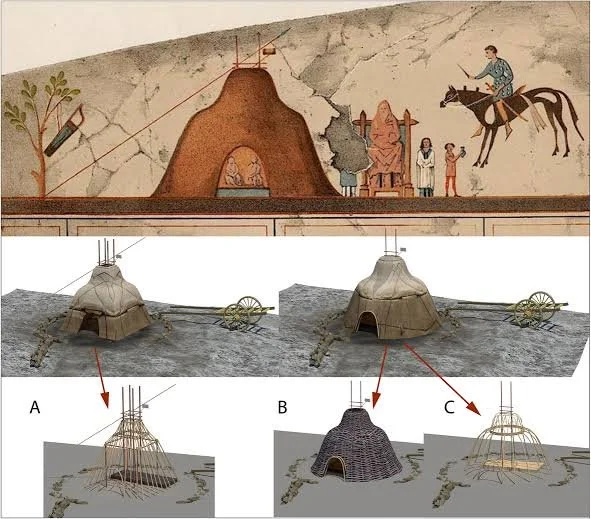
Temporary shelters may be reconstructed from postholes, stake impressions, stone anchors, or patterns of artifact distribution.
A circular or oval arrangement of postholes could indicate a shelter, but it might also represent a fence or another structure. The spacing, depth, orientation, and relationship to other features must be examined.
Ethnographic comparisons can provide possible models for how tents or lightweight structures were supported. Yet a modern or historically documented tent should not automatically be used as a direct template for a prehistoric camp.
Shelter designs change through time and vary according to available materials, cultural traditions, and practical needs.
Hearths and Cooking Areas
Hearths are among the most recognizable features of temporary occupation.
Burned soil, charcoal, ash, and heat-altered stones can indicate where fires were made. Their position may reveal patterns of domestic activity.
A hearth located near a shelter entrance might have served cooking or heating purposes. Multiple hearths could reflect repeated visits, several household groups, or different activities.
Researchers must also consider natural fires and later disturbances. Micromorphology, charcoal analysis, and soil examination can help determine whether a feature was created through human activity.
Animal Pens and Pastoral Activity
Livestock management can leave substantial traces.
Repeated animal movement may compact soil, alter vegetation, and create distinctive deposits of dung and organic material. Fences or temporary enclosures may be indicated by postholes, stone alignments, or concentrated wear patterns.
Animal bones can provide information about species, age, slaughter practices, and diet. These data may help researchers determine whether animals were raised primarily for meat, milk, wool, transport, or multiple purposes.
Dung deposits can sometimes be identified through microscopic analysis or chemical signatures. However, these methods require suitable preservation and careful comparison with other possible sources of organic matter.
Winter Conditions and Site Selection
Environmental reconstruction is essential when identifying a possible winter camp.
Researchers may examine local topography, prevailing winds, water availability, snow accumulation, vegetation, and access to grazing or stored fodder.
A sheltered valley may have offered protection from cold winds, while a south-facing slope could receive more sunlight. Yet these factors are not universally decisive. In some regions, winter flooding, predators, or access to fuel may have mattered more.
Past environmental conditions must also be reconstructed. The climate and vegetation of an ancient landscape may have differed from those observed today.
Archaeological Survey and Remote Sensing
Field survey can identify surface artifacts and subtle landscape features.
A systematic survey records the location, density, and type of material found across an area. Differences in artifact concentration may indicate zones of activity.
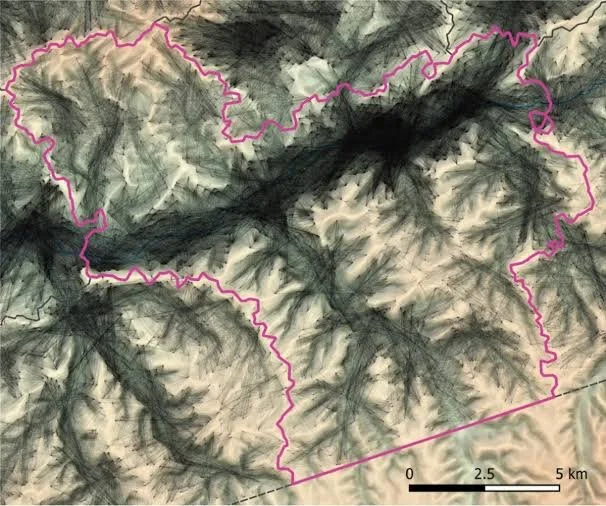
Remote-sensing techniques can also help. Aerial imagery, satellite data, photogrammetry, and LiDAR may reveal earthworks, pathways, enclosures, or changes in vegetation that are difficult to recognize at ground level.
However, remote sensing does not automatically identify a feature's function. A linear earthwork may be a field boundary, drainage feature, road, or enclosure. Ground investigation and dating are needed to determine its significance.
Soil Chemistry and Microarchaeology
When visible structures are absent, microscopic and chemical evidence may be especially useful.
Phosphate concentrations can sometimes indicate areas where organic waste accumulated. Changes in soil composition may reveal animal pens, cooking areas, or repeated human activity.
Micromorphology examines undisturbed soil samples under a microscope, allowing researchers to identify tiny layers and changes caused by burning, trampling, dung, or other processes.
These techniques are particularly valuable because temporary camps may leave little architectural evidence.
Nevertheless, chemical signatures are rarely unique. A high phosphate concentration may result from several types of activity, so interpretation requires comparison with the surrounding landscape.
Dating Repeated Occupation
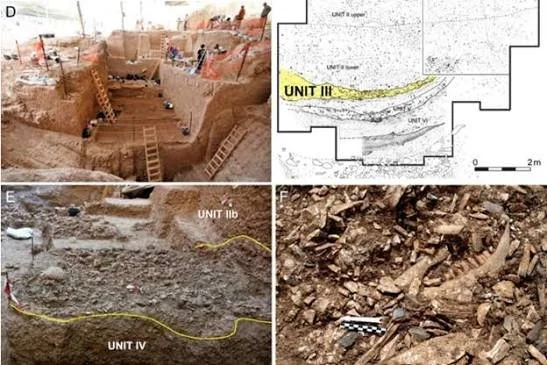
A site used repeatedly over many years may contain material from several separate visits.
Radiocarbon dating can estimate the age of suitable organic remains, while other methods may help date artifacts or sediments.
The challenge is establishing which activity produced the dated material. Charcoal from an older fire may have been moved into a later deposit, and animal bones may be redeposited by erosion or human activity.
Multiple dates and a clear stratigraphic sequence generally provide a stronger foundation than a single sample.
Distinguishing a Winter Camp from Other Sites
A temporary camp can resemble a small farmstead, hunting station, military encampment, or seasonal workshop.
Researchers must compare several lines of evidence.
A pastoral camp might contain animal-management features, seasonal occupation deposits, and an artifact assemblage consistent with mobile domestic life. A hunting station might show a different pattern of animal remains and tool use.
However, these categories can overlap. Pastoralists also hunted, repaired tools, prepared food, and engaged in trade. A camp could serve several purposes over time.
Experimental Archaeology and Ethnographic Comparison
Experimental archaeology can test how particular activities create material traces.
Researchers may construct temporary shelters, use hearths, move livestock through enclosures, or examine how cleaning practices affect artifact distributions.
Such experiments can help explain why a camp leaves certain patterns and not others.
Ethnographic research can also provide valuable insights into seasonal movement and camp organization. But comparisons must be made carefully. Modern communities have their own histories and technologies, and they should not be treated as unchanged representatives of ancient societies.
Conclusion
Reconstructing nomadic winter camps from minimal features requires archaeologists to interpret small and often ambiguous traces within a wider environmental and cultural framework. Hearths, postholes, animal remains, dung deposits, soil chemistry, and artifact distributions can collectively reveal where people lived and how they organized seasonal activities.
No single feature proves that a site was a winter camp. Strong interpretations depend on dating, environmental reconstruction, spatial analysis, and comparison with alternative explanations.
When these methods are combined, seemingly insignificant traces can reveal how mobile communities adapted to cold seasons, managed livestock, organized domestic life, and maintained long-standing patterns of movement across changing landscapes.