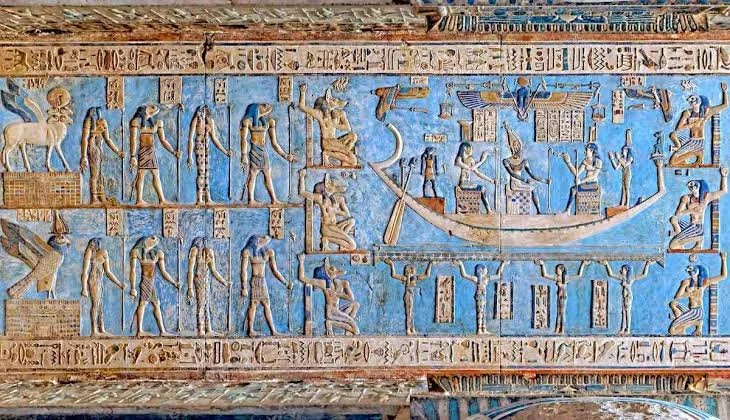
Introduction
Blue has held a distinctive place in the visual cultures of many ancient societies. It can evoke the sky, water, distance, protection, prestige, and the supernatural. Yet producing a stable blue pigment was often technically challenging because many naturally occurring blue minerals were scarce, geographically restricted, or difficult to process.
Ancient Egypt is especially famous for Egyptian blue, an artificially manufactured pigment used in painting, sculpture, and decorative objects. However, blue pigments and blue-colored materials were used in numerous other regions, including Mesopotamia, the Mediterranean, Central Asia, and parts of Europe.
Investigating blue pigments outside Egypt reveals how technological knowledge, mineral resources, trade, artistic practice, and symbolism interacted across the ancient world.
What Is a Blue Pigment?
A pigment is a material that produces color when dispersed in a binding medium or applied to a surface. It differs from a dye, which generally colors materials through a process of absorption or chemical interaction.
Ancient blue coloration could come from minerals, manufactured compounds, or organic colorants.
Important examples include:
Azurite: a naturally occurring copper carbonate mineral with a blue appearance.
Lapis lazuli: a deep-blue semiprecious stone used for inlays, beads, and ground pigment.
Indigo: an organic colorant obtained from certain plants.
Smalt: a blue glass pigment containing cobalt, especially important in later historical periods.
Egyptian blue: a manufactured calcium copper silicate pigment that originated in ancient Egypt but later became known beyond its place of invention.
These materials differ in chemical composition, durability, cost, and suitability for particular artistic techniques.
Blue in Mesopotamia
Mesopotamian societies developed extensive traditions of glazed architecture, decorative objects, seals, and luxury materials.
Blue and blue-green colors appeared in glazed bricks and other manufactured objects. The color could be produced through mineral compounds and glaze technologies rather than relying solely on ground natural stone.
Glazed architectural decoration required knowledge of raw materials, firing conditions, and surface chemistry. The production of consistent colors therefore involved specialized craftspeople and workshop traditions.
Blue-colored objects could be associated with palaces, temples, and elite settings. Their visual effect was especially powerful when used across large architectural surfaces.
However, the meaning of a blue glaze cannot be assumed from color alone. Its interpretation depends on the object, its location, its imagery, and its historical context.
Lapis Lazuli and Long-Distance Exchange
Lapis lazuli was one of the most valued blue materials in antiquity.
Major ancient sources were located in what is now northeastern Afghanistan, especially the Badakhshan region. From there, the stone traveled through networks connecting Central Asia, Iran, Mesopotamia, and other parts of the ancient world.
Because lapis lazuli was difficult to obtain in many regions, objects made from it could carry considerable prestige.
The material was used for beads, inlays, seals, and other decorative items. When ground into pigment, it could provide a rich blue, although its cost and physical properties made it different from more readily available pigments.
Lapis lazuli demonstrates that the history of color is also a history of transportation. A blue object discovered far from a geological source may reveal the movement of raw materials, finished goods, and specialist knowledge.
Azurite and Local Mineral Resources
Azurite offered another route to blue coloration.
Unlike lapis lazuli, azurite is a copper mineral that can occur in geological environments associated with copper deposits. Its availability therefore depended on local geology and access to mining or collecting sites.
The mineral could be ground into pigment for artistic use.
Its behavior differs from that of other blue materials. Under some conditions, azurite can alter or become less stable, which affects how it survives in archaeological contexts.
Identifying azurite in ancient artwork requires material analysis. A visually blue surface may have been produced by a different mineral or a mixture of compounds.
Egyptian Blue Beyond Egypt
Egyptian blue deserves special attention because it demonstrates that pigment technologies could travel.
The pigment was manufactured through a controlled process involving silica, a copper source, calcium, and heat. The resulting material has a characteristic crystalline structure that can be identified through scientific analysis.
Egyptian blue was used beyond Egypt in parts of the ancient Mediterranean, including the Greek and Roman worlds.
Its presence outside Egypt does not necessarily mean that the finished pigment was imported directly from Egypt. Knowledge of the technology, raw materials, or manufactured pigment could have moved through several routes.
Scientific identification can help researchers determine whether a blue material is Egyptian blue, but the wider question of where it was manufactured may require additional evidence.
Blue Pigments in Greek and Roman Art
Greek and Roman artists used different materials to create blue surfaces in painting, sculpture, and decorative arts.
The exact palette varied according to period, region, available resources, and the type of object being decorated.
Blue could be used in wall paintings, architectural decoration, pottery-related contexts, and representations of clothing or divine figures. Roman artists, in particular, made use of Egyptian blue in a variety of settings.
Ancient painted surfaces can be misleading today because pigments may fade, transform chemically, or become obscured by dirt and later treatments. A statue or building that appears largely white today may originally have included colored details.
Modern pigment analysis has therefore changed how scholars understand ancient visual culture.
Blue in Central Asia and the Wider Eurasian World
Blue materials circulated across Central Asia through trade and political networks connecting different cultural regions.
Lapis lazuli was particularly important because its geological sources lay far from many of the societies that valued it.
The movement of blue materials illustrates how luxury goods could connect communities separated by large distances.
However, the appearance of blue decoration in different regions does not automatically indicate that all societies shared the same symbolic interpretation. A color could be valued for rarity, technical difficulty, religious associations, or simply its visual impact.
Symbolism: Sky, Water, Protection, and Power
Blue can carry many meanings, and those meanings vary by culture and period.
Because blue is associated with the sky and water in human perception, it can become linked with weather, fertility, cosmic order, or divine presence. In some contexts, blue-colored materials were used in protective objects or elite decoration.
Yet symbolism must be established from evidence rather than inferred solely from modern associations.
An object decorated in blue might have been valued for its beauty or expense without representing a specific deity. Conversely, a blue object in a ritual setting may have carried meanings that cannot be recovered from color alone.
Inscriptions, repeated iconographic patterns, burial contexts, and comparisons with contemporary texts can help researchers interpret these possibilities.
Scientific Methods for Identifying Pigments
Modern analysis has greatly improved the study of ancient pigments.
Methods may include:
X-ray fluorescence: identifies many elements present in a material.
Raman spectroscopy: helps identify molecular and crystalline structures.
X-ray diffraction: can identify crystalline compounds.
Microscopy: reveals pigment particles, layering, and manufacturing characteristics.
Infrared imaging: can sometimes reveal underlayers or features not visible to the naked eye.
Each method has strengths and limitations. Some provide elemental information but cannot independently distinguish all compounds. Others may require careful sampling or specialized equipment.
The best results often come from combining several analytical methods with archaeological context.
Trade, Technology, and Artistic Choice
Blue pigment history is not simply a catalogue of minerals. It reflects decisions made by artists, patrons, traders, and craftspeople.
A painter might choose a locally available mineral for affordability, a manufactured pigment for consistency, or a costly stone for a prestigious commission.
A workshop might adopt a new technology through trade or migration. Another community might imitate the appearance of an expensive pigment using a cheaper alternative.
These choices help explain why similar colors can be produced through very different material processes.
Conservation Challenges
Blue pigments can be vulnerable to environmental conditions.
Light, moisture, chemical reactions, salts, and incompatible restoration materials may change their appearance. Some pigments darken or fade, while others may detach from their supporting surfaces.
Conservators must identify the materials before choosing cleaning or restoration methods.
Incorrect treatment can destroy evidence about the original pigment, its layering, or its relationship with the surrounding artwork.
Conclusion
The use of blue pigments outside Egypt demonstrates the close relationship between geology, technology, trade, and artistic expression. Natural minerals such as azurite and lapis lazuli provided important sources of blue, while manufactured materials such as Egyptian blue show how technical knowledge could spread beyond its original center of production.
Blue could communicate prestige, beauty, protection, or religious significance, but its meaning varied according to context. By combining scientific pigment analysis with archaeology and historical interpretation, researchers can reconstruct not only how ancient people produced blue but also how the search for color connected distant societies.