Introduction
Clay pipes became an important part of urban material culture after tobacco smoking spread through Europe and other regions from the sixteenth century onward. Small, fragile, and often inexpensive, tobacco pipes were used by people from a wide range of social backgrounds. Their broken stems and bowls accumulated in streets, taverns, homes, workshops, ports, and waste deposits.
These artifacts offer archaeologists an unusually detailed view of everyday life. They can reveal patterns of consumption, manufacturing, trade, social distinction, and urban waste disposal.
The relationship between clay pipes, sanitation, and class is especially important because cities were not simply places where people lived and worked. They were also environments where refuse accumulated, public health problems emerged, and authorities attempted to regulate behavior.
The Arrival of Tobacco Smoking
Tobacco smoking spread beyond the Americas following European contact in the late fifteenth and sixteenth centuries.
By the seventeenth century, smoking had become established in many European cities. Tobacco circulated through maritime trade, colonial networks, merchants, and specialized retailers.
The growth of smoking created demand for suitable pipes. Clay was a useful material because it could be molded, fired, and manufactured in large quantities.
Early modern pipes were often made with relatively small bowls, partly reflecting the cost of tobacco and changing patterns of consumption. Designs varied across time and region.
How Clay Pipes Were Manufactured
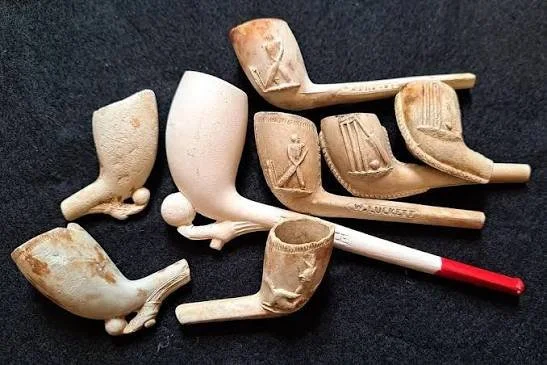
A clay pipe generally consisted of a bowl that held tobacco and a narrow stem through which smoke was drawn.
Manufacturers shaped pipes from prepared clay, often using molds. The pipes were then dried and fired.
The quality of the clay, the firing process, the mold design, and the skill of the maker influenced the finished object.
Some pipes were plain, while others carried decorative elements, maker's marks, initials, or recognizable bowl shapes.
Because pipes were inexpensive and easily broken, large quantities entered the archaeological record. Their fragility, once a disadvantage for the user, became an advantage for researchers studying patterns of everyday consumption.
Clay Pipes as Chronological Evidence
Pipe styles changed over time.
Bowl size, stem length, manufacturing details, and decorative features can help archaeologists estimate the date of a deposit. In some regions, securely dated pipe sequences provide a useful chronological tool for studying seventeenth-, eighteenth-, and nineteenth-century sites.
However, a pipe fragment does not provide an exact date on its own. Old objects can remain in use, and broken materials may be moved into later deposits.
Researchers must therefore consider the archaeological context, associated artifacts, stratigraphy, and local manufacturing history.
Smoking in Taverns, Homes, and Public Spaces
Smoking took place in many social environments.
Taverns and inns offered spaces where travelers, laborers, merchants, and local residents could gather. Pipes could also be used in private homes, workshops, ships, military settings, and outdoor spaces.
The social meaning of smoking varied. In some contexts, it was a routine leisure activity. In others, it became associated with sociability, masculine identity, commercial life, or status.
Archaeologists can investigate these patterns by comparing pipe fragments from different types of sites.
A high concentration of pipe fragments in a tavern deposit might reflect intensive use, cleaning practices, or the disposal of broken pipes. It should not automatically be interpreted as evidence that the site's entire population smoked equally often.
Class and the Cost of Consumption
Clay pipes were generally more accessible than expensive objects made from precious materials. This made them useful for examining consumption across social groups.
Plain pipes might have been used by people with limited resources, while decorated or finely manufactured examples could appeal to customers seeking a distinctive object.
Nevertheless, material simplicity does not necessarily identify a poor owner. An inexpensive pipe might be used by a wealthy person, while a fragment from a decorated pipe might have reached a site through trade or reuse.
Class interpretations become stronger when pipe evidence is combined with building types, other household objects, documentary records, and the broader economic context.
Maker's Marks and Urban Industry
Some pipe makers marked their products with initials, symbols, names, or other identifying features.
These marks can help researchers investigate production and distribution.
If similar marks appear at multiple sites, they may suggest that a workshop supplied a wider market. Documentary sources may identify manufacturers, apprentices, retailers, or guilds.
The evidence can also reveal how urban industries operated. Pipe production required access to clay, fuel, tools, workspace, and distribution networks.
Workshops could serve local customers while also supplying merchants and neighboring settlements.
Broken Pipes and the Archaeology of Waste
Clay pipes frequently broke during use. Their fragments could be discarded in household rubbish, swept into street deposits, thrown into pits, or incorporated into construction fill.
Urban refuse therefore contains traces of both consumption and sanitation practices.
The presence of pipe fragments in a drain or cesspit does not necessarily mean the pipes were used there. Such features could receive material from nearby streets, buildings, or later cleaning operations.
Understanding waste disposal requires reconstructing the formation of the deposit, not simply identifying the objects inside it.
Sanitation and Public Health
Early modern cities faced substantial challenges in removing waste and maintaining clean streets.
Refuse could accumulate near houses, markets, workshops, and waterways. Drains and cesspits served different functions, and their maintenance varied according to local infrastructure and resources.
Broken clay pipes became part of this wider waste stream.
Their presence can help researchers understand how everyday consumption contributed to the material burden of urban life.
However, pipe fragments alone cannot measure disease or establish a direct relationship between smoking and sanitation conditions. Public health interpretations require additional evidence from written records, environmental archaeology, and studies of urban infrastructure.
Regulation and Public Attitudes Toward Smoking
Authorities in different places responded to tobacco smoking in different ways.
Some governments attempted to regulate its sale or use, while other authorities collected revenue through taxation and trade controls.
Public attitudes also changed over time. Smoking could be criticized on moral, medical, religious, or social grounds while remaining popular in everyday life.
Clay pipes provide a material record of consumption, but they rarely reveal the user's opinions. Regulations, court records, personal writings, and commercial documents are needed to understand the debates surrounding tobacco.
Archaeological Distribution and Social Space
Mapping pipe fragments across a city can reveal patterns of activity.
Concentrations around commercial districts may reflect taverns, workshops, markets, or transport facilities. Deposits near ports may be connected with sailors, travelers, and imported goods.
Comparisons between elite residences and working-class neighborhoods may reveal differences in the types or quantities of pipes discarded.
Yet such comparisons must account for excavation size, preservation, cleaning practices, and differences in waste disposal. A site with more excavated soil may naturally produce more artifacts.
What Chemical Analysis Can Reveal
Scientific analysis can sometimes help identify the composition of pipe clay and compare it with known geological sources or production regions.
Elemental analysis may distinguish some groups of raw materials, although similar clays can produce overlapping chemical signatures.
Residue analysis may also be considered in particular cases, but identifying the contents of an ancient pipe is not always straightforward. Organic material can degrade, contamination can occur, and many substances leave no distinctive surviving trace.
Claims about specific tobacco blends or other smoked materials should therefore be based on demonstrable evidence.
Conclusion
Urban clay pipes provide a valuable record of smoking, commerce, social life, and waste disposal in early modern cities. Their changing forms can help date archaeological deposits, while maker's marks and material analysis can illuminate production and trade.
Their distribution also reveals how ordinary consumption became part of the urban environment. Broken pipes entered streets, drains, pits, and household rubbish, linking private habits with public sanitation.
Although clay pipes cannot independently reconstruct social class or public health, they become powerful evidence when studied alongside buildings, documents, environmental remains, and other artifacts. Through this combined approach, a small and fragile object can reveal much about the organization of early modern urban life.