Feasting has played an important role in many societies, providing opportunities for communities to gather, exchange resources, strengthen relationships, and mark significant events. In pastoral communities, where wealth and daily life may be closely connected to herds of sheep, goats, cattle, or other livestock, large meals can carry particular economic and social importance. Animals represent more than a source of food: they may also symbolize wealth, household security, status, and long-term obligations between families. Archaeological evidence of large-scale animal processing and cooking can therefore help researchers investigate how pastoral communities organized gatherings and used food to maintain social relationships.
Reconstructing a feast from archaeological remains is not as simple as finding a large collection of animal bones beside a fire. Burned soil, charcoal, hearths, and animal remains can result from many different activities, including ordinary cooking, repeated domestic use, waste disposal, craft production, or accidental fires. A large deposit may have accumulated over a long period rather than during a single event. Archaeologists must determine whether the remains represent a distinct episode of activity or a mixture of materials deposited through repeated use of the same location.
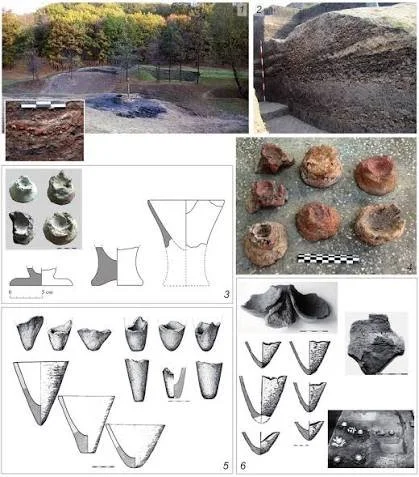
Burn patterns can provide useful evidence about how fire was used at a site. The distribution of charcoal, ash, reddened soil, and heat-altered stones may help identify the position and approximate extent of a hearth. In some cases, burned areas may show that several fires operated at the same time, potentially indicating an activity involving more than one cooking station. The shape and depth of heat alteration can offer clues about the intensity and duration of burning, although soil composition, moisture, and the availability of fuel also influence these patterns.
Different methods of cooking can leave different archaeological traces. Meat may have been roasted over open fires, cooked in vessels, or prepared through combinations of heating and boiling. Large animals might have required substantial fires and considerable fuel, while smaller portions could have been prepared using more limited equipment. However, burned bones do not always represent food cooked directly over a fire. Bones may be burned after a meal when discarded remains are thrown into a hearth, or they may be exposed to fire during the cleaning of an activity area. Researchers must distinguish between evidence of cooking and evidence of later disposal whenever possible.
Animal bones are particularly valuable because they can reveal which species were present, how animals were processed, and whether the remains represent a large or small portion of a herd. Species identification may show whether the deposit contains mostly sheep and goats, cattle, or a mixture of livestock. Differences in the ages of the animals can provide information about herd management and the selection of animals for consumption. For example, the presence of animals of several ages may reflect a different pattern of slaughter from a deposit dominated by young adults. These patterns, however, must be interpreted in relation to the local economy and the natural characteristics of each species.
Butchery marks can help reconstruct how carcasses were divided. Cut marks made by stone or metal tools may indicate where joints were separated, while fracture patterns can provide evidence of marrow extraction or the processing of bones for other purposes. The distribution of body parts may also be informative. A deposit containing many meat-rich portions could reflect food preparation or consumption, while an assemblage dominated by less desirable portions might represent waste brought from another location. Yet bones can be transported, sorted, reused, and discarded in different places, so the remains found at a feast site may not represent every stage of animal processing.
The minimum number of animals represented in a deposit is another important consideration. A large collection of bone fragments does not necessarily indicate that a large number of animals were slaughtered, because a single carcass can produce many fragments. Archaeologists compare repeated skeletal elements, side, size, age, and other characteristics to estimate how many individual animals are represented. Fragmentation can make this process difficult, particularly when bones have been broken, burned, trampled, or affected by soil conditions. Estimates should therefore reflect the limitations of the surviving material rather than present an uncertain count as an exact figure.
Reconstructing the scale of a feast requires even greater caution. The number of animals consumed does not translate directly into a reliable estimate of attendees. Some meat may have been distributed to households that were not present, while other portions may have been stored, exchanged, or carried away. Bones from the meal may have been deposited in several locations, and some remains may have disappeared through decay or later disturbance. Researchers can estimate the potential amount of edible meat represented by an assemblage, but calculations of the number of participants need to account for these uncertainties and should generally be presented as broad possibilities.
Pastoral feasting may also have been connected to the seasonal movement of herds. Some gatherings could have taken place when animals were readily available near a settlement or seasonal camp. Others may have coincided with marriage arrangements, alliances, religious observances, funerary events, or negotiations between households. Large meals could help redistribute food and demonstrate a host's ability to provide resources for others. In some contexts, slaughtering valuable animals may have reinforced relationships between groups, while in others a feast may have served a more practical purpose, such as marking a seasonal gathering or bringing together people involved in herding and trade.
The archaeological evidence for these social functions is often indirect. A large concentration of bones does not independently prove that an event was ceremonial, and a large hearth does not necessarily indicate a communal gathering. Stronger interpretations emerge when the remains are associated with other evidence, such as unusual arrangements of structures, specialized objects, repeated deposits, or a settlement layout capable of accommodating groups of visitors. Comparisons with other sites from the same region can help establish whether the scale and composition of the assemblage differ from ordinary household activity.
The location of a possible feasting site may also reveal practical decisions. Pastoral groups needed access to water, fuel, grazing areas, and places where animals could be gathered or slaughtered. A site positioned near a seasonal route or a reliable water source may have been well suited to temporary gatherings. Evidence of temporary shelters, animal enclosures, or repeated occupation could support an interpretation involving seasonal use. Environmental remains, including charcoal and plant fragments, may help reconstruct the surrounding landscape and indicate which fuel sources were available. These clues can provide a broader picture of how people organized large meals within mobile or semi-mobile ways of life.
Dating is essential when researchers want to determine whether a deposit represents one feast or repeated activity. Stratigraphy can reveal whether burned layers formed during separate episodes, while radiocarbon dating may establish the age of suitable charcoal or bone collagen. However, charcoal from long-lived trees can produce dates older than the event in which it was burned, a problem known as the old-wood effect. Bones may also be difficult to date when preservation is poor or when the animal's diet introduces complications. A combination of dating evidence and careful examination of the deposit's formation is therefore preferable to relying on a single sample.
Taphonomic analysis, which examines what happened to remains between their original deposition and archaeological recovery, is especially important. Animal bones can be affected by scavengers, trampling, weathering, soil acidity, water movement, and later human activities. These processes may change the apparent proportions of species and skeletal elements or create patterns that resemble deliberate disposal. Burned remains may also be moved from their original location before burial. By studying surface modifications, fragmentation, weathering, and the relationship between bones and sediment, researchers can evaluate how closely the surviving assemblage reflects the original event.
Reconstructing pastoral feasting sites ultimately involves bringing together several incomplete forms of evidence. Burn patterns can reveal where and how fires were used, while bones provide information about animal selection, slaughter, food preparation, and disposal. Environmental remains, settlement features, and dating evidence help place these activities within a wider landscape and chronology. The social meaning of a gathering is more difficult to establish, but the combination of archaeological clues can show whether an assemblage differs from ordinary household consumption and whether it may represent a larger communal event. Through careful analysis, even fragmented bones and traces of ancient fires can contribute to understanding how pastoral communities shared resources, maintained relationships, and created occasions for collective life.