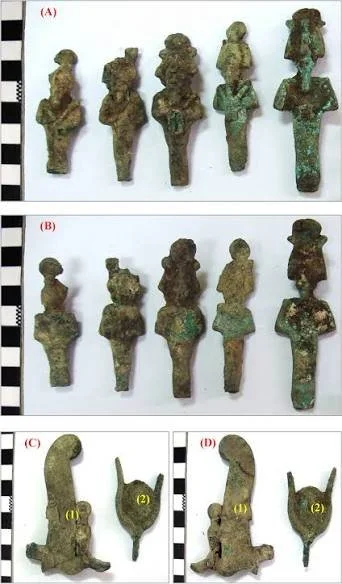
Bronze artifacts recovered from wetland environments can provide valuable information about ancient metalworking, burial practices, and the environmental conditions that affected objects after they were deposited. Bronze, commonly made from copper and tin, was used to manufacture tools, weapons, ornaments, vessels, and objects associated with social or ceremonial activities. Although bronze is generally more resistant to certain forms of damage than some other metals, it can undergo complex chemical changes during burial. In wetlands, where water, organic matter, dissolved minerals, and fluctuating oxygen levels interact, corrosion can develop in ways that are difficult to understand through visual examination alone.
Corrosion is often described as the deterioration of metal through chemical or electrochemical reactions with its surroundings. In archaeological bronze, the process may begin soon after an object is buried, although the rate and character of corrosion depend on the local environment. Copper reacts with substances in soil and water to form different corrosion products, while tin may behave differently and sometimes become concentrated in particular layers. Other elements, including lead, may also be present depending on the original alloy. The composition of an artifact therefore influences how it responds to burial conditions, and two bronze objects from the same site may develop noticeably different surfaces.
Wetlands create particularly complicated burial environments because their chemistry can change over short distances. Some areas remain waterlogged and oxygen-poor for long periods, while others experience seasonal flooding, drainage, or fluctuations in groundwater. Organic material in the sediment can support microbial activity and influence the availability of chemical compounds. Dissolved salts and minerals may enter the deposit through groundwater or surrounding geological formations. These conditions affect the reactions that take place on the metal surface and can produce corrosion layers with different colors, textures, and mineral compositions.
Copper corrosion products may include oxides, carbonates, chlorides, and sulfide minerals, depending on the substances available in the burial environment. Green or blue-green surfaces are often associated with copper compounds, but color alone cannot identify a specific mineral. Similar colors may arise from different chemical processes, and corrosion layers can contain several compounds mixed together. Dark or black surfaces may also develop under particular conditions, including environments where sulfur compounds are present. The visible appearance of an artifact is therefore a useful starting point for examination, but it is not a reliable substitute for laboratory analysis.
Chloride-bearing environments can be especially problematic for copper alloys. Chloride compounds may become incorporated into corrosion layers and contribute to continuing deterioration when moisture and oxygen conditions change. Some forms of chloride-related corrosion can remain active even after an artifact has been removed from the ground. An object that appears stable during excavation may begin to develop powdery deposits, pits, or new areas of corrosion after exposure to air. This is one reason why wetland bronze requires careful handling and appropriate conservation assessment soon after recovery.
Sulfur chemistry can also influence the condition of bronze buried in wetlands. In oxygen-poor sediments rich in decomposing organic matter, microbial processes may contribute to the formation of sulfide compounds. These compounds can interact with copper and other metals, producing corrosion layers that differ from those formed in more oxygenated soils. The resulting mineral patterns may preserve information about the burial environment, including changes in water saturation and the availability of particular chemical substances. However, the relationship between a corrosion layer and a specific environmental event is rarely simple. Different processes can occur at the same time, and later changes may alter the original deposits.
Geochemical analysis allows researchers to investigate these processes in greater detail. X-ray diffraction can help identify crystalline minerals, while Raman spectroscopy can provide information about molecular structure and mineral composition. Scanning electron microscopy combined with elemental analysis can reveal the distribution of elements across a corrosion layer and show how the layer is organized. These methods can be used together to examine the relationship between the original metal, the corrosion products, and the surrounding sediment. Soil and water samples may also be analyzed to identify chemical conditions that contributed to corrosion.
The internal structure of a corrosion layer can be as important as its outer appearance. Some artifacts develop several distinct layers, reflecting changes in the substances that interacted with the metal over time. A relatively compact layer may form close to the original surface, while more porous deposits develop farther outward. In other cases, corrosion penetrates deeply into the metal, leaving only a fragile remnant of the original object. Researchers can examine these layers to understand how deterioration progressed, although the sequence may have been modified by groundwater movement, soil disturbance, or changes that occurred after excavation.
The original composition of the bronze must also be considered. Ancient metalworkers did not always produce alloys with perfectly uniform proportions of copper and tin. Differences in the materials used, the melting process, and the manufacturing technique could create variations within a single object. Some artifacts also contain lead or other elements that affect their physical properties and corrosion behavior. By comparing alloy composition with the distribution of corrosion products, researchers can investigate whether particular parts of an object were more vulnerable to deterioration. Such comparisons may also contribute to broader research into ancient metalworking practices and the selection of raw materials.
Corrosion can reveal information about burial conditions, but it should not be treated as direct proof of an object's original purpose. A heavily corroded bronze weapon is not necessarily evidence of a violent event, just as a beautifully preserved ornament does not automatically indicate ritual use. The condition of the metal reflects a combination of its composition, burial environment, duration of exposure, and later treatment. To investigate whether an object was deliberately deposited as an offering, buried with an individual, discarded as waste, or lost accidentally, archaeologists must examine its position, associated finds, and the wider context of the site.
The transition from burial to excavation creates another important stage in the object's history. When bronze is removed from a wetland, its exposure to oxygen, changing humidity, and new temperatures can alter the chemical balance that existed underground. Salt crystals may form as moisture evaporates, while unstable corrosion products can react with the new environment. Conservators therefore need to document the object's condition and assess its composition before deciding how to clean or stabilize it. Aggressive removal of corrosion may destroy surface details, manufacturing marks, or evidence of the object's burial history.
The study of bronze corrosion in wetlands brings together archaeology, chemistry, geology, and conservation science. Through the analysis of mineral composition, alloy structure, soil conditions, and changes after excavation, researchers can better understand how ancient metal objects survived and deteriorated. These findings help distinguish original manufacturing features from later damage and support decisions about long-term preservation. More broadly, the geochemistry of corrosion demonstrates that archaeological objects continue to interact with their environments long after their original use has ended, recording a complicated history that extends from metalworking and deposition to burial and modern recovery.