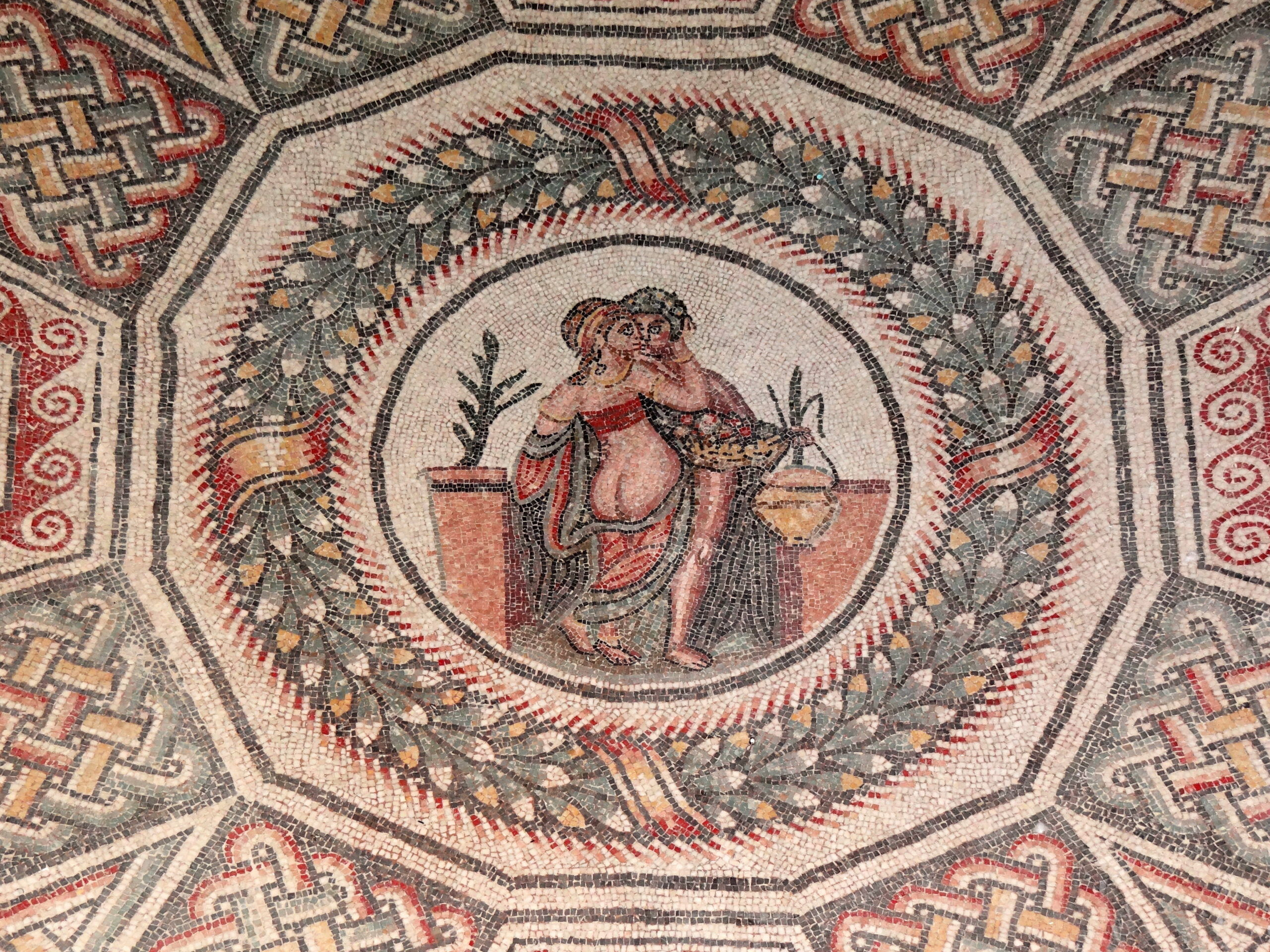
The Villa Romana del Casale in Sicily contains the most extensive and well-preserved collection of Roman mosaics in the world. Dating to the early 4th century CE, this palatial estate features over 3,500 square meters of intricate floor art.
While the physical site remains a UNESCO World Heritage marvel, digital reconstruction has become the primary tool for archaeologists to understand the villa’s original architectural splendor and the "visual narrative" intended by its mysterious owner.
1. The Scope of the Art: A World in Stone
The mosaics were not mere decorations; they were a display of immense wealth and political connections. The stones used (tesserae) were sourced from across the Empire to provide a vast palette of natural colors.
The Great Hunt: A 60-meter-long mosaic depicting the capture and transport of exotic animals—elephants, tigers, and rhinoceroses—from Africa and India to the Colosseum in Rome.
The "Bikini Girls": Formally known as the Coronation of the Victress, this mosaic depicts young women engaged in weightlifting, discus throwing, and ball games, wearing two-piece athletic outfits that look remarkably modern.
Mythological Scenes: Elaborate depictions of Polyphemus, Hercules, and Arion riding a dolphin, used to showcase the owner’s high level of classical education (paideia).
2. The Challenge of Physical Preservation
For centuries, the villa was buried under a mudslide, which paradoxically "pickled" and protected the mosaics from weathering and looters. However, since their excavation in the 1950s, they have faced new threats.
Humidity and Micro-climates: The influx of tourists and the weight of modern protective structures created moisture traps that threatened to loosen the tesserae.
Restoration Fatigue: Early attempts to preserve the mosaics using cement and wax actually caused long-term damage by trapping salt and moisture beneath the surface.
3. Digital Reconstruction: The Virtual Restoration
Archaeologists and digital engineers are now using non-invasive technology to "rebuild" the villa in virtual space without touching a single stone.
Laser Scanning (LiDAR): Millions of data points are used to create a 3-dimensional map of the villa’s topography. This allows researchers to see how light would have hit the mosaics at different times of day.
Photogrammetry: Thousands of high-resolution overlapping photos are stitched together to create 3D models of individual mosaic rooms. This allows for "micro-analysis" of the artist's technique, such as the opus vermiculatum (worm-like work) used for fine details.
Color Correction: Using chemical analysis of the stone types, digital artists can "re-saturate" the mosaics in a virtual environment, showing the vibrant reds, deep blues, and shimmering golds as they appeared 1,700 years ago.
4. Augmented Reality (AR) on Site
One of the most exciting developments at the Villa Romana del Casale is the use of AR to bridge the gap between ruins and reality.
Virtual Overlays: Using tablets or AR glasses, visitors can stand in the Peristyle and see the missing walls, painted frescoes, and soaring timber-trussed roofs rise up around the existing mosaic floors.
Narrative Animation: Digital tools can "animate" the Great Hunt, showing the intended flow of the story as a guest would have walked through the corridor, transforming the floor from a static image into a cinematic experience.
5. Solving Archaeological Mysteries
Digital modeling has helped settle long-standing debates about who owned the villa.
The Imperial Theory: Some scholars believe it belonged to the Emperor Maximian. Digital reconstructions of the throne room and the "Great Hunt" suggest a scale of ceremony that only an Emperor or a high-ranking member of the Tetrarchy could maintain.
The Senatorial Theory: Others argue the iconography points to a wealthy Roman Senator involved in the trade of wild animals for the games. Digital mapping of the guest flow suggests a home designed for massive social receptions and political "networking."
The Villa Romana del Casale is a testament to the fact that archaeology is no longer just about the shovel; it is about the pixel. By digitally preserving these "stone carpets," we ensure that even if the physical stones eventually succumb to time, the stories they tell will remain accessible in high-definition.