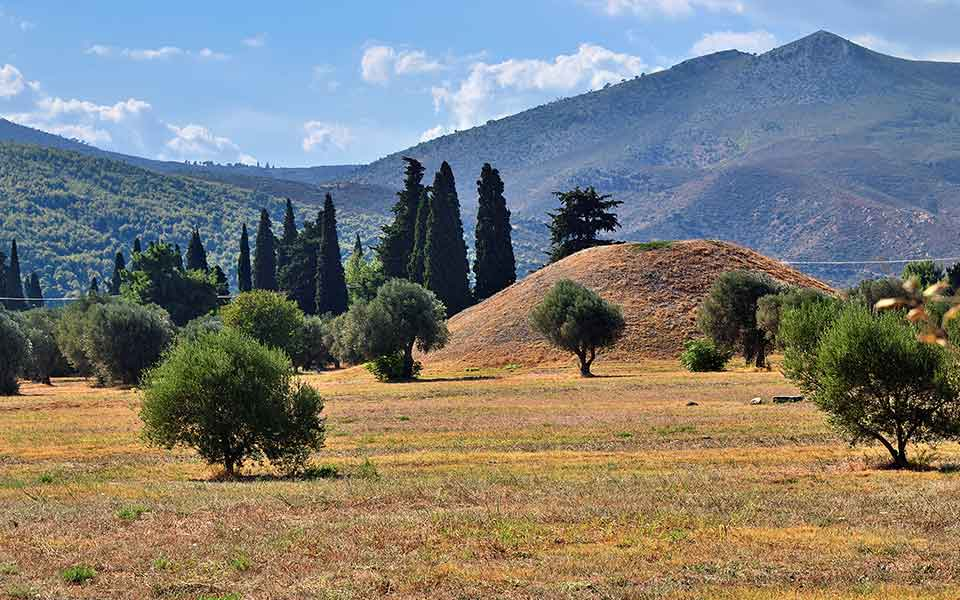
The Battle of Marathon (490 BCE) was a pivotal moment in Western history, where a heavily outnumbered Athenian force defeated the first Persian invasion of Greece. While the tactics of the battle are legendary, the physical proof of the conflict lies in a massive, 9-meter-high earthwork known as the Soros, or the Burial Mound of the Athenians.
The mound is one of the few archaeological sites that directly links a specific historical event described by ancient writers, like Herodotus, to a tangible physical location.
1. The Significance of the Soros
In ancient Greece, it was standard practice to return the bodies of the fallen to their home city for burial in the public cemetery (the Kerameikos). Marathon was a rare exception.
Special Honors: Because of their extraordinary bravery in saving Athens from the Persians, the 192 Athenians who died were buried exactly where they fell on the battlefield.
The Structure: The mound was originally surrounded by marble slabs (stelae) inscribed with the names of the dead, organized by their tribes.
The "Plataean" Mound: A second, smaller mound was discovered nearby at Vrana, which archaeologists believe holds the remains of the Plataeans, the only other Greeks who came to Athens' aid during the battle.
2. Excavation: Proving the Legend
For centuries, the mound was just a prominent hill on the plain. It wasn't until the late 19th century that archaeology confirmed its identity.
Schliemann's Failure: Heinrich Schliemann (famous for Troy) dug into the mound in 1884 but found nothing, leading him to believe it was a prehistoric structure.
Staïs's Success: In 1890-1891, Greek archaeologist Valerios Staïs excavated deeper and found a layer of cremated human bones, charcoal, and funeral vases (lekythoi) dating precisely to the early 5th century BCE.
The Evidence of Battle: Mixed with the remains were obsidian and flint arrowheads. While these seem primitive for the Iron Age, they match Herodotus’s description of the Persian army's Ethiopian archers, who used stone-tipped arrows.
3. Tactical Insight: Where the Fighting Was Heaviest
The location of the mound provides a "GPS coordinate" for the climax of the battle.
The Thin Center: Miltiades, the Athenian general, intentionally thinned his center to strengthen his wings. When the Persians broke through the middle, the Athenian wings closed in like a trap (a double envelopment).
The Killing Ground: The mound is located in the area where the center of the Greek line took the brunt of the Persian assault. This suggests the 192 fallen were likely those who held the line against the Persian elite while the wings secured the victory.
4. The Trophy of Marathon
Near the Great Marsh at the edge of the plain stands a reconstruction of the Trophy of Marathon.
The Original: After the battle, the Athenians erected a monument consisting of captured Persian armor and weapons hung on a wooden post.
The Marble Successor: Later, this was replaced with a permanent white marble column topped by a Nike (Victory) statue. Fragments of this column were found built into a nearby medieval tower, allowing archaeologists to relocate the site where the Persians finally broke and fled toward their ships.
5. The "Tomb of the Persians" Mystery
If 192 Athenians were buried in a great mound, where are the 6,400 Persians who Herodotus claims died?
Mass Graves: Archaeologists have never found a "Great Mound of the Persians." It is likely they were buried in simple, unmarked mass pits that have since been covered by the shifting silt of the Charadros River.
The Great Marsh: Many Persians were driven into the marsh during their retreat. This swampy ground likely swallowed many of the remains, making them nearly impossible to recover through traditional excavation.
6. Ritual and Memory
The mound was not just a grave; it was a site of active worship. Every year, Athenian youths (ephebes) would travel to the plain to offer sacrifices and lay wreaths at the mound.
Votive Offerings: Excavations revealed hundreds of small ceramic vessels and food remains, showing that for centuries after the battle, the "Marathon-fighters" (Marathonomachoi) were treated as semi-divine heroes, much like the figures from Homeric myths.
The Burial Mound of the Athenians serves as a permanent anchor for the legend of the "Marathon Run." It reminds us that behind the myth of Pheidippides and the 26-mile race, there was a visceral, bloody struggle that was meticulously documented and honored by the survivors.