
Introduction
The Meroitic civilization developed in the Middle Nile region and became one of the most important states of ancient Nubia.
Its political center eventually shifted southward toward Meroe, while religious and economic networks extended across the Nile Valley.
The title Serra East: Nubia's Meroitic Temple points toward an archaeological landscape associated with Meroitic-period remains in northern Nubia.
Because the identification of individual structures as Meroitic temples requires archaeological documentation, the title should be interpreted within the broader context of Nubian temple architecture.
The Kingdom of Kush
Meroitic civilization developed from the earlier Kingdom of Kush.
Kush became a major power in northeastern Africa.
At one point, Kushite rulers controlled Egypt as the Twenty-Fifth Dynasty.
Later, the political center shifted farther south.
Meroe
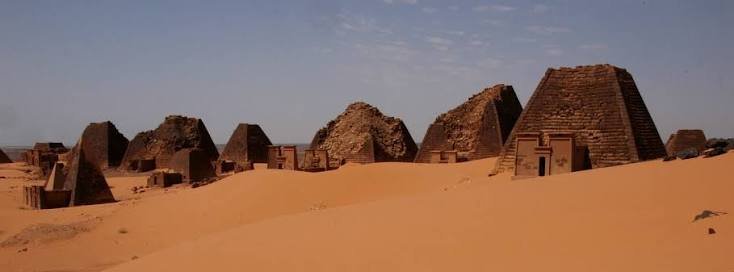
Meroe became an important royal center.
The region contained:
palaces,
temples,
pyramids,
workshops,
settlements,
and cemeteries.
Ironworking was also associated with the Meroitic world, although interpretations of its scale and organization continue to be studied.
Religious Architecture
Meroitic temples could be dedicated to several deities.
Important religious figures included:
Amun,
Isis,
Apedemak,
Hathor,
and other Egyptian and Nubian deities.
The coexistence of Egyptian religious traditions with local Nubian beliefs produced distinctive religious architecture.
Temple Design
Temples could contain:
pylons,
courtyards,
sanctuaries,
columns,
offering areas,
and relief decoration.
Their layouts reflected both Egyptian architectural traditions and local developments.
The Meroitic Script
One of the most fascinating features of Meroitic civilization is its writing system.
Meroitic used both hieroglyphic and cursive scripts.
Although scholars can read much of the script's signs, the Meroitic language itself remains only partially understood.
This limits our ability to reconstruct the exact meaning of many inscriptions.
Religious Imagery
Meroitic art often portrayed rulers and gods.
One particularly distinctive deity is Apedemak, frequently represented as a lion-headed figure.
His prominence demonstrates that Nubian religion was not simply an imitation of Egypt.
Local religious traditions developed their own distinctive expressions.
Serra and the Nile
Northern Nubia was connected to both Egypt and the wider Meroitic world.
The Nile functioned as the principal transportation route.
Temples positioned along the river could therefore participate in economic, religious, and political networks.
Archaeological Context
A temple cannot be understood simply as an isolated building.
Researchers examine its relationship with settlements, cemeteries, roads, river channels, agricultural areas, and other religious structures.
This broader context reveals how religion interacted with everyday life.
Conclusion
Serra East: Nubia's Meroitic Temple provides an entry point into the complex religious world of ancient Nubia.
Meroitic temples demonstrate the interaction between Egyptian religious traditions and indigenous Nubian beliefs.
Their inscriptions, architecture, and imagery provide evidence for a civilization that developed its own political and cultural identity while maintaining long-standing connections with the Nile Valley world.





