
Introduction
Sesebi was an important New Kingdom settlement in Nubia associated with the reign of Akhenaten and the dramatic religious and political changes of the fourteenth century BCE.
Located near the Nile in modern Sudan, Sesebi provides archaeologists with evidence for Egyptian settlement and administration in a region where political power, trade, and cultural interaction were closely connected.
The site is especially interesting because of its association with the Amarna period, when Akhenaten promoted the worship of the Aten and reorganized Egypt's religious institutions.
The Foundation of Sesebi
Sesebi appears to have been developed as an organized Egyptian settlement during the reign of Akhenaten.
Its layout included substantial mud-brick architecture, administrative buildings, residential areas, and a temple complex.
The settlement's planned character suggests that it served a significant administrative and political function.
Its location along the Nile made it strategically useful for transportation and communication.
Akhenaten's Religious Revolution
Akhenaten's reign is famous for the promotion of the Aten, represented as the solar disk whose rays ended in hands.
The king established a new capital at Akhetaten, modern Amarna, and dramatically reduced the political prominence of traditional cults.
The ideological transformation was not limited to Egypt.
Monuments in Nubia also reflected the changing religious environment.
Sesebi therefore provides an opportunity to study how the Amarna religious reforms affected Egypt's southern territories.
The Temple
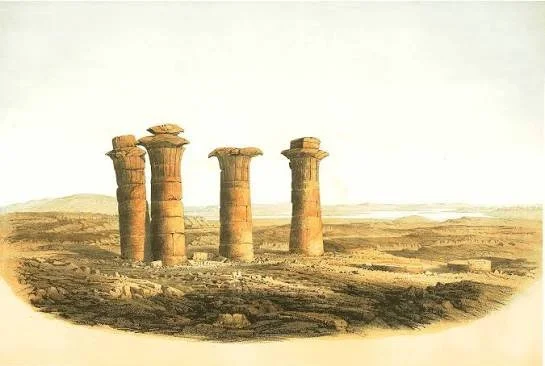
The temple complex at Sesebi is particularly significant.
Its architecture and inscriptions demonstrate connections with the religious policies of Akhenaten. However, subsequent rulers altered the site, reflecting the political reversal that followed Akhenaten's death.
The restoration of traditional Egyptian religious institutions under later rulers transformed many monuments associated with the Aten.
Sesebi therefore preserves evidence for both ideological change and ideological restoration.
The Town's Population
A major archaeological question concerns who lived at Sesebi.
The settlement was associated with Egyptian administration, but Nubia itself was home to diverse communities.
Workers, soldiers, administrators, craftspeople, merchants, and local populations could have interacted at the site.
Pottery, architecture, tools, food remains, and other archaeological materials can help researchers investigate everyday life.
Such evidence is often more revealing than monumental inscriptions because it provides clues about ordinary people.
The Archaeology of Mud Brick
Much of Sesebi's architecture was constructed from mud brick.
Mud brick was one of the most common building materials throughout the Nile Valley because suitable clay and water were readily available.
Although less durable than stone, mud-brick architecture could be constructed rapidly and on a large scale.
Its preservation therefore requires specialized archaeological methods.
Wall foundations, collapsed structures, streets, and room layouts can reveal how settlements were organized.
Sesebi and Imperial Administration
Sesebi illustrates how Egyptian power operated outside the traditional Egyptian heartland.
Military authority alone could not maintain a large territory.
The Egyptian state required administrative centers, agricultural production, transportation, taxation, religious institutions, and labor systems.
Settlements such as Sesebi were therefore components of a broader imperial infrastructure.
Conclusion
Sesebi provides a valuable window into New Kingdom Nubia during one of the most transformative periods in Egyptian history.
Its architecture and archaeological remains connect southern Egyptian administration with the religious revolution of Akhenaten. At the same time, the settlement demonstrates that imperial landscapes were inhabited by diverse communities whose experiences cannot be reconstructed solely through royal inscriptions.





