
Introduction
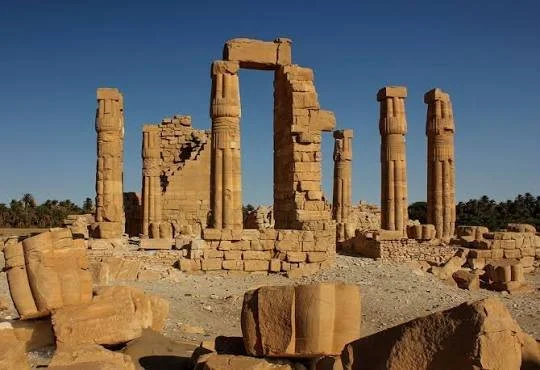
Soleb is one of the most spectacular surviving monuments of ancient Nubia. Located in what is now northern Sudan, the site contains the remains of a monumental temple constructed during the reign of the Egyptian pharaoh Amenhotep III in the fourteenth century BCE.
The temple was dedicated primarily to Amun and to the deified form of Amenhotep III himself. Its architecture demonstrates the extraordinary scale of Egyptian royal investment in Nubia during the New Kingdom.
Soleb is particularly important because it illustrates how Egyptian rulers used monumental architecture to express political authority far beyond the traditional boundaries of Egypt.
Amenhotep III and the Nubian Frontier
Amenhotep III ruled during the Eighteenth Dynasty, a period of considerable wealth and international influence.
Egypt's control over Nubia had expanded dramatically during the preceding centuries. Gold production, trade, military power, and administrative expansion made the southern territories extremely important to the Egyptian state.
Monumental temples became instruments through which Egypt expressed its authority.
Soleb was therefore not simply a religious building. It was also a political statement.
The Temple Complex
The temple at Soleb was built on a grand scale.
Its architecture included monumental gateways, courtyards, columns, sanctuaries, and extensive decorative programs. Reliefs portrayed gods, royal ceremonies, offerings, and other scenes connected with Egyptian religious ideology.
The temple's layout followed principles recognizable from major Egyptian religious architecture, yet its presence in Nubia gave the building a distinctive political meaning.
The temple transformed the landscape into a monumental expression of pharaonic authority.
Amenhotep III as a Divine Figure
One of the most remarkable features of Soleb is the association between the temple and the king's divine identity.
Egyptian kings were understood through a complex theological system in which the ruler occupied a special position between gods and humanity.
At Soleb, Amenhotep III became associated with divine worship. The temple therefore contributed to a larger program through which royal monuments could reinforce the ideological legitimacy of Egyptian rule.
This did not necessarily mean that Nubians simply accepted Egyptian religion unchanged. Religious practices in Nubia developed through interaction between Egyptian traditions and local beliefs.
The Temple and Amun
Amun was one of the most important gods of the New Kingdom.
The god's major cult center was at Karnak in Thebes, but Amun's influence extended throughout the Egyptian-controlled Nile Valley.
Soleb's association with Amun linked Nubia directly to the religious ideology of the Egyptian state.
The temple could consequently serve as a ceremonial center while also reinforcing political relationships between the Egyptian administration and local populations.
The Columns and Reliefs
The surviving architectural fragments at Soleb provide valuable information about New Kingdom artistic conventions.
Reliefs depict royal and divine imagery, while inscriptions commemorate Amenhotep III and his achievements.
The craftsmanship demonstrates the resources available to the Egyptian monarchy during one of its wealthiest periods.
The monument also helps researchers study the development of imperial iconography. Images of the king, gods, foreign peoples, and conquered or subordinate territories formed part of a visual language through which Egypt represented its place in the wider world.
Soleb and Modern Archaeology
The site was investigated by modern archaeologists during the twentieth century, particularly through major work associated with Michela Schiff Giorgini and later researchers.
Archaeological work has documented the architecture, inscriptions, sculpture, and surrounding settlement landscape.
Soleb has also become important for understanding relationships between Nubian monuments and Egyptian imperial centers.
The temple's survival is remarkable considering the environmental conditions and the long history of reuse.
Conclusion
Soleb is one of the clearest examples of how architecture became an instrument of empire in ancient Nubia.
The temple combined religion, royal ideology, artistic expression, and political authority. Its monumental remains demonstrate the wealth and organizational capabilities of the Egyptian New Kingdom while simultaneously reminding researchers that Nubia was a complex cultural region rather than merely an extension of Egypt.





