
Introduction
The archaeological landscape of Nubia preserves some of the most important evidence for ancient Egypt's interaction with the regions south of the First Cataract. Among the settlements and defensive installations associated with these interactions is Tabo, a site in the broader Nubian archaeological landscape whose significance is connected with the long history of Egyptian administration, military organization, trade, and cultural exchange along the Nile.
The phrase "Middle Kingdom fort" should be approached carefully. Nubia contained numerous Egyptian fortifications during the Middle Kingdom, particularly during the Twelfth Dynasty, when Egyptian rulers established a chain of defensive settlements and fortresses between the First and Second Cataracts and farther south. These installations were not simply military bases. They served as administrative centers, customs points, storage facilities, residences, and mechanisms for controlling movement through the Nile corridor.
Tabo therefore belongs to a larger archaeological story: the transformation of the Nile Valley into a politically interconnected landscape in which Egyptian authorities and Nubian societies negotiated power, trade, migration, and cultural identity.
Egypt's Middle Kingdom Expansion into Nubia
The Middle Kingdom, particularly the reigns of rulers of the Twelfth Dynasty, witnessed a major expansion of Egyptian state activity into Lower Nubia. Earlier Egyptian rulers had already conducted expeditions southward, but Middle Kingdom governments developed a much more systematic strategy.
Fortresses were constructed at strategically important points along the Nile. Their locations allowed authorities to monitor river traffic and protect communication routes.
The fortification system is particularly associated with rulers such as Senusret I, Senusret III, and Amenemhat III. Senusret III is especially famous for strengthening Egypt's southern frontier and establishing or expanding a network of fortifications.
These installations demonstrate that Nubia was not a peripheral region in Egyptian history. It was an economically and strategically significant zone.
Architecture of Nubian Fortresses
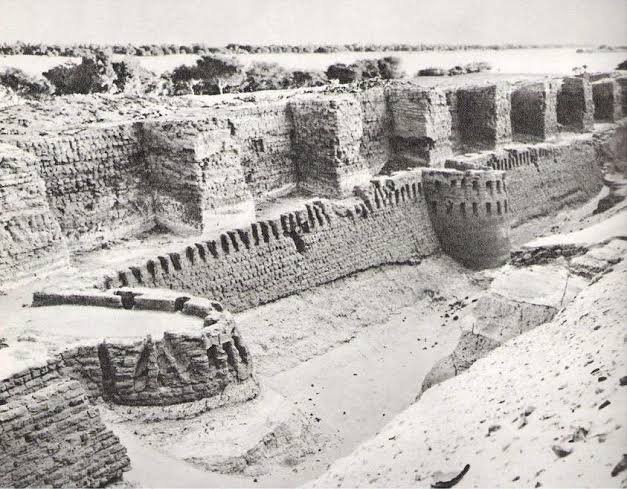
Middle Kingdom fortresses could contain massive mud-brick walls, towers, gates, internal streets, administrative structures, granaries, magazines, and residential quarters.
Their architecture was adapted to the geography of the Nile. Some were constructed on rocky islands or elevated river terraces, while others occupied strategic bends and narrow passages.
The thick walls provided protection, but the fortresses also controlled access. Gates and river approaches could be monitored, allowing officials to regulate the movement of people and goods.
Archaeological remains from comparable Middle Kingdom fortresses show sophisticated planning. Buildings were often arranged according to administrative and military requirements, revealing the organizational capabilities of the Egyptian state.
Trade and Administration
Military control was only one component of the fortress system.
Nubia supplied Egypt with valuable resources including gold, livestock, ebony, ivory, animal products, stone, and other commodities. Egyptian authorities therefore had strong economic reasons to maintain a presence in the region.
Fortresses could function as distribution centers where goods were recorded, stored, and transported northward.
Administrative documents and archaeological materials from Middle Kingdom Nubia reveal an environment in which soldiers, officials, merchants, laborers, and local communities interacted.
This makes sites such as Tabo important not only for military history but also for reconstructing ancient economic networks.
Egyptians and Nubians
The presence of Egyptian architecture does not mean that Nubia was culturally empty before Egyptian expansion.
Nubian communities had long-established political and economic traditions. The Middle Kingdom therefore represented interaction between established societies rather than the arrival of civilization into an otherwise undeveloped landscape.
Objects found in Nubian contexts can demonstrate both Egyptian influence and local traditions. Pottery, burial practices, architecture, and personal objects provide evidence for cultural interaction.
Some individuals may have adopted Egyptian customs while retaining local identities, illustrating the complexity of ancient cultural boundaries.
The Archaeological Importance of Tabo
The importance of Tabo lies within this wider historical framework.
A Middle Kingdom fortress can reveal:
Egyptian military organization
Nile transportation systems
taxation and administration
long-distance trade
interactions between Egyptian and Nubian communities
frontier management
architectural engineering
Archaeology therefore allows researchers to reconstruct political relationships without relying exclusively on Egyptian royal inscriptions.
Conclusion
Tabo's association with Nubia's Middle Kingdom fortress tradition highlights one of the most important periods of ancient Nile Valley history. Egyptian expansion created a chain of installations designed to secure territory, regulate movement, and facilitate economic activity, but these fortresses also became places where Egyptian and Nubian societies interacted.
The archaeology of such sites demonstrates that the Middle Kingdom frontier was not simply a line dividing two civilizations. It was a dynamic zone of exchange, negotiation, and cultural transformation.





