The Sahara Was Once Green—and 12,000-Year-Old Paintings Prove It
Deep within southeastern Algeria lies one of the world's greatest prehistoric archives.
The Tassili n'Ajjer is a vast plateau of sandstone formations, rock shelters, cliffs, and extraordinary prehistoric art.
Thousands of paintings and engravings have been recorded across the region.
Together, they preserve evidence of human life extending across enormous periods of environmental and cultural change.
The images include animals, hunters, cattle herders, human figures, ceremonial scenes, and mysterious symbolic forms.
They tell a story that seems almost impossible when viewed against the modern Sahara.
Once, this region was dramatically wetter.
And the art proves it.
The Green Sahara
The Sahara has experienced major climatic changes.
During wetter prehistoric periods, rainfall patterns differed significantly from those of today.
Lakes expanded.
Vegetation increased.
Animals inhabited regions that later became desert.
Human populations followed available resources.
The paintings of Tassili n'Ajjer preserve animals associated with wetter landscapes, including species that could not survive in the modern desert environment.
A Prehistoric Archive
The exact dates of individual artworks vary, and some are difficult to establish with precision.
The broader artistic sequence spans several millennia.
Researchers often classify the imagery into overlapping stylistic and cultural phases.
These include traditions associated with:
Large wild animals.
Human figures.
Pastoral cattle societies.
Later horse and camel periods.
The sequence reflects enormous social change.
The Round Head Paintings
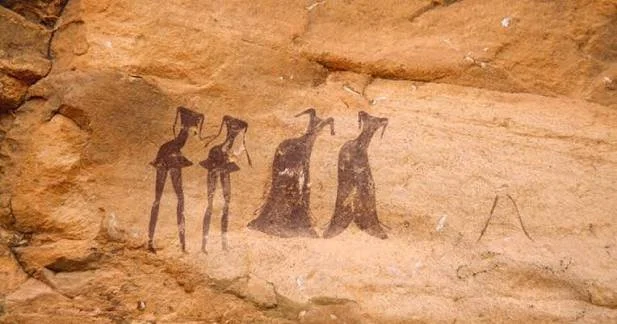
Among the most famous and mysterious images are the so-called Round Head paintings.
These depict human-like figures with distinctive rounded heads.
Some are extremely large.
Their meaning remains uncertain.
Modern popular culture has sometimes exaggerated these images into stories about astronauts or extraterrestrials.
There is no reliable archaeological evidence that they depict aliens.
The paintings should instead be studied within their prehistoric cultural context.
Their mystery is real—but the mystery is human, not extraterrestrial.
The Arrival of Cattle
One of the most important transformations visible in the art is the growing importance of cattle.
Pastoral scenes depict herders and domesticated animals.
This represents a major change in human economic life.
Instead of relying primarily on hunting and gathering, communities increasingly managed livestock.
Cattle also acquired social and symbolic importance.
Art as Environmental Evidence
The animals depicted at Tassili n'Ajjer help reconstruct ancient environments.
Images include species associated with grasslands and wetter habitats.
The art therefore provides a visual complement to environmental archaeology.
Scientists can compare artistic evidence with:
Lake sediments.
Pollen.
Fossils.
Geological records.
Together, these sources reconstruct the changing Sahara.
The Threats to the Art
The paintings are vulnerable.
Threats include:
Natural weathering.
Human damage.
Tourism.
Graffiti.
Climate change.
Unlike a museum object, a rock shelter cannot simply be moved indoors.
Conservation must protect the art in its original landscape.
Why Tassili n'Ajjer Is One of Humanity's Greatest Archives
The site preserves evidence of human imagination across thousands of years.
The artists left no written books.
Yet their images communicate across time.
They show us animals.
Bodies.
Tools.
Social relationships.
Changing economies.
The modern Sahara appears dry and empty.
But the paintings reveal another world.
A world of water.
Grass.
Animals.
Communities.
And human beings who transformed stone walls into history.